Thinking back about the last post, about how a society/culture/tribe identifies with its art, I began to consider what this meant for America.
Most of our cultural landmarks have not been in the visual arts, for one thing. When I think of American contributions to world culture, I think musically: jazz, blues, gospel, rock, Broadway show tunes. Then there are the cultural identifiers which perhaps the rest of the world might not celebrate: baseball, rodeo, the more fanciful forms of American roadside architecture, Las Vegas.
There is a lot of great American art: the paintings of Edward Hopper, Andrew Wyeth, Homer Winslow. The photographs of Dorothea Lange and Ansel Adams. The architecture of Frank Lloyd Wright. All to name just a tiny fraction of America's visual cultural riches. But what is America's Mona Lisa*? Our Parthenon?
There are a few paintings, several sculptures, a feat of engineering, and a temple that I think fit the bill.
The paintings would be Gilbert Stuart's portrait of George Washington (which we have because Dolley Madison recognized iconic art when she saw it and saved it from the marauding British), Emanuel Gottlieb Leutze's Washington Crossing the Delaware, and perhaps, Grant Wood's American Gothic.**
The sculpture would be Mount Rushmore, the Gateway Arch (is it sculpture? is it architecture?), and most importantly, the Statue of Liberty. How lovely that, in a nation of immigrants, the most significant piece of public art in the country should herself be an immigrant.
The engineering feat? That would be the Golden Gate Bridge, which holds a place in American imagination far beyond its utility as a means of getting from the City by the Bay to Sausalito. (Okay, I'm a Northern Californian. I'm biased.)
And the temple would be the Lincoln Memorial.***
What am I missing? What other pieces of visual art are quintessentially American?
* In 1911, Vincent Perugia stole the Mona Lisa from the Louvre and brought it back with him to Florence. In France the crime was seen as a national calamity; in Italy, the thief was viewed as a popular hero.
** No, I'm not entirely serious with that last one.
***I'm not including the White House or Capitol: they are primarily interesting for political reasons.
Tuesday, May 30, 2006


Sunday, May 28, 2006
Stupid people tricks, art division
In 1687, the Venetians besieged Athens, which was controlled by the Ottoman Turks. They shelled the city, including the Parthenon, which took a direct hit, blowing out the center of the building in the process.
Odd that a single shell should inflict such damage on a structure sturdy enough to stand pretty much intact for eighteen hundred years. It might have not had such damage had the Turks not decided to use the building as a gunpowder magazine. Funny how that works.
One of the great works of classical architecture, lost to the shortsightedness of war. Not that recent wars have done all that much better: during World War II the world saw the destruction of Coventry Cathedral, not to mention numerous artworks that simply vanished or were destroyed. The Vietnam War and the subsequent rise of the Khmer Rouge regime in Cambodia resulted in the vandalism and neglect of the temple complexes at Ankgor Wat and Akgor Thom. (Fortunately, there is some hope there: preservation efforts are underway, as the sites at Ankgor have been listed as World Heritage Sites.) Early on in the war in Iraq, museums in Baghdad were looted, with priceless artifacts stolen and destroyed. Part of the reason may have been the failure of American forces to secure the National Museum.
War always carries with it a terrible cost in human lives. As a society, in America, we have done a bad job at estimating what those costs will be; so do most nations embarking on a course of war. And the human costs always eclipse the cultural costs: whatever the damage to the temple complexes at Ankgor, as heartbreaking as that may be, it pales in comparison to the horrors inflicted upon the Cambodian people. The looting of the antiquities in Baghdad cannot trump the massacre at Haditha.
But maybe they are of a piece. Art says who we are as a people, gives us our identity. There is a reason beyond simple prestige that the Greek government has been fighting for years to recover the statues from marble friezes of the Parthenon, which currently reside in the British Museum in London. If you see people of a country as not worth protecting, why would you care about protecting their cultural treasures?
Except that that legacy, in some sense belongs to the world as well as to each country. When cultural treasures are destroyed, we are all the poorer: witness the international outcry at the destruction of the colossal Buddhas by the Taliban.
I'm not quite sure where I'm going with this, other than I keep thinking that when all is said and done, there needs to be a reckoning of the cultural destruction wreaked upon Iraq -- or any other war-torn country -- and that needs to be mourned by others than those who suffered the immediate loss, and even by their enemies.
Odd that a single shell should inflict such damage on a structure sturdy enough to stand pretty much intact for eighteen hundred years. It might have not had such damage had the Turks not decided to use the building as a gunpowder magazine. Funny how that works.
One of the great works of classical architecture, lost to the shortsightedness of war. Not that recent wars have done all that much better: during World War II the world saw the destruction of Coventry Cathedral, not to mention numerous artworks that simply vanished or were destroyed. The Vietnam War and the subsequent rise of the Khmer Rouge regime in Cambodia resulted in the vandalism and neglect of the temple complexes at Ankgor Wat and Akgor Thom. (Fortunately, there is some hope there: preservation efforts are underway, as the sites at Ankgor have been listed as World Heritage Sites.) Early on in the war in Iraq, museums in Baghdad were looted, with priceless artifacts stolen and destroyed. Part of the reason may have been the failure of American forces to secure the National Museum.
War always carries with it a terrible cost in human lives. As a society, in America, we have done a bad job at estimating what those costs will be; so do most nations embarking on a course of war. And the human costs always eclipse the cultural costs: whatever the damage to the temple complexes at Ankgor, as heartbreaking as that may be, it pales in comparison to the horrors inflicted upon the Cambodian people. The looting of the antiquities in Baghdad cannot trump the massacre at Haditha.
But maybe they are of a piece. Art says who we are as a people, gives us our identity. There is a reason beyond simple prestige that the Greek government has been fighting for years to recover the statues from marble friezes of the Parthenon, which currently reside in the British Museum in London. If you see people of a country as not worth protecting, why would you care about protecting their cultural treasures?
Except that that legacy, in some sense belongs to the world as well as to each country. When cultural treasures are destroyed, we are all the poorer: witness the international outcry at the destruction of the colossal Buddhas by the Taliban.
I'm not quite sure where I'm going with this, other than I keep thinking that when all is said and done, there needs to be a reckoning of the cultural destruction wreaked upon Iraq -- or any other war-torn country -- and that needs to be mourned by others than those who suffered the immediate loss, and even by their enemies.
Sunday, May 14, 2006
Barry and Babe.... and Hank.
So, it looks like Barry Bonds will pass Babe Ruth on the all time home run list. To which I say...
Big fat hairy deal.
One would think, from the way everyone is going on about this, that Ruth still held the home-run record. Even some journalists still think Ruth holds the record: in an article in the Peninsula (local) section of the San Jose Mercury News, Dan Reed wrote "[Bonds] failed to do what everyone wanted him to do -- tie the all-time home run record of Babe Ruth." Clearly, Mr. Reed needs to walk across the office and talk to the sportswriters occasionally. I can only imagine what they might have said about the article.
America is obsessed with Ruth. No one is ever good enough to match the Great One. Roger Maris played in a season that was too long: Ford Frick, the commissioner of baseball (and the man responsible for the 162 game season to begin with) decreed that Ruth's record had to be broken in 154 games or it wouldn't count. (He either ignored or conveniently forgot that the season Ruth set the single-season record, the Yankees played 155 games, because they had tied one earlier in the season.) Frick set this condition for no other season record. Bonds and before him McGwire and Sosa have all been tainted by the steroids scandals. There are those who argue that the record 73 home runs in a single season set by Bonds in 2001 is illegitimate.
Ruth played in smaller stadiums, without grueling travel schedules, during an era when a ball that bounced over the fence could be counted as a home run. More importantly, he played before the color line was broken: Ruth never had to face Negro League pitchers like Satchel Paige. Nothwithstanding, Ruth has always been seen as "America's home run king."
Except he's not.
Hank Aaron is.
Ruth is an "American"-type hero: brash, mythic, larger-than-life. Many of us with more than a passing acquaintance with baseball history are familiar with story of Ruth's "called home run" and his legendary carousing.
Hank Aaron, on the other hand, carries himself with quiet dignity. He is one of baseball's class acts. He pursued Ruth's record in the face of death threats from racists furious that a black man would dare sully the Bambino's legacy. He earned his record not in a blaze of glory but by remarkable consistency: while he never hit more than 47 home runs in one season, there were only three years, his first and his last two in the league, that he did not hit at least twenty. Furthermore, he not only exceeded Ruth's record, he obliterated it. He didn't pass Ruth's total by 5 homers, but by 5%.
There has never been a whiff of scandal or a hint of impropriety about Aaron. His record can't be dismissed as being the product of some pharmaceutical lab, or disparaged as being the result of simply a matter of more games per season.
Instead, he's simply ignored. It's surprising how many people still say "Babe Ruth's record..." even though the record hasn't been Ruth's for 32 years now. This entire circus surrounding Barry Bonds pursuit of second place is testament to how much Ruth still holds sway over the American imagination. It's a shame: if I would pick a ballplayer to represent me or my country, I would much prefer it be a man of courage and dignity like Aaron.
Let Barry Bonds pass Ruth on the home run list. It doesn't matter.
Let him reach, oh, 745 or 750, and then it will matter. Because then the issue of whether Bonds's home runs are tainted, the product of chemistry not talent, reflects on whether he should take the title from the true champion.
Big fat hairy deal.
One would think, from the way everyone is going on about this, that Ruth still held the home-run record. Even some journalists still think Ruth holds the record: in an article in the Peninsula (local) section of the San Jose Mercury News, Dan Reed wrote "[Bonds] failed to do what everyone wanted him to do -- tie the all-time home run record of Babe Ruth." Clearly, Mr. Reed needs to walk across the office and talk to the sportswriters occasionally. I can only imagine what they might have said about the article.
America is obsessed with Ruth. No one is ever good enough to match the Great One. Roger Maris played in a season that was too long: Ford Frick, the commissioner of baseball (and the man responsible for the 162 game season to begin with) decreed that Ruth's record had to be broken in 154 games or it wouldn't count. (He either ignored or conveniently forgot that the season Ruth set the single-season record, the Yankees played 155 games, because they had tied one earlier in the season.) Frick set this condition for no other season record. Bonds and before him McGwire and Sosa have all been tainted by the steroids scandals. There are those who argue that the record 73 home runs in a single season set by Bonds in 2001 is illegitimate.
Ruth played in smaller stadiums, without grueling travel schedules, during an era when a ball that bounced over the fence could be counted as a home run. More importantly, he played before the color line was broken: Ruth never had to face Negro League pitchers like Satchel Paige. Nothwithstanding, Ruth has always been seen as "America's home run king."
Except he's not.
Hank Aaron is.
Ruth is an "American"-type hero: brash, mythic, larger-than-life. Many of us with more than a passing acquaintance with baseball history are familiar with story of Ruth's "called home run" and his legendary carousing.
Hank Aaron, on the other hand, carries himself with quiet dignity. He is one of baseball's class acts. He pursued Ruth's record in the face of death threats from racists furious that a black man would dare sully the Bambino's legacy. He earned his record not in a blaze of glory but by remarkable consistency: while he never hit more than 47 home runs in one season, there were only three years, his first and his last two in the league, that he did not hit at least twenty. Furthermore, he not only exceeded Ruth's record, he obliterated it. He didn't pass Ruth's total by 5 homers, but by 5%.
There has never been a whiff of scandal or a hint of impropriety about Aaron. His record can't be dismissed as being the product of some pharmaceutical lab, or disparaged as being the result of simply a matter of more games per season.
Instead, he's simply ignored. It's surprising how many people still say "Babe Ruth's record..." even though the record hasn't been Ruth's for 32 years now. This entire circus surrounding Barry Bonds pursuit of second place is testament to how much Ruth still holds sway over the American imagination. It's a shame: if I would pick a ballplayer to represent me or my country, I would much prefer it be a man of courage and dignity like Aaron.
Let Barry Bonds pass Ruth on the home run list. It doesn't matter.
Let him reach, oh, 745 or 750, and then it will matter. Because then the issue of whether Bonds's home runs are tainted, the product of chemistry not talent, reflects on whether he should take the title from the true champion.
Monday, May 01, 2006
Last Christmas, I got one of my favorite gifts ever: the complete Broadway soundtrack to Rent. I have listened to the soundtrack an estimated 475 times. At one point, the CDs disappeared -- I think my family hid them. No worries: I had already ripped them to my computer.
One of the things I love about the Broadway version, as opposed to the movie, is that it really is an opera. Unlike, say, The Sound of Music, or Into the Woods, you can follow almost the entire plot of the musical simply from the recording.
It has turned into a great -- if unlikely -- teaching tool.
I have preteens, late elementary and middle school kids. They are getting the standard "Just Say No" drugs and alcohol education, and the older is beginning to get AIDS and sex-ed talks. (Even in California, abstinence only education has hit.) I have a great problem with the way these are taught. First of all is the simple excessiveness: one child told me I shouldn't use ammonia-based cleaning solution because a D.A.R.E. officer told him it was a bad idea. But more importantly, I think they teach kids to view others with a lack of compassion.
It starts out "Using drugs and alcohol is bad, using drugs and alcohol is stupid." It turns into "Stupid people use drugs, bad people use drugs." What happens then when a kid is confronted with someone who uses drugs or alcohol? Either they demonize the user as being bad or stupid, or they discard what they are taught about drugs or alcohol, not all of which is bad.
Which is where Rent comes in. While I don't play all of the soundtrack for them (among other things, I skip "La Vie Boheme" because I really don't want to have a discussion about what S&M is), and I'm not keen on the bad language, I do play enough to get a sense of the characters.
Enough to get a sense that Mimi is not a bad person. Roger is not a bad person. They are experiencing consequences of their choices -- and some of those choices were and are bad. Mimi's continued use of heroin, in particular, is a bad choice, to the extent it is a choice, given the nature of addiction. Which led me and my youngest to have a discussion of addiction, and why someone would make such choices, and how that doesn't mean they are beyond help.
It has also proven useful in talking about HIV/AIDS. About what HIV is and does. How about how you cannot get AIDS from casual contact (misinformation they picked up from their peers). About how AIDS is a disease, not a moral judgment, regardless of how you contracted it.
The question of homosexuality has been very easy to deal with: when asked if Angel was Collins's boyfriend, I simply said yes. And whether Maureen and Joanne were girlfriends, likewise. (Both of which led to my happiest parenting moment recently: when my youngest son heard on the radio of a school group arguing for the right to have materials for their afterschool club about how homosexuality is a sin, he responded, "Why do they care if people are gay? It's not like it hurts them any. Why can't they mind their own business?")
I wish I could write to Jonathan Larson and tell him how important his work is. Wherever he is in the afterlife, I hope he knows.
One of the things I love about the Broadway version, as opposed to the movie, is that it really is an opera. Unlike, say, The Sound of Music, or Into the Woods, you can follow almost the entire plot of the musical simply from the recording.
It has turned into a great -- if unlikely -- teaching tool.
I have preteens, late elementary and middle school kids. They are getting the standard "Just Say No" drugs and alcohol education, and the older is beginning to get AIDS and sex-ed talks. (Even in California, abstinence only education has hit.) I have a great problem with the way these are taught. First of all is the simple excessiveness: one child told me I shouldn't use ammonia-based cleaning solution because a D.A.R.E. officer told him it was a bad idea. But more importantly, I think they teach kids to view others with a lack of compassion.
It starts out "Using drugs and alcohol is bad, using drugs and alcohol is stupid." It turns into "Stupid people use drugs, bad people use drugs." What happens then when a kid is confronted with someone who uses drugs or alcohol? Either they demonize the user as being bad or stupid, or they discard what they are taught about drugs or alcohol, not all of which is bad.
Which is where Rent comes in. While I don't play all of the soundtrack for them (among other things, I skip "La Vie Boheme" because I really don't want to have a discussion about what S&M is), and I'm not keen on the bad language, I do play enough to get a sense of the characters.
Enough to get a sense that Mimi is not a bad person. Roger is not a bad person. They are experiencing consequences of their choices -- and some of those choices were and are bad. Mimi's continued use of heroin, in particular, is a bad choice, to the extent it is a choice, given the nature of addiction. Which led me and my youngest to have a discussion of addiction, and why someone would make such choices, and how that doesn't mean they are beyond help.
It has also proven useful in talking about HIV/AIDS. About what HIV is and does. How about how you cannot get AIDS from casual contact (misinformation they picked up from their peers). About how AIDS is a disease, not a moral judgment, regardless of how you contracted it.
The question of homosexuality has been very easy to deal with: when asked if Angel was Collins's boyfriend, I simply said yes. And whether Maureen and Joanne were girlfriends, likewise. (Both of which led to my happiest parenting moment recently: when my youngest son heard on the radio of a school group arguing for the right to have materials for their afterschool club about how homosexuality is a sin, he responded, "Why do they care if people are gay? It's not like it hurts them any. Why can't they mind their own business?")
I wish I could write to Jonathan Larson and tell him how important his work is. Wherever he is in the afterlife, I hope he knows.
Monday, April 10, 2006
A picture is worth thousand words: a morality tale.
If you wander down one of the corridors in the Metropolitan Museum of Art devoted to eighteenth- and nineteenth-century British art, you will come across a full length portrait of one George Harley Drummond, by Sir Henry Raeburn.
George Harley Drummond was the eldest son of a wealthy member of the British aristocracy, aged 25 at the time the portrait was painted. He had been married several years, and had a seven-year old son and two other children, who were the subject of another portrait by the same painter done around the same time. Sir Henry Raeburn was Scotland's premier portrait painter.
At first glance, the portrait appears to be just another "aristocrat with horse" painting. Except something seems off-kilter.
In most equestrian paintings, at least of the ones I've seen, if the man is not astride the horse then he is leaning on or standing next to the horse's neck. In this painting, George Harley Drummond is standing next to the horse's saddle, with the horse facing away from the viewer. The curators at the Met put it most delicately: "The foreshortened view of the grazing bay horse is the most complex part of the composition, though not the most important. It is curious, therefore, that the animal's hindquarters should be so prominently displayed."
No, it's not curious, not at all. Not when you look at the painting, and look from the the vapid young man to the horse and back again.
It is a truism in law that the one person you don't stiff is your defense attorney -- because they know where the bodies are buried. Similarly, the one person you should strive to be nice to is your portraitist.
Otherwise, he may let all of posterity know just what a horse's ass you really are.
George Harley Drummond was the eldest son of a wealthy member of the British aristocracy, aged 25 at the time the portrait was painted. He had been married several years, and had a seven-year old son and two other children, who were the subject of another portrait by the same painter done around the same time. Sir Henry Raeburn was Scotland's premier portrait painter.
At first glance, the portrait appears to be just another "aristocrat with horse" painting. Except something seems off-kilter.
In most equestrian paintings, at least of the ones I've seen, if the man is not astride the horse then he is leaning on or standing next to the horse's neck. In this painting, George Harley Drummond is standing next to the horse's saddle, with the horse facing away from the viewer. The curators at the Met put it most delicately: "The foreshortened view of the grazing bay horse is the most complex part of the composition, though not the most important. It is curious, therefore, that the animal's hindquarters should be so prominently displayed."
No, it's not curious, not at all. Not when you look at the painting, and look from the the vapid young man to the horse and back again.
It is a truism in law that the one person you don't stiff is your defense attorney -- because they know where the bodies are buried. Similarly, the one person you should strive to be nice to is your portraitist.
Otherwise, he may let all of posterity know just what a horse's ass you really are.
Friday, April 07, 2006
The Prado Moment.
I still say it was the fault of that damn painting.
I had flown to Madrid from the West Coast -- six hours across country, with the obligatory four hour layover at JFK, then seven hours over the Atlantic -- and gotten in about 10 in the morning. I and the friend I flew with were retrieved by my husband and a friend and coworker, with the plan being an afternoon in Madrid, followed possibly by tapas, and an early night at Torrejón de Ardoz, where we were staying. The theory was that staying up without napping would help our bodies acclimate to Spanish time (nine hours later than home). This would mean that we would have stayed up for close to 24 hours straight by the time we went to bed.
I was in Spain as consolation prize for having a husband who is on the road roughly four months a year. Every couple of years, I go abroad with the saved frequent flyer miles -- that year (2004), to Spain. After a short stay in the vicinity of Madrid, his project was heading south to the the Spanish hill country north of Seville, to a small mining town called Rio Tinto. I was along for the ride.
After my husband and the fabulous Sarah Huffman (see sidebar) met me and my friend at the airport, we went into town. After the first of what would seem like innumerable dinners of jamón (Spanish ham -- similar to proscuitto) at the Muséo de Jamón (a chain restaurant with walls covered completely with dried hams -- a little like dining in Norman Bates's parlor), we headed for the Prado. Since I don't care much for jamón, I didn't eat very much.
The Prado is one of the world's most magnificent musems. In addition to an unparalleled collection of Spanish art, it contains masterpieces of Italian, German, Dutch, and Flemish art. While I was eager to see the Goyas and Velazquezes (although not the Picassos -- they are at the Reine Sofia, and at that point in time I was not interested in Picasso anyway), I was dying to see one of the most bizarre works of art ever created: Heironymous Bosch's "Garden of Earthly Delights".
There is an unfortunate tendency today to attribute anything unusual or extremely imaginative to the impact of either drugs or mental illness. This is rubbish -- there is very little that the healthy human mind cannot come up with independent of outside influences. However, having seen Bosch's work, I think ergotism is about as good an explanation for it as anything else.
"The Garden of Earthly Delights" is not a very large painting, as these things go, especially considering the triptych was designed as an altarpiece: the central panel is roughly 7' x 6', the side panels half that width. The three panels are "The Garden of Eden", on the left, "The Garden of Earthly Delights", in the middle, and "Hell", on the right.
No matter which panel you start with, it is a strange work of art. "The Garden of Eden" is the calmest, most reassuring, but even there you see trees with strange, fleshy limbs, and an odd fountain that looks almost alive. Bizarre creatures inhabit the pond near the front, including what looks to be a half duck-half fish with arms. Still, compared to what is to follow, this panel is sanity itself.
The central panel is where things get seriously trippy. The panel is crammed full of people and creatures engaged in various sexual and other activities. Giant fruit litter the landscape. People are trapped inside clams. There is a big circle of people on animals towards the back. Presumably, at least some of this made symbolic sense to its intended audience in the 16th century. As I don't live in the 16th century, however, it was all lost on me.
It was sometime while looking at the middle panel that I started to feel strange. A sense of dizziness and disorientation began to set in. I felt creeping nausea. An intelligent person would have stopped and gone elsewhere, but, well, I was there to see this painting, by God, and I was going to see this painting thoroughly if it killed me.
I then started looking at the end panel.
Every college dorm in America has at least one copy of "Hell" posted up on a wall somewhere. It's just the sort of thing you need to contemplate during acid trips. But as often as I had seen prints of the damned thing, it was worse in person.
It is bizarre and fascinating and dark. It is filled with fantastic creatures -- the most notable being the "tree-man" at the center -- who either are torturing or being tortured. A woman being sucked by leeches. A bird-like creature consuming people and shitting them out. People strung up on harps like crufixes. The knight pinned down and eaten by dogs. The ears -- nothing but ears -- with the knife-blade between them.
I couldn't look away.
I started feeling seriously disoriented. I felt like I was losing my sanity. I was going to fall into the painting. My nausea went from "creeping" to "jumping".
I walked away and looked at some of Bosch's other, less strange (but still rather odd) work. When that didn't make me feel better, I went and sat down in the room next door with the Breughels. The nausea subsided, but the dizziness and disorientation did not. What happened next is still quite hazy. At some point, I made my way down to the ladies room on the ground floor, which has nice cool marble tile floors and walls. I leaned against them...
Only to be shaken awake by a guard. Other museum patrons had called the guard because I appeared to have passed out. I was unable to communicate with the guard because my extremely limited Spanish fled, leaving me with only "no habla Español" which I mumbled over and over.
The guard took me to the museum infirmary, where I had better luck communicating with the doctor, who spoke English. The doctor at first thought she must be having trouble understanding me -- after all, I had said I had just arrived that day? Surely, that was not right. No, I said, that was right -- I had just gotten off the plane. She looked at me for a moment, shook her head, and gave me some apple juice.
After lying down, and having more apple juice and some glucose gel, I felt somewhat better. The doctor diagnosed severe jet-lag and low blood sugar, and ordered me to go back to my hotel and sleep. Which I did, after my friends (who had gone to security when I disappeared) retrieved me from the infirmary.
Two days later, when I came back to the Prado, I had no desire whatsoever to see anymore of Bosch's handiwork. I avoided the Bosch room completely, and instead concentrated on the Spanish painting on the upper floors, including the heartrending "Third of May" by Goya. (Goya himself had a few strange episodes: there is a room devoted to the "Black Goyas", which are bizarre and grotesque paintings Goya did toward the end of his life. The most well-known of these is probably "Saturn Devouring One of His Children".)
I would have thought no more of it, except "Prado moment" became a byword on that trip. A couple of weekends later, when I finally returned to the group after getting lost looking for restrooms at the Alhambra, my husband remarked, "Thank goodness. I thought you were having another Prado moment."
Of course not, silly. There are no Bosches at the Alhambra.
I had flown to Madrid from the West Coast -- six hours across country, with the obligatory four hour layover at JFK, then seven hours over the Atlantic -- and gotten in about 10 in the morning. I and the friend I flew with were retrieved by my husband and a friend and coworker, with the plan being an afternoon in Madrid, followed possibly by tapas, and an early night at Torrejón de Ardoz, where we were staying. The theory was that staying up without napping would help our bodies acclimate to Spanish time (nine hours later than home). This would mean that we would have stayed up for close to 24 hours straight by the time we went to bed.
I was in Spain as consolation prize for having a husband who is on the road roughly four months a year. Every couple of years, I go abroad with the saved frequent flyer miles -- that year (2004), to Spain. After a short stay in the vicinity of Madrid, his project was heading south to the the Spanish hill country north of Seville, to a small mining town called Rio Tinto. I was along for the ride.
After my husband and the fabulous Sarah Huffman (see sidebar) met me and my friend at the airport, we went into town. After the first of what would seem like innumerable dinners of jamón (Spanish ham -- similar to proscuitto) at the Muséo de Jamón (a chain restaurant with walls covered completely with dried hams -- a little like dining in Norman Bates's parlor), we headed for the Prado. Since I don't care much for jamón, I didn't eat very much.
The Prado is one of the world's most magnificent musems. In addition to an unparalleled collection of Spanish art, it contains masterpieces of Italian, German, Dutch, and Flemish art. While I was eager to see the Goyas and Velazquezes (although not the Picassos -- they are at the Reine Sofia, and at that point in time I was not interested in Picasso anyway), I was dying to see one of the most bizarre works of art ever created: Heironymous Bosch's "Garden of Earthly Delights".
There is an unfortunate tendency today to attribute anything unusual or extremely imaginative to the impact of either drugs or mental illness. This is rubbish -- there is very little that the healthy human mind cannot come up with independent of outside influences. However, having seen Bosch's work, I think ergotism is about as good an explanation for it as anything else.
"The Garden of Earthly Delights" is not a very large painting, as these things go, especially considering the triptych was designed as an altarpiece: the central panel is roughly 7' x 6', the side panels half that width. The three panels are "The Garden of Eden", on the left, "The Garden of Earthly Delights", in the middle, and "Hell", on the right.
No matter which panel you start with, it is a strange work of art. "The Garden of Eden" is the calmest, most reassuring, but even there you see trees with strange, fleshy limbs, and an odd fountain that looks almost alive. Bizarre creatures inhabit the pond near the front, including what looks to be a half duck-half fish with arms. Still, compared to what is to follow, this panel is sanity itself.
The central panel is where things get seriously trippy. The panel is crammed full of people and creatures engaged in various sexual and other activities. Giant fruit litter the landscape. People are trapped inside clams. There is a big circle of people on animals towards the back. Presumably, at least some of this made symbolic sense to its intended audience in the 16th century. As I don't live in the 16th century, however, it was all lost on me.
It was sometime while looking at the middle panel that I started to feel strange. A sense of dizziness and disorientation began to set in. I felt creeping nausea. An intelligent person would have stopped and gone elsewhere, but, well, I was there to see this painting, by God, and I was going to see this painting thoroughly if it killed me.
I then started looking at the end panel.
Every college dorm in America has at least one copy of "Hell" posted up on a wall somewhere. It's just the sort of thing you need to contemplate during acid trips. But as often as I had seen prints of the damned thing, it was worse in person.
It is bizarre and fascinating and dark. It is filled with fantastic creatures -- the most notable being the "tree-man" at the center -- who either are torturing or being tortured. A woman being sucked by leeches. A bird-like creature consuming people and shitting them out. People strung up on harps like crufixes. The knight pinned down and eaten by dogs. The ears -- nothing but ears -- with the knife-blade between them.
I couldn't look away.
I started feeling seriously disoriented. I felt like I was losing my sanity. I was going to fall into the painting. My nausea went from "creeping" to "jumping".
I walked away and looked at some of Bosch's other, less strange (but still rather odd) work. When that didn't make me feel better, I went and sat down in the room next door with the Breughels. The nausea subsided, but the dizziness and disorientation did not. What happened next is still quite hazy. At some point, I made my way down to the ladies room on the ground floor, which has nice cool marble tile floors and walls. I leaned against them...
Only to be shaken awake by a guard. Other museum patrons had called the guard because I appeared to have passed out. I was unable to communicate with the guard because my extremely limited Spanish fled, leaving me with only "no habla Español" which I mumbled over and over.
The guard took me to the museum infirmary, where I had better luck communicating with the doctor, who spoke English. The doctor at first thought she must be having trouble understanding me -- after all, I had said I had just arrived that day? Surely, that was not right. No, I said, that was right -- I had just gotten off the plane. She looked at me for a moment, shook her head, and gave me some apple juice.
After lying down, and having more apple juice and some glucose gel, I felt somewhat better. The doctor diagnosed severe jet-lag and low blood sugar, and ordered me to go back to my hotel and sleep. Which I did, after my friends (who had gone to security when I disappeared) retrieved me from the infirmary.
Two days later, when I came back to the Prado, I had no desire whatsoever to see anymore of Bosch's handiwork. I avoided the Bosch room completely, and instead concentrated on the Spanish painting on the upper floors, including the heartrending "Third of May" by Goya. (Goya himself had a few strange episodes: there is a room devoted to the "Black Goyas", which are bizarre and grotesque paintings Goya did toward the end of his life. The most well-known of these is probably "Saturn Devouring One of His Children".)
I would have thought no more of it, except "Prado moment" became a byword on that trip. A couple of weekends later, when I finally returned to the group after getting lost looking for restrooms at the Alhambra, my husband remarked, "Thank goodness. I thought you were having another Prado moment."
Of course not, silly. There are no Bosches at the Alhambra.
Time out from our current discussion on art -- Terry Karney has written perhaps not a manifesto but a mission statement on being a liberal. Go Terry!
Thursday, April 06, 2006
The girl I love.
She's not a Hollywood Beauty.
She would be classified as being on the large side -- she's normal by most standards, but not for show business. Her face shows a gentle intelligence, but would never launch a thousand ships. Her arms are strong, her hands roughened. Although her clothes are modest and becoming, she is never going to top any "Best Dressed" lists.
I would drop everything on a moment's notice and fly around the world to sit at her feet.
At least, until the guards kicked me out.
I don't know her name -- people who know art history possibly do -- but I know her, the curve of her hand as it cradles the milk jug, the intent half smile as she focuses on pouring out the milk into the dish; and I know the room in which she stands, the window and the table and the loaves of crusty bread so clear you can almost smell their warm yeasty goodness.
She is Vermeer's Kitchen Maid.
She's not as flashy, say, as "The Girl with the Pearl Earring." She has about her a peace and contentment that heals the soul. I want to stay in that room, maybe find out who she is, ask her for one of the loaves, some of the milk. I want to watch the light pouring in through the window, catching her cap, her gown, the milk, her arms.
The light is the most remarkable thing about her -- and try as I might, I cannot think of the painting as anything but "her", as totally identified with the unknown woman at its center. No print can do this painting justice. Light pours out of the canvas in a manner that defies description. You can sit in the Vermeer Room of the Rijksmuseum in Amsterdam on a gray and dank day and watch the light pour out of the window next to the woman's head, as if you were in the same room with her, hearing the gentle burble of the milk flowing into the bowl.
I love art, deeply. But even within that, there are a small handful of pieces that matter to me at an almost primal level. Among those, most dear to my heart is the Kitchen Maid.
The girl I love.
She would be classified as being on the large side -- she's normal by most standards, but not for show business. Her face shows a gentle intelligence, but would never launch a thousand ships. Her arms are strong, her hands roughened. Although her clothes are modest and becoming, she is never going to top any "Best Dressed" lists.
I would drop everything on a moment's notice and fly around the world to sit at her feet.
At least, until the guards kicked me out.
I don't know her name -- people who know art history possibly do -- but I know her, the curve of her hand as it cradles the milk jug, the intent half smile as she focuses on pouring out the milk into the dish; and I know the room in which she stands, the window and the table and the loaves of crusty bread so clear you can almost smell their warm yeasty goodness.
She is Vermeer's Kitchen Maid.
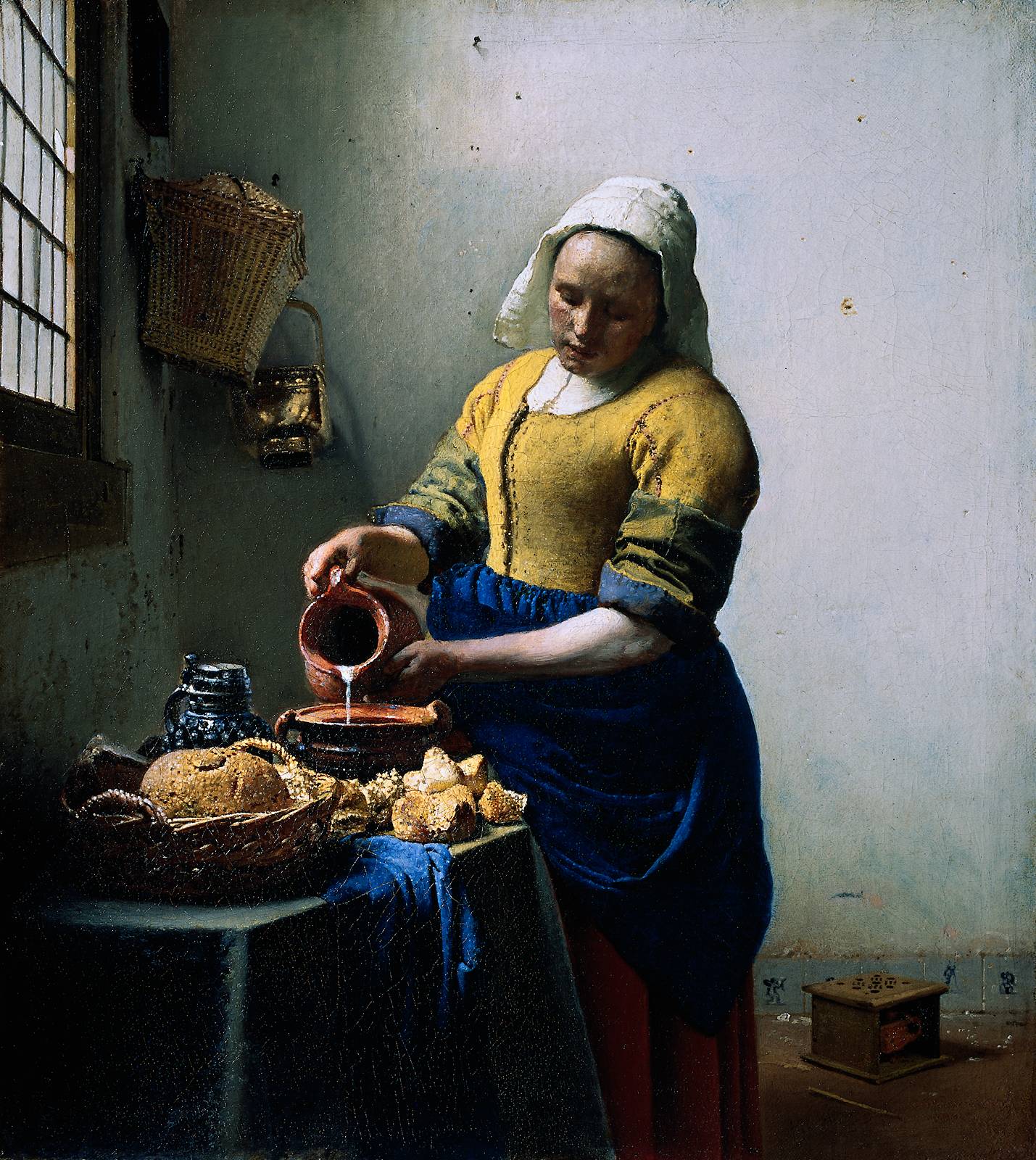
She's not as flashy, say, as "The Girl with the Pearl Earring." She has about her a peace and contentment that heals the soul. I want to stay in that room, maybe find out who she is, ask her for one of the loaves, some of the milk. I want to watch the light pouring in through the window, catching her cap, her gown, the milk, her arms.
The light is the most remarkable thing about her -- and try as I might, I cannot think of the painting as anything but "her", as totally identified with the unknown woman at its center. No print can do this painting justice. Light pours out of the canvas in a manner that defies description. You can sit in the Vermeer Room of the Rijksmuseum in Amsterdam on a gray and dank day and watch the light pour out of the window next to the woman's head, as if you were in the same room with her, hearing the gentle burble of the milk flowing into the bowl.
I love art, deeply. But even within that, there are a small handful of pieces that matter to me at an almost primal level. Among those, most dear to my heart is the Kitchen Maid.
The girl I love.
On Seeing Art.
You may well wonder at the vehemence in my last post; I did a bit myself. It boils down to this:
Art matters to me.
Art matters not in an abstract, "Gee, isn't that pretty" way, but in a visceral, longing so strong I can taste it way.
Great art is a glimpse of God. Or, as a wise priest I know once put it, there is no secular art.
And limiting art seems very much to me like limiting God. There is no chance for surprise, no chance for the unexpected, no chance to push the boundaries of what we know as "acceptable."
I was also angered by the intellectual dishonesty in the little "test" Libertas set out. If the blogger does in fact know anything about art, they have to know you cannot assess a work of art based on pictures taken of it.
Pictures of things can lie. What was true for Henry VIII, when Hans Holbein's portrait of Anne of Cleves was perhaps a shade too flattering, and is true today, to the dismay of many a client of OK Cupid, is also true of photographs of paintings. And just as there are people who are more attractive in real life than one would guess based on their photographs, so too with paintings.
I have seen the Mona Lisa. Even subtracting the fact that it is behind a thick wall of glass (for security purposes), it is small, it is dark, it is not terribly appealing. Photographs are much more attractive, although to tell you the truth, I've never been all that smitten with her anyway.
I have also seen, not "Convergence," the Pollock used by Libertas in his little "test," but an equally unphotogenic Pollock, "Lavender Mist." From a distance, it is an unremarkable mass of brown and pale lavender. Close up, the eye detects the swirls and patterns in the paint, and , almost involuntarily, tries to make sense of them. One is -- or can be, if one lets oneself -- be drawn into the play of light and texture on the canvas, light and texture which get obliterated by the camera's lens. It is not my favorite painting -- not even my favorite abstract painting -- but I would not hesitate to call it art.
Note, this does not arise from a preference for Pollock over da Vinci, or new over old. Around the corner from the Mona Lisa in the Louvre, is my favorite da Vinci, "The Virgin and Child with St. Anne", which is breathtaking. And my favorite paintings of all are by the Dutch master Vermeer. (By the way, it should be noted that you cannot asssess an Old Master by its photograph any more than you can an Abstract Expressionist: Vermeer's paintings often go from being merely pretty in print to being transcendent in real life.)
And what is true in painting can also be true in poetry, in prose, in music.
God is limitless. Art should be limitless, too, bound only by the restrictions placed upon it by our frail human forms.
Art matters to me.
Art matters not in an abstract, "Gee, isn't that pretty" way, but in a visceral, longing so strong I can taste it way.
Great art is a glimpse of God. Or, as a wise priest I know once put it, there is no secular art.
And limiting art seems very much to me like limiting God. There is no chance for surprise, no chance for the unexpected, no chance to push the boundaries of what we know as "acceptable."
I was also angered by the intellectual dishonesty in the little "test" Libertas set out. If the blogger does in fact know anything about art, they have to know you cannot assess a work of art based on pictures taken of it.
Pictures of things can lie. What was true for Henry VIII, when Hans Holbein's portrait of Anne of Cleves was perhaps a shade too flattering, and is true today, to the dismay of many a client of OK Cupid, is also true of photographs of paintings. And just as there are people who are more attractive in real life than one would guess based on their photographs, so too with paintings.
I have seen the Mona Lisa. Even subtracting the fact that it is behind a thick wall of glass (for security purposes), it is small, it is dark, it is not terribly appealing. Photographs are much more attractive, although to tell you the truth, I've never been all that smitten with her anyway.
I have also seen, not "Convergence," the Pollock used by Libertas in his little "test," but an equally unphotogenic Pollock, "Lavender Mist." From a distance, it is an unremarkable mass of brown and pale lavender. Close up, the eye detects the swirls and patterns in the paint, and , almost involuntarily, tries to make sense of them. One is -- or can be, if one lets oneself -- be drawn into the play of light and texture on the canvas, light and texture which get obliterated by the camera's lens. It is not my favorite painting -- not even my favorite abstract painting -- but I would not hesitate to call it art.
Note, this does not arise from a preference for Pollock over da Vinci, or new over old. Around the corner from the Mona Lisa in the Louvre, is my favorite da Vinci, "The Virgin and Child with St. Anne", which is breathtaking. And my favorite paintings of all are by the Dutch master Vermeer. (By the way, it should be noted that you cannot asssess an Old Master by its photograph any more than you can an Abstract Expressionist: Vermeer's paintings often go from being merely pretty in print to being transcendent in real life.)
And what is true in painting can also be true in poetry, in prose, in music.
God is limitless. Art should be limitless, too, bound only by the restrictions placed upon it by our frail human forms.
Tuesday, April 04, 2006
Ars Gratia Artis
While rummaging around the blogosphere -- or at least the small corner of it I forage in -- I ran across a link (via Julia over at Sisyphus Shrugged) to Libertas, a conservative art blog. At the beginning of a review for, of all things, the latest Spike Lee film, Libertas asserts his own exalted position as an arbiter of what is proper in the art world:
Ah, yes. One of the "my three-year-old can paint better than Jackson Pollock" people. He then confirms this by setting the reader a test, in which the Mona Lisa and the Jackson Pollock painting "Convergence" (not that Libertas has the academic honesty to actually identify the painting), are placed side by side. If the reader identifies the first -- but not the second -- as art, then they are deemed to have sufficient aethestic sensibilities to be allowed to proceed to read his movie review.
There's a certain amount of irony at this level of hauteur being exercised over a movie review. For much of the cinema's history, movies -- especially popular movies -- have not been taken seriously as works of art. That nothwithstanding, let's look at his presumptions, shall we? Just what sort of world would we live in, if Libertas were minister of art?
No James Joyce, of course. Or Franz Kafka. No e.e. cummings, or William Carlos Williams. No Arnold Schoenberg or Philip Glass. Little visual art -- save photography -- past 1920. No Picasso, Bracque, Warhol, Johns. No Brancusi.
No Stravinksy. Both "Rites of Spring" and "The Firebird" caused riots when they debuted -- they were too revolutionary. Gershwin's "Rhapsody in Blue" would in no way be acceptable for concert halls.
Auden would be okay; some, but not all, Eliot. Eugene O'Neill would probably be okay, but Samuel Beckett would be right out.
If you accept that movies are art -- which Libertas seems to -- then without people breaking the constraints of form there would be no Snow White, or any of her progeny from Disney. No Intolerance, no Rashomon, no La Dolce Vita. More recently, no Memento. The brilliant Charlie Kauffman would be out of a job: Being John Malkovich, Adaptation, and Eternal Sunshine of the Spotless Mind would all be beyond the pale.
And what of theater? I have spoken of Beckett, and O'Neill. What of musical theater? If movies can be considered art, then surely musicals can be as well. Without Richard Rodgers and Oscar Hammerstein II breaking through what were then the conventions of the form, we would have shows where the stories were merely excuses for trotting out the latest tunes from Tin Pan Alley. And if we accept that the new paradigm is set by the story show as created by Rodgers and Hammerstein, and as practiced by Lerner and Lowe, and Kander and Ebb, and Jerry Herman, and so on .... then the constraints of that form, in both song structure and in subject matter, have been broken through -- and brilliantly -- by Stephen Sondheim.
But let's go back further.... the ultimate experimental modern novel is Don Quixote, which was so experimental many consider it to have created the genre. And let's not forget Tristram Shandy, shall we? A masterpiece of English literature, Laurence Sterne's eighteenth century novel is so unique Hollywood couldn't touch it -- at least until Tristram Shandy: A Cock & Bull Story, which isn't a film of the novel but a film about how hard it would be to make a film of the novel.
If one tossed out painters who broke with the conventions on the form, that would eliminate, oh... Manet, Goya (have you ever seen the "Black Goyas"? reeaaally creepy), Monet, Van Gogh, Cezanne, Toulouse-Latrec, Klimt, and countless others. Oh, and there's Whistler, of whose "Nocture in Black and Gold" Ruskin wrote "I have seen, and heard, much of Cockney impudence before now; but never expected to hear a coxcomb ask two hundred guineas for flinging a pot of paint in the public's face." In fact, let's just go back to iconography, shall we?
Art is like life: Sturgeon's Law applies here as much as anywhere else. Whenever you have anyone break the conventions of the form and time in which they are working, most often, you'll get self-indulgent garbage. Whenever you have anyone stay within the conventions of the form in which they are working, a fair amount of the time you will get pretentious, self-important twaddle.
Goliath can keep his safe, well-ordered, rule-bound world.
For myself, a world without the fragile delicacy of "somewhere i have never traveled" by cummings, or the devastating anguish of Picasso's "Guernica," or, on a less exalted level, perhaps, without the demonic glee of Sweeney Todd, would be much poorer indeed.
There are many Philistines in the world, but only one Goliath: that’s me. I think abstract art is a con game. I think free verse stinks. I think atonal music should be outlawed and experimental novels burned. Whenever an artist declares he’s going to break through the restrictions of his form, I feel he should be treated the same as a chess player who declares he’s going to ignore the rules of his game—like an idiot, a harmless eccentric at best. The rules are the game, the restrictions are the form. Indeed, much of the excitement of art comes from watching the spatial confines of the sonnet, say, or the canvas or the movie screen, give way into emotional infinity.
Ah, yes. One of the "my three-year-old can paint better than Jackson Pollock" people. He then confirms this by setting the reader a test, in which the Mona Lisa and the Jackson Pollock painting "Convergence" (not that Libertas has the academic honesty to actually identify the painting), are placed side by side. If the reader identifies the first -- but not the second -- as art, then they are deemed to have sufficient aethestic sensibilities to be allowed to proceed to read his movie review.
There's a certain amount of irony at this level of hauteur being exercised over a movie review. For much of the cinema's history, movies -- especially popular movies -- have not been taken seriously as works of art. That nothwithstanding, let's look at his presumptions, shall we? Just what sort of world would we live in, if Libertas were minister of art?
No James Joyce, of course. Or Franz Kafka. No e.e. cummings, or William Carlos Williams. No Arnold Schoenberg or Philip Glass. Little visual art -- save photography -- past 1920. No Picasso, Bracque, Warhol, Johns. No Brancusi.
No Stravinksy. Both "Rites of Spring" and "The Firebird" caused riots when they debuted -- they were too revolutionary. Gershwin's "Rhapsody in Blue" would in no way be acceptable for concert halls.
Auden would be okay; some, but not all, Eliot. Eugene O'Neill would probably be okay, but Samuel Beckett would be right out.
If you accept that movies are art -- which Libertas seems to -- then without people breaking the constraints of form there would be no Snow White, or any of her progeny from Disney. No Intolerance, no Rashomon, no La Dolce Vita. More recently, no Memento. The brilliant Charlie Kauffman would be out of a job: Being John Malkovich, Adaptation, and Eternal Sunshine of the Spotless Mind would all be beyond the pale.
And what of theater? I have spoken of Beckett, and O'Neill. What of musical theater? If movies can be considered art, then surely musicals can be as well. Without Richard Rodgers and Oscar Hammerstein II breaking through what were then the conventions of the form, we would have shows where the stories were merely excuses for trotting out the latest tunes from Tin Pan Alley. And if we accept that the new paradigm is set by the story show as created by Rodgers and Hammerstein, and as practiced by Lerner and Lowe, and Kander and Ebb, and Jerry Herman, and so on .... then the constraints of that form, in both song structure and in subject matter, have been broken through -- and brilliantly -- by Stephen Sondheim.
But let's go back further.... the ultimate experimental modern novel is Don Quixote, which was so experimental many consider it to have created the genre. And let's not forget Tristram Shandy, shall we? A masterpiece of English literature, Laurence Sterne's eighteenth century novel is so unique Hollywood couldn't touch it -- at least until Tristram Shandy: A Cock & Bull Story, which isn't a film of the novel but a film about how hard it would be to make a film of the novel.
If one tossed out painters who broke with the conventions on the form, that would eliminate, oh... Manet, Goya (have you ever seen the "Black Goyas"? reeaaally creepy), Monet, Van Gogh, Cezanne, Toulouse-Latrec, Klimt, and countless others. Oh, and there's Whistler, of whose "Nocture in Black and Gold" Ruskin wrote "I have seen, and heard, much of Cockney impudence before now; but never expected to hear a coxcomb ask two hundred guineas for flinging a pot of paint in the public's face." In fact, let's just go back to iconography, shall we?
Art is like life: Sturgeon's Law applies here as much as anywhere else. Whenever you have anyone break the conventions of the form and time in which they are working, most often, you'll get self-indulgent garbage. Whenever you have anyone stay within the conventions of the form in which they are working, a fair amount of the time you will get pretentious, self-important twaddle.
Goliath can keep his safe, well-ordered, rule-bound world.
For myself, a world without the fragile delicacy of "somewhere i have never traveled" by cummings, or the devastating anguish of Picasso's "Guernica," or, on a less exalted level, perhaps, without the demonic glee of Sweeney Todd, would be much poorer indeed.
Just call me "Iron Chef Comfort Food"
One of my current popcorn shows is "Be The Next Food Network Star." Like all reality shows, it has the attraction of watching people drive themselves crazy doing things I would never do, in this case for something (my own tv cooking show!) that I would never want. Unlike "Survivor," it has the additional advantage of having what seem to be generally nice people as contestants.
The last episode was on, among other things, how well the contestants multitasked. They seemed daunted by the task. Wimps.
I am not a stellar cook, merely an adequate one. My cheesy whipped potatoes are beloved by my family, and I can do a decent job on chicken, and I am renowned among my friends for my frosted mint brownies. (Oh, and I have made croissants. From scratch.) I love making new potatoes with garlic, and broccoli, but also use a lot of convenience foods. I do make a very nice Thanksgiving dinner, however.
And I can multitask like nobody's business. Take tonight.
It was not a usual dinner: I was not eating, the teenager was not home. Unlike, my usual practice in such cases, which is to say, "Guess you guys are on your own, aren't you?," I agreed to act as short order cook. My husband had spent the day tromping through mud and rain shooting imaginary bears*, my nine-year-old was recovering from being sick, and since I was making food for them I agreed to make the other pre-teen something. I told everyone I would make what they wanted for dinner.
Things went down something like this:
Place chicken patty in microwave, turn on. Put water and salt in pan for grits. Put skillet on burner, preheat for potstickers, add oil. Get eggs and two kinds of cheese out of fridge. Remove chicken patty from microwave, place on bread, place in toaster oven with slice of Tillamook sharp cheddar cheese -- set on "toast". Put frozen potstickers in skillet, cook for two minutes. Place omelette pan on burner, preheat. Add grits to boiling water. Add one cup water to potstickers, cover, set timer for eight minutes. Stir grits again. Add butter to omelette pan, beat eggs, season, pour into omelette pan. Plate chicken patty sandwich with yogurt. Stir grits. Add cheese -- shredded cheddar/jack blend (yes, I buy the big bags from Costco) and grated parmesan/asiago (no, I grate my own) -- to omelette. Stir grits. Flip & plate omelette. Plate grits next to omelette, with butter and cheese. Remove potstickers from heat. Plate, and explain to child that he really does need to eat something other than just potstickers for dinner -- maybe some yogurt?
All the while having a conversation with the nine-year-old about the fact that C.S. Lewis and J.R.R. Tolkien were contemporaries and friends.
Total elapsed time: 15 minutes. Okay, so it's convenience and comfort foods, but that's still not shabby. If I hadn't been making the potstickers, I could have done it in ten. And I can do similar feats with real food -- i.e., things with actual vitamin and mineral content.
And you know what? I could have done that with a camera rolling. I've never had to cook under the glare of the spotlights, but I have had to deal with "is it done yet?,""why can't we have tortellini?"(from one child), "but I don't like tortellini"(from another), "do we have to have meat sauce?," "you made what he liked last night, why can't you make what I like tonight?," "Ewwwww garlic," "it's not my night to do the dishes," "Hon, I have to leave in ten minutes," "it's not my night to clear the table," and the ever popular "can I make my own dinner?"
I am Mom. See me multitask.
*Seriously, he was running through the woods shooting imaginary bears; okay, pictures of imaginary bears. All as part of a USGS defense against wild animals course he is required to complete in order to do field work.
The last episode was on, among other things, how well the contestants multitasked. They seemed daunted by the task. Wimps.
I am not a stellar cook, merely an adequate one. My cheesy whipped potatoes are beloved by my family, and I can do a decent job on chicken, and I am renowned among my friends for my frosted mint brownies. (Oh, and I have made croissants. From scratch.) I love making new potatoes with garlic, and broccoli, but also use a lot of convenience foods. I do make a very nice Thanksgiving dinner, however.
And I can multitask like nobody's business. Take tonight.
It was not a usual dinner: I was not eating, the teenager was not home. Unlike, my usual practice in such cases, which is to say, "Guess you guys are on your own, aren't you?," I agreed to act as short order cook. My husband had spent the day tromping through mud and rain shooting imaginary bears*, my nine-year-old was recovering from being sick, and since I was making food for them I agreed to make the other pre-teen something. I told everyone I would make what they wanted for dinner.
Things went down something like this:
Place chicken patty in microwave, turn on. Put water and salt in pan for grits. Put skillet on burner, preheat for potstickers, add oil. Get eggs and two kinds of cheese out of fridge. Remove chicken patty from microwave, place on bread, place in toaster oven with slice of Tillamook sharp cheddar cheese -- set on "toast". Put frozen potstickers in skillet, cook for two minutes. Place omelette pan on burner, preheat. Add grits to boiling water. Add one cup water to potstickers, cover, set timer for eight minutes. Stir grits again. Add butter to omelette pan, beat eggs, season, pour into omelette pan. Plate chicken patty sandwich with yogurt. Stir grits. Add cheese -- shredded cheddar/jack blend (yes, I buy the big bags from Costco) and grated parmesan/asiago (no, I grate my own) -- to omelette. Stir grits. Flip & plate omelette. Plate grits next to omelette, with butter and cheese. Remove potstickers from heat. Plate, and explain to child that he really does need to eat something other than just potstickers for dinner -- maybe some yogurt?
All the while having a conversation with the nine-year-old about the fact that C.S. Lewis and J.R.R. Tolkien were contemporaries and friends.
Total elapsed time: 15 minutes. Okay, so it's convenience and comfort foods, but that's still not shabby. If I hadn't been making the potstickers, I could have done it in ten. And I can do similar feats with real food -- i.e., things with actual vitamin and mineral content.
And you know what? I could have done that with a camera rolling. I've never had to cook under the glare of the spotlights, but I have had to deal with "is it done yet?,""why can't we have tortellini?"(from one child), "but I don't like tortellini"(from another), "do we have to have meat sauce?," "you made what he liked last night, why can't you make what I like tonight?," "Ewwwww garlic," "it's not my night to do the dishes," "Hon, I have to leave in ten minutes," "it's not my night to clear the table," and the ever popular "can I make my own dinner?"
I am Mom. See me multitask.
*Seriously, he was running through the woods shooting imaginary bears; okay, pictures of imaginary bears. All as part of a USGS defense against wild animals course he is required to complete in order to do field work.
Wednesday, March 29, 2006
Out here with the yellow lines and the dead armadillos.
The fabulous Jim Hightower once said "There's nothing in the middle of the road but yellow lines and dead armadillos." Certainly, in regards to the abortion debate, it seems that the two sides face each other across barricades, lobbing grenades back and forth. There is no middle of the road. Except where I am.
Make no mistake: I am completely pro-choice. I firmly believe abortion should be safe, legal, and rare.
But, on a personal level, I recognize the beginning of life as carrying very deep significance. Yes, even before viability. Yes, even at a very early stage. I would not abort a pregnancy even in the first twelve weeks, except to protect my life or my health. You can scoff, you can laugh, you can call me irrational, whatever, but there it is: I think abortion is an extremely significant moral act, perhaps not murder, but which can achieve in some circumstances an equivalent moral import. However, I recognize that is my own personal moral calculus and no one else's, and I make no judgment upon anyone who has had an abortion, other than to feel sad that they had to make what is often, no matter what your politics, a painful and difficult choice.
I can understand how someone in the right to life movement can come to say that "abortion is murder." I know people who say that. I have family who say that. I believe that they believe that. I also believe that, for some of the people I talk to, it is a shorthand for a complex idea that would otherwise be unwieldy: murder is the closest thing to what it feels like happens morally when an abortion happens, so that's the word they use. That may not mean that they think about all the legal consequences flowing from abortions in exactly the same way that they would murder.
I have seen in the past two or three weeks a lot of crowing about how hypocritical right-to-lifers are because of that "abortion is murder" stance. If abortion is murder, then why don't any of the proposed anti-abortion bills provide for prison sentences for the women having the abortion? They clearly don't actually believe what they're saying! They are only interested in subjugating women. HYPOCRISY! Idiots! We win!
Except that this isn't a high-school debating match. You don't get points for slicing your opponent up into little bits with your brilliant logic and rhetorical skills. What you do get is a closing down of dialogue, and an increasing radicalization on both sides. And really -- do you want to push people to supporting prison sentences for women getting abortions? That's just as likely as ever convincing people of the rightness of the pro-choice position by belittling them.
And what if they do mean murder when they say murder? It is possible to condemn a crime, and have compassion for the criminal. Or to view shades and degrees of culpability. Ah, but to allow that pro-life advocates might think that, then one has to view them as capable of making nuanced moral decisions. They have to be human! Gasp!
And it's not like we on the left don't occasionally come up with our own sterling examples of hypocrisy: the San Francisco Board of Supervisors has chosen to pass resolutions condemning various conservative religious organizations -- the Catholic Church; Battle Cry for a Generation, a fundamentalist Christian group that stages teen rallies -- who are anti-choice or oppose same-sex marriage. Considering that we -- by which I mean pro-choice, pro-same-sex-marriage progressives, presumably including the members of the SF Board of Supervisors -- have been fighting like hell to keep religion out of government, don't you think we should try to keep government out of religion? That wall of separation between church and state we treasure runs both ways.
People say that the two sides can't talk to each other. I think they're wrong -- and a January, 2006 study from the University of Florida backs me up. The study found the differences both sides perceived between themselves and the folks across the barricades were exaggerated.
Screaming at the other side over one issue -- abortion -- makes it all that much harder to change hearts and minds on other issues, such as the war in Iraq, or the dangers to civil liberties presented by the PATRIOT Act, or same-sex marriage. Because no one likes to be called a hypocrite, or these days, told that they are evil. For is not oppressing others evil?
Personally, I'd rather lose the debating match, if I can engage in open and heartfelt discussion. After all, that's what adults do.
If I seem angry and bitter about all of this, I am. I know people on both sides, good people, people who searched their consciences to arrive at an answer to the most difficult political and moral question of our age. I am fed up with the nastiness lobbed across the barricades. I am tired tired TIRED of the demonization, of the caricaturing, of the reductionism being spouted from either end of the debate.
You know what? Different may not mean wrong.
And, much more importantly, WRONG does not always and everywhere mean EVIL.
And maybe if we start remembering that for a change then maybe we can reclaim the debate from the screaming demagogues and actually get somewhere.
And maybe, just maybe, we can reclaim the center here. And get rid of these damned armadillos.
Make no mistake: I am completely pro-choice. I firmly believe abortion should be safe, legal, and rare.
But, on a personal level, I recognize the beginning of life as carrying very deep significance. Yes, even before viability. Yes, even at a very early stage. I would not abort a pregnancy even in the first twelve weeks, except to protect my life or my health. You can scoff, you can laugh, you can call me irrational, whatever, but there it is: I think abortion is an extremely significant moral act, perhaps not murder, but which can achieve in some circumstances an equivalent moral import. However, I recognize that is my own personal moral calculus and no one else's, and I make no judgment upon anyone who has had an abortion, other than to feel sad that they had to make what is often, no matter what your politics, a painful and difficult choice.
I can understand how someone in the right to life movement can come to say that "abortion is murder." I know people who say that. I have family who say that. I believe that they believe that. I also believe that, for some of the people I talk to, it is a shorthand for a complex idea that would otherwise be unwieldy: murder is the closest thing to what it feels like happens morally when an abortion happens, so that's the word they use. That may not mean that they think about all the legal consequences flowing from abortions in exactly the same way that they would murder.
I have seen in the past two or three weeks a lot of crowing about how hypocritical right-to-lifers are because of that "abortion is murder" stance. If abortion is murder, then why don't any of the proposed anti-abortion bills provide for prison sentences for the women having the abortion? They clearly don't actually believe what they're saying! They are only interested in subjugating women. HYPOCRISY! Idiots! We win!
Except that this isn't a high-school debating match. You don't get points for slicing your opponent up into little bits with your brilliant logic and rhetorical skills. What you do get is a closing down of dialogue, and an increasing radicalization on both sides. And really -- do you want to push people to supporting prison sentences for women getting abortions? That's just as likely as ever convincing people of the rightness of the pro-choice position by belittling them.
And what if they do mean murder when they say murder? It is possible to condemn a crime, and have compassion for the criminal. Or to view shades and degrees of culpability. Ah, but to allow that pro-life advocates might think that, then one has to view them as capable of making nuanced moral decisions. They have to be human! Gasp!
And it's not like we on the left don't occasionally come up with our own sterling examples of hypocrisy: the San Francisco Board of Supervisors has chosen to pass resolutions condemning various conservative religious organizations -- the Catholic Church; Battle Cry for a Generation, a fundamentalist Christian group that stages teen rallies -- who are anti-choice or oppose same-sex marriage. Considering that we -- by which I mean pro-choice, pro-same-sex-marriage progressives, presumably including the members of the SF Board of Supervisors -- have been fighting like hell to keep religion out of government, don't you think we should try to keep government out of religion? That wall of separation between church and state we treasure runs both ways.
People say that the two sides can't talk to each other. I think they're wrong -- and a January, 2006 study from the University of Florida backs me up. The study found the differences both sides perceived between themselves and the folks across the barricades were exaggerated.
Screaming at the other side over one issue -- abortion -- makes it all that much harder to change hearts and minds on other issues, such as the war in Iraq, or the dangers to civil liberties presented by the PATRIOT Act, or same-sex marriage. Because no one likes to be called a hypocrite, or these days, told that they are evil. For is not oppressing others evil?
Personally, I'd rather lose the debating match, if I can engage in open and heartfelt discussion. After all, that's what adults do.
If I seem angry and bitter about all of this, I am. I know people on both sides, good people, people who searched their consciences to arrive at an answer to the most difficult political and moral question of our age. I am fed up with the nastiness lobbed across the barricades. I am tired tired TIRED of the demonization, of the caricaturing, of the reductionism being spouted from either end of the debate.
You know what? Different may not mean wrong.
And, much more importantly, WRONG does not always and everywhere mean EVIL.
And maybe if we start remembering that for a change then maybe we can reclaim the debate from the screaming demagogues and actually get somewhere.
And maybe, just maybe, we can reclaim the center here. And get rid of these damned armadillos.
Sunday, March 26, 2006
Looking at the Mountain
Early fall, I had been looking forward to Brokeback Mountain coming out. Not as much as some other releases -- Capote, Good Night and Good Luck, and Rent-- but I thought it looked quite promising. Ang Lee is a good director, and while I don't care much for Heath Ledger, Jake Gyllenhall is, to use a not-too-technical term, yummy.
For one reason or another, I didn't see it. I actually have not seen a lot of movies that one could not take children to -- not since I saw Capote, at any rate, which would have been early December. And when I did go to movies, I needed to see comedies, escapist fare; Brokeback Mountain seemed too heavy, too difficult. Now I find myself in the position of wanting to see more serious fare, with Brokeback still in the theaters ... and I no longer want to see it.
In the post-Oscar analysis, with the lambasting of the Academy's decision to award the Best Picture Oscar to Crash, it seems that liking Brokeback Mountain has become a political litmus test. What else to make of the analysts decrying Crash's selection as an example of rampant homophobia? Ignoring the fact that there were, in fact, people who were less than impressed with Brokeback Mountain, for reasons having nothing to do with politics and everything to do with the quality . (As there were with Crash, too, for that matter.) I know people who have not even seen Crash who are willing to blame Brokeback's loss to homophobia. Sheesh.
Me? I don't think Crash should have won. Does that make me a racist? I think Capote and Good Night and Good Luck were better movies. I'm not alone: if you look on Rottentomatoes.com, which aggregates film reviews from all over to give sort of a general rating, Good Night & Good Luck and Capote both scored well above Brokeback Mountain, which in turn scored well above Crash. But you don't see partisans for Capote screaming about homophobia in the award process -- oh, wait, Truman Capote was an "effete New York intellectual," as Jon Stewart pointed out. Doesn't count.
The fact is, Brokeback Mountain got made and distributed by a major studio, and as of March 26, 2006, has made $158 million, a nice return on a budget on $14 million. It was nominated for eight Oscars, it won three. And while people mutter how courageous it is for actors to play gay characters, within the last 15 years, several actors and actresses have won Oscars for playing gay, lesbian, or transgendered characters -- Tom Hanks in Philadelphia, Nicole Kidman in The Hours, Hillary Swank in Boys Don't Cry, Philip Seymour Hoffman this year for Capote -- and quite a few more have been nominated. None of them seem to have suffered as a result.
Is there homophobia in Hollywood? No doubt. After all, the number of performers who are openly gay is slim, with actresses outnumbering actors. (God bless Sir Ian McKellen!) Is that why Crash won? Who knows? It's a movie about Los Angeles, most of the voters live in the San Fernando Valley, and it resonates with them on a primal, everyday level in a way that a movie about a couple of Wyoming ranchhands doesn't. (That theory is not mine: I've heard it more places than I can shake a copy of EW at. My theory is rather more cynical than that.)
I don't like my entertainment choices being turned into political or religious statements, whether that be by members of the Catholic League who opposed people like me seeing Kevin Smith's Dogma (best movie on religion ever made) or fundamentalists who imply that I need to see The Passion of the Christ to be "saved." Or people who insist that liking Brokeback Mountain is a requirement for showing how unhomophobic I am.
After all, in the end, they're only movies.
For one reason or another, I didn't see it. I actually have not seen a lot of movies that one could not take children to -- not since I saw Capote, at any rate, which would have been early December. And when I did go to movies, I needed to see comedies, escapist fare; Brokeback Mountain seemed too heavy, too difficult. Now I find myself in the position of wanting to see more serious fare, with Brokeback still in the theaters ... and I no longer want to see it.
In the post-Oscar analysis, with the lambasting of the Academy's decision to award the Best Picture Oscar to Crash, it seems that liking Brokeback Mountain has become a political litmus test. What else to make of the analysts decrying Crash's selection as an example of rampant homophobia? Ignoring the fact that there were, in fact, people who were less than impressed with Brokeback Mountain, for reasons having nothing to do with politics and everything to do with the quality . (As there were with Crash, too, for that matter.) I know people who have not even seen Crash who are willing to blame Brokeback's loss to homophobia. Sheesh.
Me? I don't think Crash should have won. Does that make me a racist? I think Capote and Good Night and Good Luck were better movies. I'm not alone: if you look on Rottentomatoes.com, which aggregates film reviews from all over to give sort of a general rating, Good Night & Good Luck and Capote both scored well above Brokeback Mountain, which in turn scored well above Crash. But you don't see partisans for Capote screaming about homophobia in the award process -- oh, wait, Truman Capote was an "effete New York intellectual," as Jon Stewart pointed out. Doesn't count.
The fact is, Brokeback Mountain got made and distributed by a major studio, and as of March 26, 2006, has made $158 million, a nice return on a budget on $14 million. It was nominated for eight Oscars, it won three. And while people mutter how courageous it is for actors to play gay characters, within the last 15 years, several actors and actresses have won Oscars for playing gay, lesbian, or transgendered characters -- Tom Hanks in Philadelphia, Nicole Kidman in The Hours, Hillary Swank in Boys Don't Cry, Philip Seymour Hoffman this year for Capote -- and quite a few more have been nominated. None of them seem to have suffered as a result.
Is there homophobia in Hollywood? No doubt. After all, the number of performers who are openly gay is slim, with actresses outnumbering actors. (God bless Sir Ian McKellen!) Is that why Crash won? Who knows? It's a movie about Los Angeles, most of the voters live in the San Fernando Valley, and it resonates with them on a primal, everyday level in a way that a movie about a couple of Wyoming ranchhands doesn't. (That theory is not mine: I've heard it more places than I can shake a copy of EW at. My theory is rather more cynical than that.)
I don't like my entertainment choices being turned into political or religious statements, whether that be by members of the Catholic League who opposed people like me seeing Kevin Smith's Dogma (best movie on religion ever made) or fundamentalists who imply that I need to see The Passion of the Christ to be "saved." Or people who insist that liking Brokeback Mountain is a requirement for showing how unhomophobic I am.
After all, in the end, they're only movies.
Friday, March 24, 2006
The world is a dangerous place. "Ethnic cleansing" by government backed militias in Darfur; eight people killed in a shoot out between police and drug gangs in Rio; protests over the youth unemployment law in France turn violent.
Iraq. Afghanistan. Israel. Palestine. Pakistan. Iran.
But two days ago the world got a little safer, hopefully: ETA declared a permanent ceasfire.
Esatablished in 1959, ETA (Euskadi Ta Askatasuna -- "Basque Homeland and Freedom" in Euskara, the Basque language) -- Spain's cousin to the IRA -- is a Basque nationalist organization with extremely violent tendencies. In 1973, it managed to assassinate Spain's Prime Minister Admiral Luis Carrero Blanco, and over the next thirty years carried out a number of bombings and assassinations. In 2001, following a year marked by a number of bombings aimed at politicians and officials, ETA announced that tourists were fair targets. In short, very scary guys.
So scary, in fact, that when Al-Qaeda bombed the Atocha train station in Madrid on March 11, 2004, the Spanish government at first strongly and unequivocally blamed ETA. The group's past made this quite plausible; so plausible, in fact, that the Spanish were able to get the U.N. to pass Resolution 1530 which names ETA as being specifically responsible for the attacks [pdf]. That it was determined rather quickly that Al-Qaeda was behind the attacks, not ETA, led to the downfall of the conservative government in the elections three days later, amid suspicions that it had deliberately misled the public about ETA's involvement. Not that suspicions of ETA were completely unfounded, mind you: two weeks before the bombings at Atocha, a van filled with explosives was discovered during a routine traffic inspection, leading to the arrest of two alleged ETA members.
By most accounts, the organization has been weakened through arrests, and the Al-Qaeda bombings have made ETA killings political suicide, even more so than they might have been before. I don't know: wounded snakes can still bite, can still kill. And ETA has declared ceasfires before: they haven't held. This is the first time they have ever used "permanent" to describe a ceasefire, though.
I hope to God this holds.
Spain is a magical country, a country of deep history and almost indescribably rich music, art, and literature. Alcala de Henáres, where the bombs that destroyed Atocha may have been placed on the trains, is the birthplace of Miguel Cervantes, creator of the noble knight who, in a very, very roundabout way (through the words of lyricist Joe Darion) is honored in the title of this blog. Madrid, where ETA's last car bombing took place in 2005, is a grand and colorful city where you can marvel at Heironymous Bosch's "Garden of Earthly Delights" or weep over Picasso's "Guernica"; head over to the Plaza Mayor and check out the street musicians; or simply wander along the spacious avenidas or through the narrow calles looking for tapas bars. And there is Barcelona, site of ETA's bloodiest attack, in 1987, which is home to Antonio Gaudi's remarkable Sagrada Familia and other works. And Seville, where in addition to being barbered, you can wonder that a human can actually move their feet that fast, when you are introduced to the art of flamenco. It was a EU summit in Seville that touched off a series of bombings by ETA in resort towns in southern Spain of 2002.
I'm sort of fond of the place. Can you tell? Along with New Zealand (which I love for very different reasons) Spain is very dear to my heart. Anything that makes the Spanish people safer matters a great deal to me.
The Basque region is seeking greater autonomy, and I have no problem with that. I support it, even. Just not when it involves bombs.
Friday, March 17, 2006
Justitia fiat coelum ("Let justice be done though the Heavens may fall.")
-- Edwin Horton's grandfather's motto
In 1933, Judge James Edwin Horton, Jr. supervised the second trial, conviction, and sentencing to death of Heywood Patterson, one of the Scottsboro Boys, for the rape of Victoria Price and Ruby Bates. In spite of evidence from the doctor who examined the two women which undercut Price's story, and Bates's testimony on the stand (admittedly, the subject of speculation that it had been bought) that there had been no rape, that the women had been with their boyfriends and had made up the story of the rape to escape being hauled in on morals charges, the all white jury took five minutes to find Patterson guilty. The trial had also been marred by racism and anti-Semitism on the part of the prosecution (the anti-Semitism aimed at Patterson's lawyer, Samuel Leibowitz).
Judge Horton, troubled by the evidence, and having been pulled aside by another doctor who had been present at the examination of the girls and who was sure they were lying, but who was too afraid to testify, did the unthinkable. He ordered a new trial for Patterson.
Clearly, this was not acceptable. The Alabama Supreme Court removed the case from Horton's control, giving it to a Judge William Callahan, who among other things, instructed the jury that it was to be presumed that no white woman would every voluntarily consent to sex with a black man. Horton also paid a personal price: he was defeated for reelection when he ran for the bench again.
Judge Horton's action was a stirring example of judicial independence in the face of mob mentality. It demonstrates why the judiciary is independent, needs to be independent -- so that they can seek justice without regard to whether it is popular. Sometimes popular notions of justice and common sense are wrong, because of prejudice or reluctance to change, and there is a long litany of cases -- Brown v. Board of Education, Loving v. Virginia, Griswold v. Connecticut, to name just three now widely accepted examples from the Supreme Court -- which testify to this.
All of which might seem obvious -- except that there are some people in South Dakota who feel otherwise. There is a ballot initiative which would effectively establish popular oversight over judicial decision-making, by creating a standing Special Grand Jury allowing anyone to bring complaints against judges. The presumption of probable cause would be against the judge, and, unless the case were completely spurious -- difficult, since the allegations of the complaint are to be liberally construed in favor of the complainant -- a special jury would be empanelled, which would act as both trier of fact and as trier of law (i.e., both jury and judge) . Three sustained complaints and a judge would be off the bench -- and there is no judicial immunity, and judges are responsible for providing for their own defense. Terry Karney has the text of the initiative and an analysis, .
Fortunately, there are many sane and responsible people in South Dakota, at least on this issue: both houses of the South Dakota legislature unanimously passed a resolution urging voters to reject the measure. The description of the motives and intentions of J.A.I.L. (the national organization behind this insanity) contained in the resolution is chilling, especially
"the author of Amendment E has publicly stated that with the passage of Amendment E, Judicial Accountability Initiated Law members from across the country will 'purposely drive to South Dakota...just for the privilege of getting a traffic ticket so you can demand a jury trial. I anticipate traffic courts to be among the first courts to all but totally close...,' thus depriving South Dakota citizens of their constitutional right of access to our courts and making it clear that Amendment E is not intended to help cure any alleged problems with South Dakota courts."
Equally disturbing is the vision of the effects of the bill: "Amendment E would permit convicted felons, whose convictions have been affirmed by our Supreme Court, to sue the prosecutors who prosecuted the felons, the jurors who voted to convict the felons, and the judges who sentenced the felons," and "Amendment E would actually allow lawsuits against all South Dakota citizen boards, including county commissioners, school board members, city council members, planning and zoning board members, township board members, public utilities commissioners, professional licensing board members, jurors, judges, prosecutors, and all other citizen boards." By eliminating summary judgment, by which a great many cases are disposed of, it would bring the machinery of justice to a grinding, messy, halt. By allowing suits against other public officials, it would destroy the integrity of government at the local and county level, since it would open up the possibility for local govermental agencies to be held hostage by potential litigants.
This is anarchy. It is the state constitutional enshrinement of jury nullification -- the concept that a jury can legally do whatever it damn well pleases -- with the added threat of dire consequences to a judge or public official who doesn't play along. No doubt Alabamians in 1933 would have welcomed this, and no doubt Judge Horton would have quickly found himself in front of a jury charged with the "blocking of a lawful conclusion of a case."
No one is safe -- not judges, not jurors, not public officials, and certainly not the public. And the ballot initiative may be coming to your state soon: JAIL is aiming at passing laws like this in all fifty states. The scary part is -- what if they succeed, even in one state?
All of this is based on a notion that "the people know best." No, they don't, not always. There is a reason the Bill of Rights exists protecting individual rights against the power of the state. Enstablishing what is essentially justice by popular opinion makes all of us unsafe -- for who is to say when any of us might need the services of an impartial and independent decisionmaker, bound by law instead of the popular emotion of the moment?
Spring Fashions have just arrived!
The Wild Winds of Fortune has a new look. Those of you familiar with my Live Journal will know that I change my layout every few months -- or every few weeks, even sometimes every few days, in times of stress and boredom.
I think the new color scheme is more "springy" and besides, the white on black was just too stark. Not quite goth -- it was too angular for that -- more rigidly modern. The world is a stark place these days; blogs don't have to mirror that in their design.
Well, to tell you the truth, all pretentiousness aside -- and was that not pretentious? -- I think the white on black was giving me eyestrain. Since I reread posts several times after their initial postings -- editing along the way -- that's no fun.
Wednesday, March 15, 2006
About that *other* baseball season....
A great man once said about the game....
"It breaks your heart. It is designed to break your heart. The game begins in the spring when everything else begins again, and it blossoms in the summer, filling the afternoons and evenings, and then as soon as the chill rains come, it stops and leaves you to face the fall alone."A. Bartlett Giamatti*
President of the American League
Commissioner of Baseball
for far too short a time
One of the Good Guys
* Because my mind works this way, I am absolutely compelled to tell you that Bart Giamatti was the father of actor Paul Giamatti. In fact, in the movie Sideways, when Paul Giamatti's character Miles looks at a photo of himself and his father, he is looking at a photo of himself and Bart.
Tuesday, March 14, 2006
Play ball!
It's baseball season again.
I hate baseball season.
I didn't use to. But then, baseball season meant rooting for teams with players whose average height was something over 58 inches. And who were older than my television set.
I am a bad Little League mom. Not bad in the psycho-baseball parent sense (those tend to be dads anyway; the psycho-moms tend to be in sports like skating); bad in the clueless and unenthusiastic sense.
Clueless because I don't play catch with my kids to develop their skills because I can't. I can catch okay, but as far as throwing... let's just say that if the fate of the free world depended upon me being able to throw a baseball and hit, oh, the broad side of a barn, we'd all be toast. (Oddly enough, I can be quite accurate with a set of car keys. Go figure.)
Batting is no better. Three years ago, the coaches on one of my kids' teams had the parents take batting practice, to boost the morale of the kids. Most of the parents were mediocre -- certainly not as good as the kids, which was the point of the whole exercise -- but I was execrable. I could not hit it when pitched to me, no matter how gently or skillfully. I couldn't even hit it more than a few feet off of a bloody tee.
Not very enthusiastic because, try as I might, I have a hard time being cheerful about sitting around freezing my ass off and watching a bunch of nine- to twelve-year-olds run around. Even when one of them is mine. No matter how much I love the kid.
It is a little known meteorological fact, but Little League ballparks in the San Francisco Bay Area are an average of ten degrees colder than adjacent land. Or maybe it just seems that way. At any rate, when it is 59 degrees, with probably a good 5 extra degrees off for wind chill, not cheering at every strikeout becomes difficult.
I've been involved in Little League for nine years now. I've never been a team parent, or a coach, or anything but a parent. I do my part as far as team snacks, and I'm fine about working the concessions stand, but that's it. I also will volunteer to keep score, because I actually know how to keep a baseball scorecard, which fewer and fewer parents seem to know how to do. And you know what? I've never regretted not being more involved. Bad mom, bad, bad mom. At this year's opening day ceremonies, people like me were sternly lectured by the league president about how this was not day care and that the league couldn't operate without parent volunteers. Wait, you mean it would have to fold? Can I organize a boycott?
It could be worse. At least I'm not a Little League psycho-parent. Although I have had the pleasure of working with lovely people as coaches, and sharing teams with generally responsible adults, there have been a few episodes of behavior (almost always on the part of people on other teams) that have made me just cringe, and say "I would never do anything like that."
Only once, though, was I ever sorely tempted to kick someone. There was a boy on a team with one of my sons whom I had never liked much. He was an angry little boy, and as my son often caught the brunt of the anger, I was not predisposed to trying to understand him. ( I like his mother, though.) One day, he was walking up to bat, and his father said "Remember, no hit, no dinner." The boy froze. The father laughed.
Poor kid. The father may have been joking -- who knows? -- but the boy thought he was completely serious. He had a panicked, desperate look on his face as he approached the plate. Fortunately, or perhaps not so fortunately, depending upon how it might have played out otherwise, the boy got a hit. They were not on the same team with us the next year, having requested different coaches, because they felt that the ones we had had (and who were continuing the team) just weren't aggressive enough. At least, that's what they told me. I was happy to have them elsewhere. The coaches they didn't want? They were a lovely couple who felt the emphasis should be on sportsmanship and fun and who were the best embodiment of what Little League professes itself to be about (as opposed to what it actually seems to be about) I've seen in nine years in the sport. And as for that boy -- I've gotten angry about how he's treated my son sometimes, but I can't find it in my heart to really dislike the kid.
Fortunately, I am down to only one Little Leaguer now. There was a time when I had three of them -- on three different teams, at three levels -- which meant three different game schedules to keep track of. More often than not, there were two games that overlapped -- or a game and a practice -- and sometimes three. Nothing like trying to be three places at once.
My kids aren't going to be their generation's Barry Bonds or Mark McGwire. That's not where their talents lie. I am not going to try and make them miserable thinking they have to be great at this -- I'm just happy if they get some exercise and fresh air. And having Little Leaguers has meant that I have actually used (i.e., for content, not simply as a pop-culture reference) Tom Hanks's exasperated exclamation from A League of Their Own: "Are you crying? There's no crying in baseball!"
Maybe baseball season isn't so bad after all. It means I get out in the sunshine -- what there is of it -- even if it is cold. Later on, in the late spring, games will very pleasant. And my son has reached the level where most of his games will be played at the park down the street. Which means I can walk to the game, and I'll get a little exercise. Win-win. Well, not exactly -- I've never had a kid on a winning team, and I doubt it will happen this year, either. But that's okay, too.
And you never know....
The most hapless team any child of mine was on was the last one that my middle child was part of. These kids were not merely bad, they were creatively bad. I didn't care, nor as far as I could tell did most of the other parents, at least past the mid-point of the season when it was apparent that they were not going be anything other than awful. We would sit in the stands and cheer anyway, because that's what you do. The coach, who was frustrated at the lack of skills of the players, still tried to rally her troops every game and keep their morale up. Which was hard towards the end: games that had been 15 run blowouts became absolutely gruesome after the "five run per inning" rule was lifted three weeks before the end of the "regular" season.
Then came time for the playoffs. It's a bit silly, really: all the teams go to the playoffs. We expected an early exit -- it's a double elimination tournament, so a couple of games and we'd be gone.
Well, no. The first game, we narrowly lost to the team that would go on to win the division championship. The second playoff game, we WON. All of a sudden, kids were hitting the cut-off man; sliding under tags; bunting. Not to mention hitting everything in sight. I still remember one pleased but shocked parent saying "What did the aliens do with our kids?" We won a second game, then a third game, and advanced to the quarterfinals.
Fairytales have to come to an end, and this one did. Throughout the streak, no one had said anything to the kids about what they had accomplished, other than "Good job!" They were just told to go out and have a good time and do their best. Other teams, burdened with expectations, couldn't handle a group of boys whose most pressing concern was what the snack was after the game. Unfortunately, before our last game, our coach told our boys in detail how remarkable their streak was and how they only had to win two more games to get to the championship game.
They came unglued. They reverted to the form they had had all season, with painful results. I don't remember the final score, other than "some godawful number to zero." I am sure I was not the only one unhappy with the coach. While I don't know that they would have won without her speech, I think they would have played better. They forgot about the "having fun" part.
You know, as much as I kvetch about Little League, I bet I'm going to miss it in three years when my youngest gets too old to play anymore.....
Naaah. It's still baseball season.
I hate baseball season.
I hate baseball season.
I didn't use to. But then, baseball season meant rooting for teams with players whose average height was something over 58 inches. And who were older than my television set.
I am a bad Little League mom. Not bad in the psycho-baseball parent sense (those tend to be dads anyway; the psycho-moms tend to be in sports like skating); bad in the clueless and unenthusiastic sense.
Clueless because I don't play catch with my kids to develop their skills because I can't. I can catch okay, but as far as throwing... let's just say that if the fate of the free world depended upon me being able to throw a baseball and hit, oh, the broad side of a barn, we'd all be toast. (Oddly enough, I can be quite accurate with a set of car keys. Go figure.)
Batting is no better. Three years ago, the coaches on one of my kids' teams had the parents take batting practice, to boost the morale of the kids. Most of the parents were mediocre -- certainly not as good as the kids, which was the point of the whole exercise -- but I was execrable. I could not hit it when pitched to me, no matter how gently or skillfully. I couldn't even hit it more than a few feet off of a bloody tee.
Not very enthusiastic because, try as I might, I have a hard time being cheerful about sitting around freezing my ass off and watching a bunch of nine- to twelve-year-olds run around. Even when one of them is mine. No matter how much I love the kid.
It is a little known meteorological fact, but Little League ballparks in the San Francisco Bay Area are an average of ten degrees colder than adjacent land. Or maybe it just seems that way. At any rate, when it is 59 degrees, with probably a good 5 extra degrees off for wind chill, not cheering at every strikeout becomes difficult.
I've been involved in Little League for nine years now. I've never been a team parent, or a coach, or anything but a parent. I do my part as far as team snacks, and I'm fine about working the concessions stand, but that's it. I also will volunteer to keep score, because I actually know how to keep a baseball scorecard, which fewer and fewer parents seem to know how to do. And you know what? I've never regretted not being more involved. Bad mom, bad, bad mom. At this year's opening day ceremonies, people like me were sternly lectured by the league president about how this was not day care and that the league couldn't operate without parent volunteers. Wait, you mean it would have to fold? Can I organize a boycott?
It could be worse. At least I'm not a Little League psycho-parent. Although I have had the pleasure of working with lovely people as coaches, and sharing teams with generally responsible adults, there have been a few episodes of behavior (almost always on the part of people on other teams) that have made me just cringe, and say "I would never do anything like that."
Only once, though, was I ever sorely tempted to kick someone. There was a boy on a team with one of my sons whom I had never liked much. He was an angry little boy, and as my son often caught the brunt of the anger, I was not predisposed to trying to understand him. ( I like his mother, though.) One day, he was walking up to bat, and his father said "Remember, no hit, no dinner." The boy froze. The father laughed.
Poor kid. The father may have been joking -- who knows? -- but the boy thought he was completely serious. He had a panicked, desperate look on his face as he approached the plate. Fortunately, or perhaps not so fortunately, depending upon how it might have played out otherwise, the boy got a hit. They were not on the same team with us the next year, having requested different coaches, because they felt that the ones we had had (and who were continuing the team) just weren't aggressive enough. At least, that's what they told me. I was happy to have them elsewhere. The coaches they didn't want? They were a lovely couple who felt the emphasis should be on sportsmanship and fun and who were the best embodiment of what Little League professes itself to be about (as opposed to what it actually seems to be about) I've seen in nine years in the sport. And as for that boy -- I've gotten angry about how he's treated my son sometimes, but I can't find it in my heart to really dislike the kid.
Fortunately, I am down to only one Little Leaguer now. There was a time when I had three of them -- on three different teams, at three levels -- which meant three different game schedules to keep track of. More often than not, there were two games that overlapped -- or a game and a practice -- and sometimes three. Nothing like trying to be three places at once.
My kids aren't going to be their generation's Barry Bonds or Mark McGwire. That's not where their talents lie. I am not going to try and make them miserable thinking they have to be great at this -- I'm just happy if they get some exercise and fresh air. And having Little Leaguers has meant that I have actually used (i.e., for content, not simply as a pop-culture reference) Tom Hanks's exasperated exclamation from A League of Their Own: "Are you crying? There's no crying in baseball!"
Maybe baseball season isn't so bad after all. It means I get out in the sunshine -- what there is of it -- even if it is cold. Later on, in the late spring, games will very pleasant. And my son has reached the level where most of his games will be played at the park down the street. Which means I can walk to the game, and I'll get a little exercise. Win-win. Well, not exactly -- I've never had a kid on a winning team, and I doubt it will happen this year, either. But that's okay, too.
And you never know....
The most hapless team any child of mine was on was the last one that my middle child was part of. These kids were not merely bad, they were creatively bad. I didn't care, nor as far as I could tell did most of the other parents, at least past the mid-point of the season when it was apparent that they were not going be anything other than awful. We would sit in the stands and cheer anyway, because that's what you do. The coach, who was frustrated at the lack of skills of the players, still tried to rally her troops every game and keep their morale up. Which was hard towards the end: games that had been 15 run blowouts became absolutely gruesome after the "five run per inning" rule was lifted three weeks before the end of the "regular" season.
Then came time for the playoffs. It's a bit silly, really: all the teams go to the playoffs. We expected an early exit -- it's a double elimination tournament, so a couple of games and we'd be gone.
Well, no. The first game, we narrowly lost to the team that would go on to win the division championship. The second playoff game, we WON. All of a sudden, kids were hitting the cut-off man; sliding under tags; bunting. Not to mention hitting everything in sight. I still remember one pleased but shocked parent saying "What did the aliens do with our kids?" We won a second game, then a third game, and advanced to the quarterfinals.
Fairytales have to come to an end, and this one did. Throughout the streak, no one had said anything to the kids about what they had accomplished, other than "Good job!" They were just told to go out and have a good time and do their best. Other teams, burdened with expectations, couldn't handle a group of boys whose most pressing concern was what the snack was after the game. Unfortunately, before our last game, our coach told our boys in detail how remarkable their streak was and how they only had to win two more games to get to the championship game.
They came unglued. They reverted to the form they had had all season, with painful results. I don't remember the final score, other than "some godawful number to zero." I am sure I was not the only one unhappy with the coach. While I don't know that they would have won without her speech, I think they would have played better. They forgot about the "having fun" part.
You know, as much as I kvetch about Little League, I bet I'm going to miss it in three years when my youngest gets too old to play anymore.....
Naaah. It's still baseball season.
I hate baseball season.
Sunday, March 12, 2006
Just travelin' thru....
I am not all that tuned in to what right wing fundamentalist Christian circles are fulminating about, beyond what I see in the media and in a few blogs. There's a reason for this: there is enough that provokes anger in this world, and placing myself where I add to it may not be healthy. I will leave it to stronger warriors than myself to fight those culture wars.
So my understanding of current fundamentalist ire at the movies is somewhat limited. From what I've heard, although they mention Capote and Transamerica as part of the great gay plot to corrupt the youth of America, their ire is mostly aimed at Brokeback Mountain. This makes sense, given the iconic nature of the cowboy in the American mythos. (Not everyone bought into that myth: the homoerotocism of the Hollywood western has been a matter for amusement long before Jon Stewart's very funny Oscar night montage.)
After the Oscars, I downloaded "Travelin' Thru" by Dolly Parton from Transamerica. After a single listening, I was astounded that there has not been screaming indignation from the fundamentalists about this song sung by Dolly Parton -- a country and western luminary -- in a movie about... about... transsexuals!!!!! How dare they!
Because "Travelin' Thru" is a spiritual.
She said "born again"! Well, clearly, she doesn't mean it like we mean it. Or does she? And just mentioning the name of Jesus doesn't make something a spiritual.
But calling on the name of Jesus does -- and with an assertion of God's love, to boot:
A spiritual with a message about acceptance and redemption. A remarkable message about becoming who you are. Especially remarkable when, as is the case with transgendered people, who you are is subject to misunderstanding, rejection, and even possibly violence (such as Brandon Teena and Gwen Araujo suffered).
A friend of mine who is a transman has described to me in the past the frustration of dealing with people who insist on calling him by his birth name, use "she" and "her" -- or worse, "it" -- when referring to him, about people who think that he is evil or damned, about Christians who say "I'll pray for you," when what they mean is "I'll pray for you to renounce your sinful ways and return to being a nice feminine wife and mother." The pain when he spoke of it was palpable and heartbreaking.
As long as I've known him he's been a man. I can't imagine him as a woman. The sort of emotional and psychological distortions he'd have to undergo to become a woman would drive anyone insane. His being a man hurts no one at all, and makes him emotionally healthier than he ever was as a woman. And we are suppposed to shame him into being someone else simply to fit our preconceived notion of who God finds acceptable?
Amen, Sister Dolly. I just wish that the people who would condemn my friend for being who he is would feel the same way. Or, if they do, they don't interpret "mending" as "forcing into the mold we need them to be in." Because that's not mending, that's bludgeoning.
As so are we all. If we all recognized that fact the world might be a gentler place. A place safe for all of us, even a middle-aged MTF meeting the son she never knew she had, or my friend.
I think that would be worth a song, don't you?
So my understanding of current fundamentalist ire at the movies is somewhat limited. From what I've heard, although they mention Capote and Transamerica as part of the great gay plot to corrupt the youth of America, their ire is mostly aimed at Brokeback Mountain. This makes sense, given the iconic nature of the cowboy in the American mythos. (Not everyone bought into that myth: the homoerotocism of the Hollywood western has been a matter for amusement long before Jon Stewart's very funny Oscar night montage.)
After the Oscars, I downloaded "Travelin' Thru" by Dolly Parton from Transamerica. After a single listening, I was astounded that there has not been screaming indignation from the fundamentalists about this song sung by Dolly Parton -- a country and western luminary -- in a movie about... about... transsexuals!!!!! How dare they!
Because "Travelin' Thru" is a spiritual.
Questions I have many, answers but a few
But we're here to learn, the spirit burns, to know the greater truth
We've all been crucified and they nailed Jesus to the tree
And when I'm born again, you're gonna see a change in me
She said "born again"! Well, clearly, she doesn't mean it like we mean it. Or does she? And just mentioning the name of Jesus doesn't make something a spiritual.
But calling on the name of Jesus does -- and with an assertion of God's love, to boot:
God made me for a reason and nothing is in vain
Redemption comes in many shapes with many kinds of pain
Oh sweet Jesus if you're listening, keep me ever close to you
As I'm stumblin', tumblin', wonderin', as I'm travelin' thru
A spiritual with a message about acceptance and redemption. A remarkable message about becoming who you are. Especially remarkable when, as is the case with transgendered people, who you are is subject to misunderstanding, rejection, and even possibly violence (such as Brandon Teena and Gwen Araujo suffered).
A friend of mine who is a transman has described to me in the past the frustration of dealing with people who insist on calling him by his birth name, use "she" and "her" -- or worse, "it" -- when referring to him, about people who think that he is evil or damned, about Christians who say "I'll pray for you," when what they mean is "I'll pray for you to renounce your sinful ways and return to being a nice feminine wife and mother." The pain when he spoke of it was palpable and heartbreaking.
As long as I've known him he's been a man. I can't imagine him as a woman. The sort of emotional and psychological distortions he'd have to undergo to become a woman would drive anyone insane. His being a man hurts no one at all, and makes him emotionally healthier than he ever was as a woman. And we are suppposed to shame him into being someone else simply to fit our preconceived notion of who God finds acceptable?
Oh sometimes the road is rugged, and it's hard to travel on
But holdin' to each other, we don't have to walk alone
When everything is broken, we can mend it if we try
We can make a world of difference, if we want to we can fly
Amen, Sister Dolly. I just wish that the people who would condemn my friend for being who he is would feel the same way. Or, if they do, they don't interpret "mending" as "forcing into the mold we need them to be in." Because that's not mending, that's bludgeoning.
Like the poor wayfaring stranger that they speak about in song
I'm just a weary pilgrim trying to find my own way home
Oh sweet Jesus if you're out there, keep me ever close to you
As I'm travelin', travelin', travelin', as I'm travelin' thru
As so are we all. If we all recognized that fact the world might be a gentler place. A place safe for all of us, even a middle-aged MTF meeting the son she never knew she had, or my friend.
I think that would be worth a song, don't you?
Wednesday, March 08, 2006
March 8 is International Women's Day. Therefore, it is also Blog Against Sexism Day. (Who decides these things, anyway?)
I have already written about feminism when I wrote about the death of Betty Friedan. And there are a great many women (and men) out there writing about sexism today, their own personal experiences of it, political analysis, etc. Because of the South Dakota Legislature, a number of those people are discussing abortion.
I need to talk about paradigms, and hope, and self-definition.
In 1854, Coventry Patmore, a respected Victorian poet, published "Angel in the House," a book-length sentimental ode to his wife Emily that would provide the standard for respectable Victorian middle class women -- and would remain influential into the early 20th century. Patmore's "Angel" was a woman who lived solely for her husband:
Virginia Woolf, in 1931, said that "killing the Angel in the House was part of the occupation of a woman writer."
Echoes of the Angel still exist. I heard her in the voice of my eighth-grade best friend warning me that boys didn't like me because I was "too smart." She was whispering in the ear of Kansas state senator Kay O'Connor when she opined that the 19th Amendment happened because "men weren't doing their jobs, and I think that's sad. I believe the man should be the head of the family. The woman should be the heart of the family." She had her fingerprints all over Maureen Dowd's 2005 book Are Men Necessary?, in which Dowd argued that men were put off by powerful, intelligent women. (To which I say, no man worth having is put off by powerful, intelligent women.)
Fortunately there are other, opposing paradigms, even for people who have the strange (and inaccurate) view of feminists as a bunch of man-hating, Birkenstock wearing separatists -- and some of them from the most unlikely places. You might never have thought that a movie about a country and western singer would provide us with a portrait of a strong and independent-minded woman, yet there she was. Velvet and steel. June Carter Cash was a remarkable woman.
Reese Witherspoon, who won an Oscar for portraying June Carter Cash, herself presented no mean role model in her grandmother: "She taught me how to be a real woman, to have strength and self-respect, and to never give those things away." What a world away from Coventry Patmore's ideal! And what a ways away even from the picture of womanhood presented by Kay O'Connor.
It's a long road, and a hard road. And people like Maureen Dowd don't help. But maybe, within my lifetime, the only Angel in the House will be the one we stick on top of the tree at Christmas.
I have already written about feminism when I wrote about the death of Betty Friedan. And there are a great many women (and men) out there writing about sexism today, their own personal experiences of it, political analysis, etc. Because of the South Dakota Legislature, a number of those people are discussing abortion.
I need to talk about paradigms, and hope, and self-definition.
In 1854, Coventry Patmore, a respected Victorian poet, published "Angel in the House," a book-length sentimental ode to his wife Emily that would provide the standard for respectable Victorian middle class women -- and would remain influential into the early 20th century. Patmore's "Angel" was a woman who lived solely for her husband:
Man must be pleased; but him to please
Is woman's pleasure; down the gulf
Of his condoled necessities
She casts her best, she flings herself.
How often flings for nought, and yokes
Her heart to an icicle or whim,
Whose each impatient word provokes
Another, not from her, but him;
While she, too gentle even to force
His penitence by kind replies,
Waits by, expecting his remorse,
With pardon in her pitying eyes;
And if he once, by shame oppress'd,
A comfortable word confers,
She leans and weeps against his breast,
And seems to think the sin was hers;
Or any eye to see her charms,
At any time, she's still his wife,
Dearly devoted to his arms;
She loves with love that cannot tire;
And when, ah woe, she loves alone,
Through passionate duty love springs higher,
As grass grows taller round a stone.
Virginia Woolf, in 1931, said that "killing the Angel in the House was part of the occupation of a woman writer."
Echoes of the Angel still exist. I heard her in the voice of my eighth-grade best friend warning me that boys didn't like me because I was "too smart." She was whispering in the ear of Kansas state senator Kay O'Connor when she opined that the 19th Amendment happened because "men weren't doing their jobs, and I think that's sad. I believe the man should be the head of the family. The woman should be the heart of the family." She had her fingerprints all over Maureen Dowd's 2005 book Are Men Necessary?, in which Dowd argued that men were put off by powerful, intelligent women. (To which I say, no man worth having is put off by powerful, intelligent women.)
Fortunately there are other, opposing paradigms, even for people who have the strange (and inaccurate) view of feminists as a bunch of man-hating, Birkenstock wearing separatists -- and some of them from the most unlikely places. You might never have thought that a movie about a country and western singer would provide us with a portrait of a strong and independent-minded woman, yet there she was. Velvet and steel. June Carter Cash was a remarkable woman.
Reese Witherspoon, who won an Oscar for portraying June Carter Cash, herself presented no mean role model in her grandmother: "She taught me how to be a real woman, to have strength and self-respect, and to never give those things away." What a world away from Coventry Patmore's ideal! And what a ways away even from the picture of womanhood presented by Kay O'Connor.
It's a long road, and a hard road. And people like Maureen Dowd don't help. But maybe, within my lifetime, the only Angel in the House will be the one we stick on top of the tree at Christmas.
"At the rager, chicks come and go..."
We here at Wild Winds of Fortune believe that great art deserves recognition. Therefore, we would like to expose as many people as possible to the joy that is T.S. Eliot's Love Song of J. Alfred Prufrock, as rewritten for frat boys.
Thanks, I think, to Geekchick over at Livejournal for passing this wonder along.
Sunday, March 05, 2006
I shouldn't even have been in St. Isaac's that morning.
I was supposed to be in Paris, stretching luxuriously as I awoke in the Hotel de Nice on the Rue de Rivoli, looking forward to a leisurely breakfast of croissants and wonderful coffee and then a trip on the Metro to the Musée de Orsay, where I would bliss out on rooms and rooms of Impressionist and post-Impressionist art.
However, we had run into the bizarre circus that was Air France's St. Petersburg operation. In those days (and these days, for all I know) the Air France counter in St. Petersburg operated on a first-come, first-served basis: as in, first-with ticket, first-on plane. Just like all other airlines right? But in St. Petersburg, they added a special twist: it didn't matter when your ticket was for -- today, tomorrow, a week from Thursday -- they would put you on the plane. At least that was how it was explained to us when we arrived at the airport well within Air France's suggested window, with confirmed tickets, only to be told that not only was the plane filled already, it was preparing to take off.
Okay, no problem, they could just put us on the flight tomorrow, right? Well, yes, they would honor my husband's ticket, but my frequent flier ticket was no good. We would have to buy another ticket for the flight tomorrow. My husband argued with the Air France manager for a long time, at one point leaving me to sit under the watchful eye of increasingly suspicious Russian soldiers with submachine guns, to no avail.
So, after an uncomfortable evening, with me being particularly grumpy at my husband on the irrational grounds that it was his idea to go shopping that morning (we ended up buying what was thereafter referred to as "the $600 lacquer bowl"), we decided to spend a little time (not much, we planned to get to the airport way way in advance, as the Air France manager hinted that he could make sure we got on the flight if we got there by such and such a time) at St. Isaac's Cathedral. St. Isaac's had once been an operating church, but under the Communists had been turned into a museum.
In Russia, there are two prices for everything, a Russian price and a tourist price. The Russians justify this on the hard to argue with grounds that a) these are their national treasures, and b) if you're traveling there, you can afford to pay more to see things. (Even the tourist price was quite low.)
I approached the ticket table. It was staffed by two Russian women who looked to be in their late forties or early fifties. (This was in 1997.)
The ticket seller looked at me for a moment and then said something in Russian, pointing to the cross I always wore, the cross I had bought a couple of years earlier in Germany. Then she said to me, "Priest's wife." (Orthodox priests can marry, and often do, and their wives are respected members of the community.)
I smiled. "No, no, I am not a priest's wife."
The woman insisted, "Priest's wife," and pointed to my cross. The other woman explained, "In Russia, the only people who could wear crosses were priest's wives."
I was taken aback. Then it occured to me that these women grew up in an era when the simple act of wearing a cross could be dangerous.
The two women, beaming at me, insisted that I pay the Russian price for admission, in spite of my protestations to the contrary. I went in to view the marvelous mosaics and gilded walls, feeling like a bit of a fraud: although, yes, I am a Christian, I am not a hero.
Whenever I hear American Christians whine about persecution, I grow angry. I remember those two Russian women, and countless others, for whom persecution was not a matter of people possibly saying mean things about you but about safety for yourself and your family. We are free to practice our religions in ways large parts of the world can only dream about -- just ask Christians in Algeria, or Buddhists in Tibet, or Muslims in Uzbekistan.
We can wear crosses with impunity, or without meaning. They can be just jewelry, to us.
But never to me, not again. I think I owe it to the Russian women to wear the cross more thoughtfully than that.
I was supposed to be in Paris, stretching luxuriously as I awoke in the Hotel de Nice on the Rue de Rivoli, looking forward to a leisurely breakfast of croissants and wonderful coffee and then a trip on the Metro to the Musée de Orsay, where I would bliss out on rooms and rooms of Impressionist and post-Impressionist art.
However, we had run into the bizarre circus that was Air France's St. Petersburg operation. In those days (and these days, for all I know) the Air France counter in St. Petersburg operated on a first-come, first-served basis: as in, first-with ticket, first-on plane. Just like all other airlines right? But in St. Petersburg, they added a special twist: it didn't matter when your ticket was for -- today, tomorrow, a week from Thursday -- they would put you on the plane. At least that was how it was explained to us when we arrived at the airport well within Air France's suggested window, with confirmed tickets, only to be told that not only was the plane filled already, it was preparing to take off.
Okay, no problem, they could just put us on the flight tomorrow, right? Well, yes, they would honor my husband's ticket, but my frequent flier ticket was no good. We would have to buy another ticket for the flight tomorrow. My husband argued with the Air France manager for a long time, at one point leaving me to sit under the watchful eye of increasingly suspicious Russian soldiers with submachine guns, to no avail.
So, after an uncomfortable evening, with me being particularly grumpy at my husband on the irrational grounds that it was his idea to go shopping that morning (we ended up buying what was thereafter referred to as "the $600 lacquer bowl"), we decided to spend a little time (not much, we planned to get to the airport way way in advance, as the Air France manager hinted that he could make sure we got on the flight if we got there by such and such a time) at St. Isaac's Cathedral. St. Isaac's had once been an operating church, but under the Communists had been turned into a museum.
In Russia, there are two prices for everything, a Russian price and a tourist price. The Russians justify this on the hard to argue with grounds that a) these are their national treasures, and b) if you're traveling there, you can afford to pay more to see things. (Even the tourist price was quite low.)
I approached the ticket table. It was staffed by two Russian women who looked to be in their late forties or early fifties. (This was in 1997.)
The ticket seller looked at me for a moment and then said something in Russian, pointing to the cross I always wore, the cross I had bought a couple of years earlier in Germany. Then she said to me, "Priest's wife." (Orthodox priests can marry, and often do, and their wives are respected members of the community.)
I smiled. "No, no, I am not a priest's wife."
The woman insisted, "Priest's wife," and pointed to my cross. The other woman explained, "In Russia, the only people who could wear crosses were priest's wives."
I was taken aback. Then it occured to me that these women grew up in an era when the simple act of wearing a cross could be dangerous.
The two women, beaming at me, insisted that I pay the Russian price for admission, in spite of my protestations to the contrary. I went in to view the marvelous mosaics and gilded walls, feeling like a bit of a fraud: although, yes, I am a Christian, I am not a hero.
Whenever I hear American Christians whine about persecution, I grow angry. I remember those two Russian women, and countless others, for whom persecution was not a matter of people possibly saying mean things about you but about safety for yourself and your family. We are free to practice our religions in ways large parts of the world can only dream about -- just ask Christians in Algeria, or Buddhists in Tibet, or Muslims in Uzbekistan.
We can wear crosses with impunity, or without meaning. They can be just jewelry, to us.
But never to me, not again. I think I owe it to the Russian women to wear the cross more thoughtfully than that.
At some point, my life became strange. Or maybe my life remained normal and I became strange. Or both.
It's been strange for quite a while now. I've dealt with it being strange by pretending that things are okay. That my life is pretty much just what I want it to be, thank you very much. No, crying in your sleep doesn't mean anything. It's not like I'm screaming. Or that it happens all the time. Just... more often than I would like it to, considering everything.
When life hand you lemons you... ah, shit. I don't make lemonade. I say Jesus Christ, what am I going to do with these lemons? And then I pretend they aren't there. Because after a while, the lemons can just become part of the scenery. Lemon yellow is a very pretty color. And when lemons dry out, they smell spicy, and turn a nice shade of yellowish brown.
Through it all I have had something I held on to, to remind me that life was not always strange, or that I had not always been strange. If you have read Night Watch by Terry Pratchett, it was the equivalent of Sam Vimes's cigar case. (If you haven't read Night Watch, go read it. It's one of Pratchett's best Discworld books.) It was a silver cross I had gotten in Hildesheim, Germany, at the cathedral gift shop.
I had gotten the cross because of the rose bush. Hildesheim is the home of a rose bush planted by Charlemagne, of which the locals are very proud and which has been a tourist attraction for centuries. You look at it climbing up the end wall of the cathedral, its blood red blossoms against the modern red brick and you can't help but be impressed.
That's right -- modern red brick. The end of the cathedral -- and the rose bush -- took a direct hit from a shell during World War II. The locals mourned their cathedral and their rose bush and their shattered lives. And a year later, in the spring, rose shoots sprang up from where the bush had been. A thousand years is a long long time, and the rose bush had put down roots strong and deep enough to withstand being bombed into oblivion.
I liked that. Something promising about that story. So I had bought a cross in the gift shop. I didn't pay any attention to the name, or the history, or anything other than it was from the cathedral with the rose bush.
A cross is a symbol of resurrection; a cross from Hildesheim doubly so. While Jesus rising from the dead seems remote and unreal -- a matter of faith, certainly -- the rose bush rising from the remnants of its tattered roots is tangible, solid. Maybe God sends us the reminders of His presence that we can use best.
I held on to that cross for ten years. It helped comfort me through long nights and painful days. Through hospital stays and childbirth. Through the death of my father, and the discovery of my son's autism.
It went with me everywhere: no mere piece of jewelry, it stayed around my neck unless I was absolutely forced to take it off -- which meant it stayed on except for when I had x-rays, CT-scans and MRIs done. Which was what I was having done in September -- a CAT-scan -- when the cross got lost. I took it off, and in the confusion (and the fact that I was falling asleep) afterwards, forgot to put it back on. It's not been found.
I have been devastated by this loss. It was not "the last straw" -- there is never one of those in life. One deals. And it was a simple thing, a little thing. But it meant more to me than any other piece of silver I've ever owned.
The cathedral had a museum, which had a website. In German. Which I don't speak. And it does not have online gift shop ordering. I couldn't even name what it was that I was looking for.
Tonight I was sitting working on a post on alienation, on community, on how I feel one and not the other, and how I write maybe to break through one and create the other... when I found myself Googling "Hildesheim." It took an hour of searching, including several false leads (going through the medieval art collection at The Cleveland Museum of Art, and the ceremonial cross of Countess Gertrude), but finally ...
I found my cross. At least, I found the cross that I had a silver replica of. The "Bernward Cross."
I am going to replace this cross. I need all the reminders of hope that I can find, these days. As do we all, I think.
Remember the rose bush.
Wednesday, March 01, 2006
This makes my blood run cold.
How dare they. How dare they.
The House of Representatives passed an immigration bill which, among its provisions, would require churches -- churches!!! -- to check the immigration status of parishioners or others before they offer them aid.
How dare they try and turn the house of the Lord into Caesar's gatekeeper. How dare they presume to place requirements on who the people of God can help.
Oh, and the best part came in a quote I heard in the news report from Channel 11 from the head of an anti-immigrant group, which ran something like "Judeo-Christian faith of course places a high value on charity... but [and this part I remember clearly] there are limits."
The Son of God came to earth, was born of a woman, suffered torture, died on a cross and this...this...this excuse of a man says there are limits?
NO. There are no limits but what we, in our cramped and ugly and grasping little hearts, place to keep other people from having things we think we should have all to ourselves.
Bastards. You shall not use God's house to exclude, to limit, to harass.
God is bigger than that. God's people are better than that.
Write your Senators. Let them know this just is not acceptable. Maybe it will get killed in the Senate version.
Talk to all the people of faith, any faith, that you know -- let them know about it, and ask them to write their Senator, as well.
Friday, February 24, 2006
Reality check time.
Let's recap, shall we?
Through Friday, the U.S. had won 23 medals, eight of them gold. That exceeds the number won at any Olympics other than Salt Lake (where we had a surreal 34) by ten. Even subtracting the events that were added to this Olympics -- team pursuit in long track speed skating, side by side slalom in snowboarding and snowboard cross -- we've won 20 medals, six of them gold.
And yet, the general opinion of sportswriters has been that this Olympics has been a great disappointment for the U.S. team. Ann Killion of the San Jose Mercury News wrote that Sasha Cohen, by winning the silver instead of the gold in women's figure skating, had failed in her opportunity to "redeem" the Winter Games for the USOC.
What the hell is going on here? The answer comes from Yahoo's Ken Murrah. All medals are not created equal, he said. "The problem is, the wrong people won at the wrong times."
On behalf of Hannah Teter, Julia Mancuso, and the men's curling team, I would like to say...
Vaffunculo anche.
If what Murrah says is correct -- and I recognize that he was talking mainly about why the ratings are so dismal -- then we have become a nation that cares more about hype than actual results. It's not enough for an athlete to win one medal -- such as Shaun White, who dominated the men's halfpipe competition -- or even two -- such as Joey Cheek or Shani Davis, both of whom have a gold and silver apiece in long track speed skating. Nor is it enough to win a silver medal in a sport in which the U.S. has been hopeless for so long that there are no expectations of success, such as Tanith Belbin and Ben Agosto did in ice dancing (ending a thirty year medal drought with a remarkable performance). No, you have to be annointed a star by the media (and Nike) before the Games begin, and, unless you are a figure skater, you have to succeed by winning multiple gold medals.
Have you noticed who sportswriters are griping about losing? Bode Miller, who was the subject of intense media hype before the Games. Chad Hedricks, likewise. (Hedricks wins my "Olympian I most wish belonged to some other country" award.) It's not enough that Hedricks has won three medals, putting him in an elite group of American athletes who have won multiple medals at one games: he didn't win enough, and only one of them was gold. Then there was the case of Jeremy Bloom, who was hyped because, not only was he a world class freestyle skier, he's a football player! Woo hoo!
They are complaining not because the U.S. isn't doing well, but because they guessed wrong about who the stars were. Big whoop. The football cliche about "any given Sunday" may be a cliche, but it still holds true, which is, as they say, why you play the games.
This is not to say that the U.S. Olympic team doesn't merit some criticism. Someone from the U.S. skating team or the USOC should have taken Davis and Hedricks aside and talked to them before their feud became bitter and public. And Lindsey Jacobellis, what in heaven's name were you thinking, girl?
But by hyping individuals rather than competition, by losing sight of the spirit of the Games themselves, the media have only fed a public perception of the Winter Olympians as losers. And that's unfortunate.
And unfair.
Oh, and Sasha Cohen? Maybe it's me, but being the second best figure skater in the whole freaking world strikes me as pretty damn impressive. So she fell. She didn't fall apart. She showed grace under the most difficult of conditions and came through. I am proud that she represents my country. If she wants to be disappointed, that's her perogative, but everyone else should just shut the hell up.
Through Friday, the U.S. had won 23 medals, eight of them gold. That exceeds the number won at any Olympics other than Salt Lake (where we had a surreal 34) by ten. Even subtracting the events that were added to this Olympics -- team pursuit in long track speed skating, side by side slalom in snowboarding and snowboard cross -- we've won 20 medals, six of them gold.
And yet, the general opinion of sportswriters has been that this Olympics has been a great disappointment for the U.S. team. Ann Killion of the San Jose Mercury News wrote that Sasha Cohen, by winning the silver instead of the gold in women's figure skating, had failed in her opportunity to "redeem" the Winter Games for the USOC.
What the hell is going on here? The answer comes from Yahoo's Ken Murrah. All medals are not created equal, he said. "The problem is, the wrong people won at the wrong times."
On behalf of Hannah Teter, Julia Mancuso, and the men's curling team, I would like to say...
Vaffunculo anche.
If what Murrah says is correct -- and I recognize that he was talking mainly about why the ratings are so dismal -- then we have become a nation that cares more about hype than actual results. It's not enough for an athlete to win one medal -- such as Shaun White, who dominated the men's halfpipe competition -- or even two -- such as Joey Cheek or Shani Davis, both of whom have a gold and silver apiece in long track speed skating. Nor is it enough to win a silver medal in a sport in which the U.S. has been hopeless for so long that there are no expectations of success, such as Tanith Belbin and Ben Agosto did in ice dancing (ending a thirty year medal drought with a remarkable performance). No, you have to be annointed a star by the media (and Nike) before the Games begin, and, unless you are a figure skater, you have to succeed by winning multiple gold medals.
Have you noticed who sportswriters are griping about losing? Bode Miller, who was the subject of intense media hype before the Games. Chad Hedricks, likewise. (Hedricks wins my "Olympian I most wish belonged to some other country" award.) It's not enough that Hedricks has won three medals, putting him in an elite group of American athletes who have won multiple medals at one games: he didn't win enough, and only one of them was gold. Then there was the case of Jeremy Bloom, who was hyped because, not only was he a world class freestyle skier, he's a football player! Woo hoo!
They are complaining not because the U.S. isn't doing well, but because they guessed wrong about who the stars were. Big whoop. The football cliche about "any given Sunday" may be a cliche, but it still holds true, which is, as they say, why you play the games.
This is not to say that the U.S. Olympic team doesn't merit some criticism. Someone from the U.S. skating team or the USOC should have taken Davis and Hedricks aside and talked to them before their feud became bitter and public. And Lindsey Jacobellis, what in heaven's name were you thinking, girl?
But by hyping individuals rather than competition, by losing sight of the spirit of the Games themselves, the media have only fed a public perception of the Winter Olympians as losers. And that's unfortunate.
And unfair.
Oh, and Sasha Cohen? Maybe it's me, but being the second best figure skater in the whole freaking world strikes me as pretty damn impressive. So she fell. She didn't fall apart. She showed grace under the most difficult of conditions and came through. I am proud that she represents my country. If she wants to be disappointed, that's her perogative, but everyone else should just shut the hell up.
Subscribe to:
Posts (Atom)