Panem et Circenses: about the moral bankruptcy of our current economic system; and Matthew 22:39: an open letter to the Archbishop Neinstedt and Pope Benedict about acceptance and tolerance of lesbians and gays, using actual quotes from the New Testament to support his positions.
I find both well worth reading, even though I have heard similar opinions expressed by other people. Some truths need to be repeated frequently.
Friday, October 26, 2012


Friday, October 19, 2012
One ringey-dingey... two ringey-dingey...
"The secret to success is sincerity. Once you can fake that, you've got it made." Jean Giradoux.
My father once said that all honest labor is honorable labor. I wonder what he would make of my latest employment.
I have become a paid phone bank staffer for political campaigns.*
That's right, I am that chipper voice who interrupts you just as you are sitting down to a romantic dinner of linguine ala carbonara and pinot noir with your girlfriend, to ask you to vote for Frank Smith** for dogcatcher. I and my colleagues are some of the most hated people in America right now.
Phone banking is telemarketing -- salesmanship with a veneer of political idealism laid on top. I have worked on four different campaigns thus far,*** each with its own scripts to recite and personalize. I have trouble with this, not with the recitation part, but with not sounding like I am reading a script. Oddly enough, the less connection I feel with a campaign, the more likely I am to detach and be loose. We are told to smile when we call -- apparently research says you sound friendlier when you do -- and it is easier to do so when you only know what's on the script and you don't have any real skin in the game. The more you care about an issue (and some of these I care about very much), the stronger the temptation to argue with naysayers on the other end of the phone.
Because different campaigns are being run out of the same location, the same phone number shows up on people's caller i.d.s. As you can imagine, this makes the third person who calls, especially if it is a wrong number, very unpopular.
I knew it would be stressful work going in, but I don't think I grasped exactly how stressful. Even aside from dealing with the people on the other end of the line, I am always worried about how I am doing. We have been told we have quotas, but we don't know what they are (at least I don't). It's a numbers game, I keep hearing: get as many people on the phone as possible, as many people to hear the name of the candidate, as many people to hear the arguments for the measure, as many people as possible to say yes. And I worry, do the five seconds I take to politely say good evening to people at wrong numbers and where the targeted voters are not home mean I lag behind everyone else? Those five seconds add up -- but I can't bring myself to hang up on people without goodbye. It is simply rude.
There is, I figure, a strong chance I will not make it to the end of next week without being let go for poor performance. I am not sure how much I would mourn that.
Telemarketing is, like waiting tables, something everyone should do sometime in their life, if for no other reason that to have empathy for those poor souls who do this long-term. It is seconds of interpersonal interaction, during which one must remain polite and alert, never argue, never take offense, repeat the talking points even when the voter keeps insisting they are undecided, followed by empty silence which can last from a few seconds to a minute or more, depending upon the calling software. Yet that empty silence is not down time: any second the next call could come through and bang! you're on again.
My coworkers are good people. There is a sense of shared mission, perhaps because we all are facing the same stresses. The younger ones tend to be more idealistic, I suspect, than the older ones. The bosses seem like reasonable people (except for one who scares me a little bit). They pay relatively well, for this kind of job, and they feed us dinner. Aside from the actual phone banking, this would be a lovely place to work. That is a big "aside."
You have to intrude on people, without having any way of knowing where they are or what is going on for them. I have called people at dinner. I have called people who were walking in the door from work. I have called and woken up sleeping shift workers.
I have called people who have moved away, and called for kids who were at college. I have called people who were sick. I have called people who were in the hospital.
I have called homes where the voter we were looking for had died. It is always easier the further back the death occurred: the voices of the loved ones of the recent dead are frozen and filled with pain.
In one case, I called the home of a woman I had gone to church with, who I knew for eighteen years, and who I liked a great deal and respected, only to be told she had just died. I left my station, went outside, cried, and in under five minutes was back on the phone fielding calls, smiling as best I could. I came away wondering what it said about me that I could go on without leaving work early that evening.
I have, thankfully, had relatively little abuse. I have had a lot of people hang up on me, but that comes with the territory, especially the closer we get to the election and the more phone calls people receive. Their patience runs out. I have had one woman tell me to go to hell, and one man threatened legal action, but that was about all. The most difficult cases can be the sweet elderly ladies who want to keep you on the phone talking to them. My heart goes out to them because they are clearly lonely, but I need to get off the phone to move on to the next voter.
The "Yes" voters please me. The "Undecided" voters don't bother me, and I am able to shrug off the "No" voters. (Although the people who dismiss an idea simply because the Mercury News or Mike Honda likes it annoy me.) But the people who ask, sincerely confused, "Who should I vote for? Tell me, please?" worry me. They are mercifully few, but they exist, most of them elderly.
Part of me wonders how much good all of this is doing. I suspect it actually does quite a bit, which I find disturbing in other ways: for every person we place on the phones, the other side has at least as many, maybe more. The fact that "it's a numbers game" may be true, but makes me faintly despairing of the state of the electorate.
Intellectually, I am not naive: I know that the more a person hears of a candidate spoken of favorably, even if it is just by a random stranger on the phone, the more likely they are to vote for that candidate. My voice may mean the difference of several votes, and contrary to popular convention these days every vote does count, especially in local elections where there are not that many votes cast to begin with.
I know how important it is to get people to vote. I know how important it is to get people to vote for candidates and measures that will make our communities stronger. This is where it all starts.
That's how the conservatives have become such a power in state houses and Congress: they started by running candidates for city council and school boards. They fought for their agenda in city and county ballot measures. They understood, in ways that progressives seemed to have forgotten, that real political power wells up from below, not descends from above. (This thought, by the way, does not originate with me -- if I could remember where I read it I would link.)
And as one of the bosses said to us, this is just the beginning of the process. It is our responsibility to follow up, to make sure that our elected officials did what they told us they were going to do. It is part of being an involved citizen. What he didn't say was how hard doing so can be.
Politics is such a messy game. I know this is naive, but I just wish it were not so.
*I am not sure how Dad would feel about this, but then again he was dubious about me becoming a lawyer, too.
**Not a real candidate.
***I am not going to identify the measures or the candidates, other than to say they fall generally in line with my political views, with which long-time readers of this blog are familiar. I could never work for campaigns or candidates I disrespected or opposed.
My father once said that all honest labor is honorable labor. I wonder what he would make of my latest employment.
I have become a paid phone bank staffer for political campaigns.*
That's right, I am that chipper voice who interrupts you just as you are sitting down to a romantic dinner of linguine ala carbonara and pinot noir with your girlfriend, to ask you to vote for Frank Smith** for dogcatcher. I and my colleagues are some of the most hated people in America right now.
Phone banking is telemarketing -- salesmanship with a veneer of political idealism laid on top. I have worked on four different campaigns thus far,*** each with its own scripts to recite and personalize. I have trouble with this, not with the recitation part, but with not sounding like I am reading a script. Oddly enough, the less connection I feel with a campaign, the more likely I am to detach and be loose. We are told to smile when we call -- apparently research says you sound friendlier when you do -- and it is easier to do so when you only know what's on the script and you don't have any real skin in the game. The more you care about an issue (and some of these I care about very much), the stronger the temptation to argue with naysayers on the other end of the phone.
Because different campaigns are being run out of the same location, the same phone number shows up on people's caller i.d.s. As you can imagine, this makes the third person who calls, especially if it is a wrong number, very unpopular.
I knew it would be stressful work going in, but I don't think I grasped exactly how stressful. Even aside from dealing with the people on the other end of the line, I am always worried about how I am doing. We have been told we have quotas, but we don't know what they are (at least I don't). It's a numbers game, I keep hearing: get as many people on the phone as possible, as many people to hear the name of the candidate, as many people to hear the arguments for the measure, as many people as possible to say yes. And I worry, do the five seconds I take to politely say good evening to people at wrong numbers and where the targeted voters are not home mean I lag behind everyone else? Those five seconds add up -- but I can't bring myself to hang up on people without goodbye. It is simply rude.
There is, I figure, a strong chance I will not make it to the end of next week without being let go for poor performance. I am not sure how much I would mourn that.
Telemarketing is, like waiting tables, something everyone should do sometime in their life, if for no other reason that to have empathy for those poor souls who do this long-term. It is seconds of interpersonal interaction, during which one must remain polite and alert, never argue, never take offense, repeat the talking points even when the voter keeps insisting they are undecided, followed by empty silence which can last from a few seconds to a minute or more, depending upon the calling software. Yet that empty silence is not down time: any second the next call could come through and bang! you're on again.
My coworkers are good people. There is a sense of shared mission, perhaps because we all are facing the same stresses. The younger ones tend to be more idealistic, I suspect, than the older ones. The bosses seem like reasonable people (except for one who scares me a little bit). They pay relatively well, for this kind of job, and they feed us dinner. Aside from the actual phone banking, this would be a lovely place to work. That is a big "aside."
You have to intrude on people, without having any way of knowing where they are or what is going on for them. I have called people at dinner. I have called people who were walking in the door from work. I have called and woken up sleeping shift workers.
I have called people who have moved away, and called for kids who were at college. I have called people who were sick. I have called people who were in the hospital.
I have called homes where the voter we were looking for had died. It is always easier the further back the death occurred: the voices of the loved ones of the recent dead are frozen and filled with pain.
In one case, I called the home of a woman I had gone to church with, who I knew for eighteen years, and who I liked a great deal and respected, only to be told she had just died. I left my station, went outside, cried, and in under five minutes was back on the phone fielding calls, smiling as best I could. I came away wondering what it said about me that I could go on without leaving work early that evening.
I have, thankfully, had relatively little abuse. I have had a lot of people hang up on me, but that comes with the territory, especially the closer we get to the election and the more phone calls people receive. Their patience runs out. I have had one woman tell me to go to hell, and one man threatened legal action, but that was about all. The most difficult cases can be the sweet elderly ladies who want to keep you on the phone talking to them. My heart goes out to them because they are clearly lonely, but I need to get off the phone to move on to the next voter.
The "Yes" voters please me. The "Undecided" voters don't bother me, and I am able to shrug off the "No" voters. (Although the people who dismiss an idea simply because the Mercury News or Mike Honda likes it annoy me.) But the people who ask, sincerely confused, "Who should I vote for? Tell me, please?" worry me. They are mercifully few, but they exist, most of them elderly.
Part of me wonders how much good all of this is doing. I suspect it actually does quite a bit, which I find disturbing in other ways: for every person we place on the phones, the other side has at least as many, maybe more. The fact that "it's a numbers game" may be true, but makes me faintly despairing of the state of the electorate.
Intellectually, I am not naive: I know that the more a person hears of a candidate spoken of favorably, even if it is just by a random stranger on the phone, the more likely they are to vote for that candidate. My voice may mean the difference of several votes, and contrary to popular convention these days every vote does count, especially in local elections where there are not that many votes cast to begin with.
I know how important it is to get people to vote. I know how important it is to get people to vote for candidates and measures that will make our communities stronger. This is where it all starts.
That's how the conservatives have become such a power in state houses and Congress: they started by running candidates for city council and school boards. They fought for their agenda in city and county ballot measures. They understood, in ways that progressives seemed to have forgotten, that real political power wells up from below, not descends from above. (This thought, by the way, does not originate with me -- if I could remember where I read it I would link.)
And as one of the bosses said to us, this is just the beginning of the process. It is our responsibility to follow up, to make sure that our elected officials did what they told us they were going to do. It is part of being an involved citizen. What he didn't say was how hard doing so can be.
Politics is such a messy game. I know this is naive, but I just wish it were not so.
*I am not sure how Dad would feel about this, but then again he was dubious about me becoming a lawyer, too.
**Not a real candidate.
***I am not going to identify the measures or the candidates, other than to say they fall generally in line with my political views, with which long-time readers of this blog are familiar. I could never work for campaigns or candidates I disrespected or opposed.
Tuesday, October 16, 2012
Work scraped tonight.
There is never a good way to find out that someone whom you liked but had not seen much in the past few years has died recently, even though she was elderly.
But finding out because you called her house while doing phone banking for a political campaign is particularly saddening.
But finding out because you called her house while doing phone banking for a political campaign is particularly saddening.
Saturday, October 13, 2012
Card game du jour.
Tonight I spent a couple of hours playing "Cards Against Humanity: The Party Game for Horrible People." The most commonly repeated line of the evening was "This is just so wrong." An Amazon reviewer, commenting on the first expansion pack, stated "Imagine if the family card game 'Apples to Apples' was re-created by Hunter S. Thompson and Charles Manson on an ether bender. That's what you get with 'Cards Against Humanity'. Highly recommended to adults with filthy, filthy minds."
The opening question sort of set the tone:
Question: "What's that smell?" Winning answer: "Dead babies."* (I never said that my friends and I were not sick people.)
My favorite question and answer was not in the least gross or suggestive, however:
Question:
"This is the way the world ends
This is the way the world ends
not with a bang but with
____________________ "
Winning answer:
"The inevitable heat death of the universe." (The second time this card came up, the winning answer was even better: "Ominous background music.")
Highly recommended for your really twisted inner teenager.
*I usually find "dead baby" jokes really obnoxious. The only one I've ever liked was "Why did the dead baby cross the road? It was stapled to the back of the chicken." That one I like for its complete bizarreness.
The opening question sort of set the tone:
Question: "What's that smell?" Winning answer: "Dead babies."* (I never said that my friends and I were not sick people.)
My favorite question and answer was not in the least gross or suggestive, however:
Question:
"This is the way the world ends
This is the way the world ends
not with a bang but with
____________________ "
Winning answer:
"The inevitable heat death of the universe." (The second time this card came up, the winning answer was even better: "Ominous background music.")
Highly recommended for your really twisted inner teenager.
*I usually find "dead baby" jokes really obnoxious. The only one I've ever liked was "Why did the dead baby cross the road? It was stapled to the back of the chicken." That one I like for its complete bizarreness.
Tuesday, October 09, 2012
Rorschach.
I used to sing in the car all the time. Somewhere over the past year I stopped, turning instead to the dulcet tones of NPR, letting my right brain slumber undisturbed. But recently I started again.
I have always had the irrational thought that my iTunes -- or my Amazon MP3 player -- was psychic. It picks up on my mood. So now, looking at the emotions conveyed by the songs that come up, I have to wonder what they mean. They keep communicating...
Restlessness.
"Together we'll could break this trap, We'll run till we drop, baby, we'll never look back." Bruce Springsteen, " Born to Run."
Wistfulness.
"I wanna be a producer, 'cause it's everything I'm not." "I Wanna Be a Producer," The Producers.
Angst.
"The past is stronger than my will to forgive, forgive you or myself, I don't know." "Shawn Colvin, "Shotgun Down the Avalanche."
Fear of death.
"And it's go, boy, go, they'll time your every breath, and every day spent in this place is two days nearer death." Great Big Sea, "The Chemical Worker's Song."
*There is of course the expurgated version of this song, but it is far less cathartic. I was playing it once, and the Not So Little Drummer Boy was very scornful. "No, mom. Just no."
I have always had the irrational thought that my iTunes -- or my Amazon MP3 player -- was psychic. It picks up on my mood. So now, looking at the emotions conveyed by the songs that come up, I have to wonder what they mean. They keep communicating...
Restlessness.
"Together we'll could break this trap, We'll run till we drop, baby, we'll never look back." Bruce Springsteen, " Born to Run."
Wistfulness.
"I wanna be a producer, 'cause it's everything I'm not." "I Wanna Be a Producer," The Producers.
Angst.
"The past is stronger than my will to forgive, forgive you or myself, I don't know." "Shawn Colvin, "Shotgun Down the Avalanche."
Fear of death.
"And it's go, boy, go, they'll time your every breath, and every day spent in this place is two days nearer death." Great Big Sea, "The Chemical Worker's Song."
Anger.
"There's a pain in my chest but I wish you the best, ah.. F*** you!" Cee Lo Green, "F*** You"*
Panic.
"Help me if you can I'm feeling down, and I do appreciate you being round..." The Beatles, "Help."
Wanderlust.
"And the people who love me ask me, when will you be back in town, and I answer quite frankly, when they stop building roads, and all God needs is gravity to hold me down." Allison Krauss and Union Station, "Gravity."
All of these songs reverberate with their own fierceness and odd determination (other than possibly "Help!").
Panic.
"Help me if you can I'm feeling down, and I do appreciate you being round..." The Beatles, "Help."
Wanderlust.
"And the people who love me ask me, when will you be back in town, and I answer quite frankly, when they stop building roads, and all God needs is gravity to hold me down." Allison Krauss and Union Station, "Gravity."
All of these songs reverberate with their own fierceness and odd determination (other than possibly "Help!").
I realize that there is a tremendous amount of confirmation bias going on, that I only am hearing the songs that are resonating with my own feelings -- still, I wonder what my iTunes and my brain are telling me. Maybe it is because it is October, which brings its own issues, as much as I love it.
October is a strong, restless month. Maybe it's rubbing off a little..
October is a strong, restless month. Maybe it's rubbing off a little..
*There is of course the expurgated version of this song, but it is far less cathartic. I was playing it once, and the Not So Little Drummer Boy was very scornful. "No, mom. Just no."
Monday, October 08, 2012
Letter I want to send
Dear History Channel:
After listening to your ad for "Custer's Last Survivor," in which you state: "New evidence is highlighted that there may have been a lone survivor of the iconic Battle of Little Big Horn whose account of 'Custer's Last Stand' changes our view of that historical day..." I would just like to note...
Plenty of people survived the Battle of the Little Big Horn. They just didn't have white skins.
You might want to think about these things.
Me.
After listening to your ad for "Custer's Last Survivor," in which you state: "New evidence is highlighted that there may have been a lone survivor of the iconic Battle of Little Big Horn whose account of 'Custer's Last Stand' changes our view of that historical day..." I would just like to note...
Plenty of people survived the Battle of the Little Big Horn. They just didn't have white skins.
You might want to think about these things.
Me.
Speaking of bumper stickers...
I have one for my van that I snagged on Saturday from the people at Headcount.org:
"Earn your right to bitch: VOTE"
My only hesitation is I don't want to corrupt the language of other people's children.
"Earn your right to bitch: VOTE"
My only hesitation is I don't want to corrupt the language of other people's children.
Sigh.
It gets really old: Vincent the black Mustang was vandalized again. Vincent has had its tires slashed twice, had acid dripped on it twice, been keyed twice, had a beer bottle thrown at it and spit at while the Rocket Scientist was driving it, and in the most recent episode, had the air let out of one tire, which has also happened before. Nothing like this has happened to any of our other vehicles. In fact, it only started a couple of years ago.
I'm sure that the fact that, unlike our other vehicles, Vincent has a "No on 8" sticker (opposing the proposition that outlawed same-sex marriage) on its back bumper has nothing to do with it. No, not at all.*
*Of course, the fact that Vincent has a vanity plate with RS's gender neutral name followed by my gender neutral name, looking like it is owned by a same-sex couple, might have something to do with this, too.
*Of course, the fact that Vincent has a vanity plate with RS's gender neutral name followed by my gender neutral name, looking like it is owned by a same-sex couple, might have something to do with this, too.
Sunday, October 07, 2012
Music memories.
Today was Day 2 of the Hardly Bluegrass Music Festival in Golden Gate Park. I was there and it was wonderful.
There were all sort of people: young hippies with long hair wearing tank tops and straw hats with rolled up sides, old hippies in tie-dye, clean-cut collegiate types in chinos, young women in sundresses, older men sporting fedoras, younger women sporting fedoras, old guys with military bearing and crew cuts, suburbanites in polo shirts. A middle-aged woman in Lands' End cords and tee.
We sat next to a circle of about ten young people, all with tattoos and most with multiple piercings, almost all dressed in black. They leaned back, each with a large dog beside them, and passed joints and smoked cigarettes and drank PBR. Several of them had a hairstyle I had never seen before -- what the Rocket Scientist christened a dreadhawk -- shaved sides with a strip of dreadlocked hair in the center. Behind us sat a family of four: a young couple with toddlers, two sweet little girls who blew bubbles and refused to take naps. There was a man who walked by selling homemade samosas, three dollars each or 2 for 5. The Resident Shrink bought several: crunchy exterior, soft-spicy interior. We were in an ocean of people: some dancing and swaying to the music; others, much to my annoyance, talking.
After a while, we moved closer to the stage to hear the act we had really come for, The Chieftains. I lay back, closing my eyes, feeling the cool ground beneath my shoulders and breeze on my face, smelling the grass -- and the occasional waft of the other grass (it is San Francisco, after all), hearing the whine of the fiddle and the lilt of the flute and the sharp rap of the heels of the Irish dancers. I opened my eyes and saw people dancing... dancing is contagious, the same as laughing.
I kept thinking about another concert ages and ages before, when I was another person in another time.
I sat on the damp ground on the Esplanade in Boston facing the bandstand, hours before the annual Pops 4th of July concert. We were there, holding spots so we could be close enough to see the stage clearly. The rain had stopped for the moment, although it would later recur. I was joined by my boyfriend (the future Rocket Scientist), our friend Rob (who would later be the best man at our wedding) and our friend Eric. Rob brought the imperfectly spiked watermelon (the vodka had only spread through one third of the fruit), Eric the chicken Kiev.* I had never had even heard of chicken Kiev before, and although it was cold it was delicious. Eric was a budding gourmet and quite decided on matters of food -- he told the good Catholic girl that Jews did not eat mayonnaise on anything.** We had sandwiches and drinks, and waited through gray skies and occasional showers for the Pops.
It was worth it -- the 4th of July concert always is, if for nothing other than Tchaikovsky's "1812 Overture." The church bells, the fireworks, the cannon; no one does this better than the Pops. In spite of the fact that I got slightly sick, probably from spending so much time wet and chilly, I had a blast. It is one of my sharpest memories from college which, given that my memory is a hunk of swiss cheese, is saying something. More than the day I arrived on campus, more than the night I broke my ankle,*** more maybe even than graduation, that 4th of July stands out clearly in my mind.
So much time has gone since then. I am not the woman I was, nor yet the woman I expected to become. This memory, as small as it is, is such a part of me, who I was, who I am, who I will become.
Maybe I'll remember today just as well years from now. I hope so.
* Eric is Jewish (and proudly so) but it only occurred to me today... chicken Kiev is not kosher.
**Eric was quite decided on many things, in the way that very bright 21-year-olds at elite colleges tend to be. Once, standing in the Los Angeles home of his best friend's mother-in-law (who was from Vegas), he grandly announced that no real culture existed in America outside of the island of Manhattan. That statement didn't go over too well.
***Of course, I was really drunk when I broke my ankle, so that could be part of the reason it's a little fuzzy.
There were all sort of people: young hippies with long hair wearing tank tops and straw hats with rolled up sides, old hippies in tie-dye, clean-cut collegiate types in chinos, young women in sundresses, older men sporting fedoras, younger women sporting fedoras, old guys with military bearing and crew cuts, suburbanites in polo shirts. A middle-aged woman in Lands' End cords and tee.
We sat next to a circle of about ten young people, all with tattoos and most with multiple piercings, almost all dressed in black. They leaned back, each with a large dog beside them, and passed joints and smoked cigarettes and drank PBR. Several of them had a hairstyle I had never seen before -- what the Rocket Scientist christened a dreadhawk -- shaved sides with a strip of dreadlocked hair in the center. Behind us sat a family of four: a young couple with toddlers, two sweet little girls who blew bubbles and refused to take naps. There was a man who walked by selling homemade samosas, three dollars each or 2 for 5. The Resident Shrink bought several: crunchy exterior, soft-spicy interior. We were in an ocean of people: some dancing and swaying to the music; others, much to my annoyance, talking.
After a while, we moved closer to the stage to hear the act we had really come for, The Chieftains. I lay back, closing my eyes, feeling the cool ground beneath my shoulders and breeze on my face, smelling the grass -- and the occasional waft of the other grass (it is San Francisco, after all), hearing the whine of the fiddle and the lilt of the flute and the sharp rap of the heels of the Irish dancers. I opened my eyes and saw people dancing... dancing is contagious, the same as laughing.
I kept thinking about another concert ages and ages before, when I was another person in another time.
I sat on the damp ground on the Esplanade in Boston facing the bandstand, hours before the annual Pops 4th of July concert. We were there, holding spots so we could be close enough to see the stage clearly. The rain had stopped for the moment, although it would later recur. I was joined by my boyfriend (the future Rocket Scientist), our friend Rob (who would later be the best man at our wedding) and our friend Eric. Rob brought the imperfectly spiked watermelon (the vodka had only spread through one third of the fruit), Eric the chicken Kiev.* I had never had even heard of chicken Kiev before, and although it was cold it was delicious. Eric was a budding gourmet and quite decided on matters of food -- he told the good Catholic girl that Jews did not eat mayonnaise on anything.** We had sandwiches and drinks, and waited through gray skies and occasional showers for the Pops.
It was worth it -- the 4th of July concert always is, if for nothing other than Tchaikovsky's "1812 Overture." The church bells, the fireworks, the cannon; no one does this better than the Pops. In spite of the fact that I got slightly sick, probably from spending so much time wet and chilly, I had a blast. It is one of my sharpest memories from college which, given that my memory is a hunk of swiss cheese, is saying something. More than the day I arrived on campus, more than the night I broke my ankle,*** more maybe even than graduation, that 4th of July stands out clearly in my mind.
So much time has gone since then. I am not the woman I was, nor yet the woman I expected to become. This memory, as small as it is, is such a part of me, who I was, who I am, who I will become.
Maybe I'll remember today just as well years from now. I hope so.
* Eric is Jewish (and proudly so) but it only occurred to me today... chicken Kiev is not kosher.
**Eric was quite decided on many things, in the way that very bright 21-year-olds at elite colleges tend to be. Once, standing in the Los Angeles home of his best friend's mother-in-law (who was from Vegas), he grandly announced that no real culture existed in America outside of the island of Manhattan. That statement didn't go over too well.
***Of course, I was really drunk when I broke my ankle, so that could be part of the reason it's a little fuzzy.
Friday, October 05, 2012
Pre-election blues.
I missed the debates on Wednesday: listening to the media analysis after the fact, it appears that Romney won, perhaps by exceeding the media's somewhat low expectations for him. I am not sure it matters to me. I have no intention in voting for the man; but a good performance from him would reassure me that the country will cope if he were to get elected.
I will be so happy when the election is over. I am sincerely hoping that my Facebook friends (all people I know in person and, for the most part, care about), who have a wide variety of political views, will give the partisan wrangling a rest. Yes, I know in many ways I am as bad as others, but I am trying to be more understanding of differences between us, and not post the most inflammatory and insulting material.
We could all decide to discuss something else, like the potential looming bacon shortage. You know, important things.
One of the things I said in my Stanford Lawyer piece was that "I learned that good people with honorable intent can look at the same problem and come up with wildly divergent answers. I learned that disagreement does not always mean someone is wrong and, more importantly, that someone being 'wrong' does not mean that they are 'evil.'"
As a nation, we forget this at our peril. The result is loss of national cohesion and identity. We become a nation whose identity is so wrapped up in our political tribal affiliations that it becomes impossible to find common ground. Furthermore, frenzied rhetoric can result in the less stable among us becoming violent. People can die.
As a person, I forget this at my peril. The peril is that I will lose relationship with people who I care about. (There is a reason that my family in Mississippi and I do not discuss politics.) I have lost too many people in my life, usually through my own carelessness and feelings of shame and unworthiness; I can ill afford to lose more.
That said, maintaining equilibrium in these turbulent political waters is difficult. The rhetoric which has flown around the ongoing fights over women's reproductive rights has been particularly nasty. It gets tiring be called a baby-killer; and the "war on women" label is exaggerated. Do I think that people such as Todd Akin and Paul Ryan are wrong? Completely. Terribly. Dangerously. Do I think they are evil people? No, even though the legislation they push forward may have evil consequences.
Is it okay to call out Todd Akin on his views on women? Absolutely. Is it okay to challenge the ethical implications of Paul Ryan's budget plans? Absolutely. But both of those can be done in a manner that still recognizes the basic humanity of the men in question.
When I am tempted to engage in simplistic rejections of people whose opinions differ from mine, I think of two people. The first is my eldest sister, who is very conservative, opposed to abortion and birth control and ... capital punishment, on the grounds that nobody but God has a right to take a life. I do not agree with some of her opinions, but at least she has a coherent .ethic supporting her political views. I like to think, in spite of evidence to the contrary, that more people do than one might suppose.
The other is a woman with whom I used to go to church. She is conservative, and strongly Republican. She opposes same-sex marriage, for one thing. It would so easy to dismiss her, to reject her as a person. I have more than one friend who would heap scorn upon her, who would question my views simply because I would be willing to associate with her. But this woman, on her own dime and with her own hands, helped renovate and support an orphanage in Tijuana. She is honestly following Jesus' command to care for the poor, more than I have ever done. How can I not respect her?
Jon Stewart, who along with Stephen Colbert is one of the sanest political voices in America, in an interview with Rachel Maddow, observed that "it is easy to grant amnesty to those whose political views we agree with, and overly demonize those who we don't." He's exactly right.
So I will struggle through the next few weeks. For the most part, I will try to refrain from posting insulting and inflammatory things on my Facebook or LiveJournal or here, for that matter -- although I am sure I will fail at that at least sometimes. The trick is to state what I believe without calling into question the humanity of those who disagree with me.
It is possible to disagree without someone without demonizing them. I need to remember that.
Randomness.
It is amazing how small things can change my opinion of people. The man at the next table in Starbucks who was loudly (if intelligently and emphatically) correcting a colleague (or more likely a subordinate) just looked over and smiled warmly at me. Given that I had just discovered myself dancing in my chair to "Black Horse and the Cherry Tree" by K.T. Tunstall, I gave him a small, sheepish smile back.
He's kind of cute. Not that I would ever go over and introduce myself, and besides, he's being loud enough that I have to listen to music from my iTunes rather than listen to the sound system.
Sometimes lately it seems to me that I have lost my brain. There are things going on, including continuing volunteer work (hi, please give us money), and job searching, but finding the intellectual energy to be able to say anything intelligent has been difficult.
I read Google News, I read SCOTUSblog (at least occasionally), I read other people's blogs. I just feel like I have nothing at all to say.
But hey, it worked for Seinfeld, right? Maybe if I keep saying the nothings that come to mind I will find something substantive in there, hidden under anxiety about my resume, and rumination about my life choices, and worry about my kids.
Speaking of SCOTUSBlog, and the Supreme Court, one of the first cases they heard oral argument on was the "when is a vessel a vessel case?" -- Lozman v. City of Riviera Beach -- that I blogged about a while back. The oral argument sounds like it was quite amusing -- at least if you were not a party to the proceedings, or their counsel. As Lyle Denniston of SCOTUSBlog said. the Justices were having "boatloads of fun" with the case. *rimshot*
There's a great takings case out of the Federal Circuit, Arkansas Fish and Game Commission v. United States, involving federal liability for flooding caused by releases from a dam if the flooding is only temporary. I am really eager to see how the Court rules on this one -- takings cases are such fun. Usually I am on the side of the government in takings cases, but here it strikes me that the government position -- essentially, "Flooding happens, that's what you get when you live on a river" -- is a bit broad, to say the least.
Twenty years ago I would have felt differently. I have actually gotten more conservative over the years -- I am now simply a crazy pinko progressive rather than a radical leftist. Actually, I was never either: merely a person with liberal social views whose politics have become more nuanced as she has aged, and who is willing to admit she's changed.
Ah, politics. I am so tired of them.
The tree across the street is starting to change color. It won't be long before the first rains, and the ginkgo trees will blaze bright gold. The crape myrtles, with their lacy flowers and exfoliating bark, are in full bloom; just another reason to love fall.
The days are shorter, and although the weather is quite warm (normal for early October in the Bay Area), cooler temps will be here soon. Halloween, bittersweet now that I no longer have anyone to make costumes for (even though I was never really very good at making costumes anyway), will be here before you know it. The challenge these days is not to buy too much candy, so that we are not swimming in snack-sized Milky Ways and M&Ms until Thanksgiving.
It is time to buy the ghost pumpkins to make pumpkin-date bread with.
It is time to go home.
He's kind of cute. Not that I would ever go over and introduce myself, and besides, he's being loud enough that I have to listen to music from my iTunes rather than listen to the sound system.
Sometimes lately it seems to me that I have lost my brain. There are things going on, including continuing volunteer work (hi, please give us money), and job searching, but finding the intellectual energy to be able to say anything intelligent has been difficult.
I read Google News, I read SCOTUSblog (at least occasionally), I read other people's blogs. I just feel like I have nothing at all to say.
But hey, it worked for Seinfeld, right? Maybe if I keep saying the nothings that come to mind I will find something substantive in there, hidden under anxiety about my resume, and rumination about my life choices, and worry about my kids.
Speaking of SCOTUSBlog, and the Supreme Court, one of the first cases they heard oral argument on was the "when is a vessel a vessel case?" -- Lozman v. City of Riviera Beach -- that I blogged about a while back. The oral argument sounds like it was quite amusing -- at least if you were not a party to the proceedings, or their counsel. As Lyle Denniston of SCOTUSBlog said. the Justices were having "boatloads of fun" with the case. *rimshot*
There's a great takings case out of the Federal Circuit, Arkansas Fish and Game Commission v. United States, involving federal liability for flooding caused by releases from a dam if the flooding is only temporary. I am really eager to see how the Court rules on this one -- takings cases are such fun. Usually I am on the side of the government in takings cases, but here it strikes me that the government position -- essentially, "Flooding happens, that's what you get when you live on a river" -- is a bit broad, to say the least.
Twenty years ago I would have felt differently. I have actually gotten more conservative over the years -- I am now simply a crazy pinko progressive rather than a radical leftist. Actually, I was never either: merely a person with liberal social views whose politics have become more nuanced as she has aged, and who is willing to admit she's changed.
Ah, politics. I am so tired of them.
The tree across the street is starting to change color. It won't be long before the first rains, and the ginkgo trees will blaze bright gold. The crape myrtles, with their lacy flowers and exfoliating bark, are in full bloom; just another reason to love fall.
The days are shorter, and although the weather is quite warm (normal for early October in the Bay Area), cooler temps will be here soon. Halloween, bittersweet now that I no longer have anyone to make costumes for (even though I was never really very good at making costumes anyway), will be here before you know it. The challenge these days is not to buy too much candy, so that we are not swimming in snack-sized Milky Ways and M&Ms until Thanksgiving.
It is time to buy the ghost pumpkins to make pumpkin-date bread with.
It is time to go home.
Wednesday, October 03, 2012
Tonight, in addition to the Presidential debates, Cory Doctorow was at a local bookstore, and I really wanted to go to. So I ... went to the Parent Orientation night for the Community College Railfan attends, an event I only found out about when I retrieved the mail this afternoon.
Being a responsible adult just sucks, sometimes.
On the good side, because the glitch in the delivery of the postcards announcing the orientation resulted in twenty-five people at an event that usually draws 200, I was able to both get my questions answered and score both a sweatshirt (forknowing guessing Michael Jordan's college major) and a travel mug (as a thank you for alerting them to the fact that the postcards were only delivered today).
The highlight of the evening for me was the Dean of Student Affairs talking about how academic disciplinary cases were handled. My favorite of her stories was about one instructor on campus who began each quarter telling students that they were not allowed to use Wikipedia because it was not a reliable source. He then proceeds to make it an even less reliable source by placing misinformation in articles, the subjects of which he then assigns students to research.
I suppose I should feel sorry for his students caught in this manner, but I don't. I do feel somewhat sorry for all the other Wikipedia users out there who may run into the fake information, but then again, this guy isn't doing anything Stephen Colbert has not done already.*
*This is my very favorite "Word" segment on the Colbert Report.** I would strongly suggest skipping the movie ad.
**Although I really like this one, in a similar vein.
Being a responsible adult just sucks, sometimes.
On the good side, because the glitch in the delivery of the postcards announcing the orientation resulted in twenty-five people at an event that usually draws 200, I was able to both get my questions answered and score both a sweatshirt (for
The highlight of the evening for me was the Dean of Student Affairs talking about how academic disciplinary cases were handled. My favorite of her stories was about one instructor on campus who began each quarter telling students that they were not allowed to use Wikipedia because it was not a reliable source. He then proceeds to make it an even less reliable source by placing misinformation in articles, the subjects of which he then assigns students to research.
I suppose I should feel sorry for his students caught in this manner, but I don't. I do feel somewhat sorry for all the other Wikipedia users out there who may run into the fake information, but then again, this guy isn't doing anything Stephen Colbert has not done already.*
*This is my very favorite "Word" segment on the Colbert Report.** I would strongly suggest skipping the movie ad.
**Although I really like this one, in a similar vein.
Tuesday, October 02, 2012
Pennsylvania' Voter ID law was put on hold for this election. As was Texas's, Ohio's and Wisconsin's. The Florida voter purge died. Things are looking good for representational democracy.
Now if we can just take care of that Republican registration fraud in Florida and California, we'll be set.
Now if we can just take care of that Republican registration fraud in Florida and California, we'll be set.
Saturday, September 29, 2012
I'm in love.
I love football. I don't love the Vikings, but I'm deeply enamored of their punter Chris Kluwe and his blog, Out of Bounds. He has been outspoken in defense of same-sex marriage, and his latest post, "Dear Mr. Balling", is a well-deserved takedown of the author of an op-ed piece in the Minneapolis Star Tribune.
Sarcasm and outrage are such an attractive combination.
Edited to add: ooh! ooh! he was on this week's "Wait, Wait, Don't Tell Me!" He's very funny.
Sarcasm and outrage are such an attractive combination.
Edited to add: ooh! ooh! he was on this week's "Wait, Wait, Don't Tell Me!" He's very funny.
It's Saturday, which brings one of the highlights of my week.
Every Saturday morning, whichever members of the household are in town head down to the neighborhood Starbucks. We get breakfast and coffee and just chat. This morning, that was The Rocket Scientist, Railfan, The Red-Headed Menace, and me. We do not just talk about the weather, and all of us are old enough and knowledgeable enough in various areas (especially given what they may be studying in school) to be active participants.
This morning's discussion covered: live-action role-playing, names -- when they were popular and gender transitions, banned books, the difference between books meant for youth and meant for adults (Lolita, Dangerous Liaisons, the works of the Marquis de Sade), Evil and Decadence in Literature (a course I took in college), great literature and works thereof which we wanted to recommend (note to self: Railfan says you need to read Bless Me, Ultima and The Red-Headed Menace wants you to read The Kite Runner and everyone else in the family is aghast that you have not read To Kill a Mockingbird), how high school reading syllabi can be instrumental in introducing one to great literature, the usefulness of books such as the Captain Underpants series to create readers, Harry Potter and how Snape was right about things, middle-school and how damaging it can be, philosophy and how reading philosophy turns you into a cynic, how people end up in professions (such as bioethics) often through trying something else first, Monsanto, genetically modified food and how studies have shown it's not bad for you, the "Save Our Seed Movement" in India and why such a movement would be impractical in the United States, upcoming shortages of meat and other foods due to the current drought, how current global warming differs from historical trends in climate change of the past several hundred millenia, how global warming will affect the flora of the Eastern North America, how global warming will affect Florida, the state of Lake Okechobee, defects in the Clean Water Act, and agricultural bio remediation. At that point we figured we had been taking up a table for well over an hour and so should probably be moving along.
Whatever other issues I may have with my family or its members, I do enjoy these conversations.
Every Saturday morning, whichever members of the household are in town head down to the neighborhood Starbucks. We get breakfast and coffee and just chat. This morning, that was The Rocket Scientist, Railfan, The Red-Headed Menace, and me. We do not just talk about the weather, and all of us are old enough and knowledgeable enough in various areas (especially given what they may be studying in school) to be active participants.
This morning's discussion covered: live-action role-playing, names -- when they were popular and gender transitions, banned books, the difference between books meant for youth and meant for adults (Lolita, Dangerous Liaisons, the works of the Marquis de Sade), Evil and Decadence in Literature (a course I took in college), great literature and works thereof which we wanted to recommend (note to self: Railfan says you need to read Bless Me, Ultima and The Red-Headed Menace wants you to read The Kite Runner and everyone else in the family is aghast that you have not read To Kill a Mockingbird), how high school reading syllabi can be instrumental in introducing one to great literature, the usefulness of books such as the Captain Underpants series to create readers, Harry Potter and how Snape was right about things, middle-school and how damaging it can be, philosophy and how reading philosophy turns you into a cynic, how people end up in professions (such as bioethics) often through trying something else first, Monsanto, genetically modified food and how studies have shown it's not bad for you, the "Save Our Seed Movement" in India and why such a movement would be impractical in the United States, upcoming shortages of meat and other foods due to the current drought, how current global warming differs from historical trends in climate change of the past several hundred millenia, how global warming will affect the flora of the Eastern North America, how global warming will affect Florida, the state of Lake Okechobee, defects in the Clean Water Act, and agricultural bio remediation. At that point we figured we had been taking up a table for well over an hour and so should probably be moving along.
Whatever other issues I may have with my family or its members, I do enjoy these conversations.
Friday, September 28, 2012
A couple of my lists...
Most annoying major characters in fiction:
Holden Caulfield, Catcher in the Rye
Cathy & Heathcliff, Wuthering Heights
Marianne Dashwood, Sense and Sensibility
Romeo & Juliet, Romeo & Juliet
Valentine Michael Smith, Stranger in a Strange Land
Chance the Gardener, Being There
Daisy Buchanan, The Great Gatsby
Harry Potter, Harry Potter & the Order of the Phoenix*
Most annoying major characters from the Big Screen**:
Scarlett O'Hara, Gone with the Wind
Luke Skywalker, Star Wars***
Anakin Skywalker & Padme, Star Wars: Revenge of the Sith
Jay, Dogma
Ariel, The Little Mermaid
Marlin, Finding Nemo
Shelby Latcherie, Steel Magnolias
Frodo Baggins and Sam Gamgee, The Lord of the Ring: Return of the King
What are yours?
*I know this is an outlier on several fronts but I wanted to include it. I love the HP books, and for most of the series I like Harry. But during most of the fifth book I kept thinking the protagonist needed to be slapped into next week. I also think Snape had some good points about the less exalted parts of Harry's character -- for example, there is no record of Harry ever being grateful to Snape even after he learned that Snape had saved his life during the Quidditch match in The Sorcerer's Stone, is there?
**Note: being on this list does not mean that I dislike the movie. I own four of the movies on that list: Dogma, Finding Nemo, Master & Commander: The Far Side of the World, The Lord of the Rings: Return of the King. Movies with annoying characters can in be redeemed if they write the character well (Finding Nemo), or the other strengths of the movie outweigh having a character that drives me batty (Star Wars). As much as I dislike the character of Jay, for example, Dogma is one my favorite movies simply because a) it raises some interesting questions about the nature of faith and b) even more so, Alan Rickman's sardonic turn as the voice of God.
***I refuse to refer to this movie as A New Hope. Not gonna happen.
Holden Caulfield, Catcher in the Rye
Cathy & Heathcliff, Wuthering Heights
Marianne Dashwood, Sense and Sensibility
Romeo & Juliet, Romeo & Juliet
Valentine Michael Smith, Stranger in a Strange Land
Chance the Gardener, Being There
Daisy Buchanan, The Great Gatsby
Harry Potter, Harry Potter & the Order of the Phoenix*
Most annoying major characters from the Big Screen**:
Scarlett O'Hara, Gone with the Wind
Luke Skywalker, Star Wars***
Anakin Skywalker & Padme, Star Wars: Revenge of the Sith
Jay, Dogma
Ariel, The Little Mermaid
Marlin, Finding Nemo
Shelby Latcherie, Steel Magnolias
Frodo Baggins and Sam Gamgee, The Lord of the Ring: Return of the King
What are yours?
*I know this is an outlier on several fronts but I wanted to include it. I love the HP books, and for most of the series I like Harry. But during most of the fifth book I kept thinking the protagonist needed to be slapped into next week. I also think Snape had some good points about the less exalted parts of Harry's character -- for example, there is no record of Harry ever being grateful to Snape even after he learned that Snape had saved his life during the Quidditch match in The Sorcerer's Stone, is there?
**Note: being on this list does not mean that I dislike the movie. I own four of the movies on that list: Dogma, Finding Nemo, Master & Commander: The Far Side of the World, The Lord of the Rings: Return of the King. Movies with annoying characters can in be redeemed if they write the character well (Finding Nemo), or the other strengths of the movie outweigh having a character that drives me batty (Star Wars). As much as I dislike the character of Jay, for example, Dogma is one my favorite movies simply because a) it raises some interesting questions about the nature of faith and b) even more so, Alan Rickman's sardonic turn as the voice of God.
***I refuse to refer to this movie as A New Hope. Not gonna happen.
"Sensibility" and me.
I love Pride and Prejudice. It is one of my favorite books, and I reread it often. I do not have the same depth of emotion about Sense and Sensibility, however: in fact until two days ago I had never been able to finish it. I could not put my finger on what I found so off-putting about this novel, until I realized that it was Marianne Dashwood.
Marianne Dashwood, one of the two sisters at the heart of the story (to whom the "sensibility" of the title refers) makes my list of the top ten most annoying characters in literature. She's not Holden Caulfield from Catcher in the Rye, nor Heathcliff and Cathy from Wuthering Heights, but she is extremely irritating.
She is self-indulgent. She is over-emotional. She gives free reign to her fancies. She is impulsive. She is given to letting her emotions run ahead of reason. She is imprudent. She wears her heart on her sleeve. She is a drama queen, par excellence.
Sort of like me, actually.
Not completely, of course -- I'm nowhere near as extravagant in my demonstrativeness*, for one thing -- but there is enough of the underlying emotional tendencies to make me uncomfortable. Sometimes the things you most dislike in other people are the aspects of your own character that are the most problematic.
I wish my temperament were more like Elinor Dashwood's: strong, level-headed, restrained. She deals with heartbreak with fortitude and strength. She calmly assesses situations, and is a comfort to others in the midst of her own disappointment. She is resilient.
There is a chance for change: by the end of the book Marianne has come to the realization that her emotional tendencies are bad for her, and is determined to be more reasoned in her approach to life. It works out well -- instead of marrying the scoundrel Willoughby, she ends up with the devoted, honorableAlan Rickman Colonel Brandon.**
There's hope.
*I sincerely hope. I do try not to be a drama queen.
**When reading this book, I had to let go of my feeling that a thirty-six year old man being in love with a young woman of seventeen was very creepy. Different mores in Austen's day, and all that.
Marianne Dashwood, one of the two sisters at the heart of the story (to whom the "sensibility" of the title refers) makes my list of the top ten most annoying characters in literature. She's not Holden Caulfield from Catcher in the Rye, nor Heathcliff and Cathy from Wuthering Heights, but she is extremely irritating.
She is self-indulgent. She is over-emotional. She gives free reign to her fancies. She is impulsive. She is given to letting her emotions run ahead of reason. She is imprudent. She wears her heart on her sleeve. She is a drama queen, par excellence.
Sort of like me, actually.
Not completely, of course -- I'm nowhere near as extravagant in my demonstrativeness*, for one thing -- but there is enough of the underlying emotional tendencies to make me uncomfortable. Sometimes the things you most dislike in other people are the aspects of your own character that are the most problematic.
I wish my temperament were more like Elinor Dashwood's: strong, level-headed, restrained. She deals with heartbreak with fortitude and strength. She calmly assesses situations, and is a comfort to others in the midst of her own disappointment. She is resilient.
There is a chance for change: by the end of the book Marianne has come to the realization that her emotional tendencies are bad for her, and is determined to be more reasoned in her approach to life. It works out well -- instead of marrying the scoundrel Willoughby, she ends up with the devoted, honorable
There's hope.
*I sincerely hope. I do try not to be a drama queen.
**When reading this book, I had to let go of my feeling that a thirty-six year old man being in love with a young woman of seventeen was very creepy. Different mores in Austen's day, and all that.
Thursday, September 27, 2012
Over at Lawyers, Guns and Money, Scott Lemiuex ("There are Many Life and Death Issues", "All American Presidential Elections are Choices Between Evils"), Paul Campos ("Purity of Essence"), Erik Loomis ("Nobody is Sweeping Dead Muslims Under the Rug"), and djw ("Dealbreakers") explore the morality of voting for third party candidates in an election such as that facing us, and why Obama's failures as a bellwether progressive should not prompt people to do so.
And Erik Loomis has a thoughtful piece on one possible reason why progressives have failed to create an effective mass movement in the past several decades, "Cultural Origins of Green Lanterism." I like it so much, I am inclined to forgive him for having voted for Nader in 2000. Everybody was young and stupid once.
All well worth reading.
And Erik Loomis has a thoughtful piece on one possible reason why progressives have failed to create an effective mass movement in the past several decades, "Cultural Origins of Green Lanterism." I like it so much, I am inclined to forgive him for having voted for Nader in 2000. Everybody was young and stupid once.
All well worth reading.
But Pachelbel's Canon gets so booooring...
I was sitting at lunch today with a group of people when my phone went off. My ringtone set off howls of laughter.
The melodious interlude that so amused my cohorts was... "The Super Chicken Theme Song."
I used to have Pachelbel's "Canon," and before that, "Eine Kleine Nachtmusik," as my ringtone, but once I heard the Super Chicken Theme Song, I knew I had found the one ringtone that truly represented who I am. More or less. As an added incentive, all three of my children believe it to be the most annoying ringtone they have ever heard.
I just need to remember to switch it to something more professional before I go into job interviews.
Cluck cluck cluck cluck.
Cluck cluck cluck cluck.
Tuesday, September 25, 2012
That's what I get for signing him up for that philosophy class at the community college last summer.
According to The Red-Headed Menace, "hipsterism is the bastard child of transcendentalism and existentialism."*
*He made sort of a cogent argument for this position, but I was too bemused by the fact that he was trying to determine the philosophical antecedents of hipsterism in the first place to listen closely.
*He made sort of a cogent argument for this position, but I was too bemused by the fact that he was trying to determine the philosophical antecedents of hipsterism in the first place to listen closely.
Sunday, September 23, 2012
Friday, September 14, 2012
Bits of Italy.
I just returned from ten days in Italy. Ten days was far too short: my stay there had to be fitted around someone else's work obligations and as a result there was too little time to spend on a country so wonderful and diverse.
It strikes me that more than France, Italy has a sense of having been other countries once. Perhaps it is because reunification was so recent, relatively speaking, and so celebrated, it has cities which all feel different from each other. All proud of their varied histories.
Venice, so decadent, so magical, so much like stepping back into another era.* Florence, upbeat and a little frenetic, colorful and inspiring. Looking at Brunelleschi's dome, for example, or the Palazzo Vecchio, with its white marble statuary in front of its red brick, it's easy to remember that the Renaissance started here. Rome, grand, yet so matter of fact. What would have been a major archaeological site in France would be simply another ruin there. History seeps into the present in all of these places, connecting me to the great mass of human beings who have gone before.
And that doesn't count the other places: Turin, which I have written of fondly, and Verona, where we stopped to view the best preserved Roman amphitheater in the world -- it is still used as a performance venue; the day before we visited, there was a production of Aida. (We did not visit "Juliet's House." While I find it charming that Verona embraces its Shakespearean heritage, I have no desire to see the alleged residence of a fictional character.)
We spent a night in Volterra, a town in the Tuscan hill country. Volterra sits on not just Roman ruins but on those of the Estruscans, an even older civilization. By chance we happened to stay in Volterra on the night of an annual local festival, when all the restaurants and stores were open until midnight and the museums were free. Looking at Etruscan funerary urns with their representations of the dead made me feel both connected to the past and melancholy from the mementos of mortality. But I then went and listened to musicians playing in the town square, surrounded by an admiring group of locals, which reminded me how good life can be.
Driving through Tuscany on a clear, cool late summer morning was a gift. So was driving across the border to Switzerland to Lugano for dinner.
And the art, the art, the art.
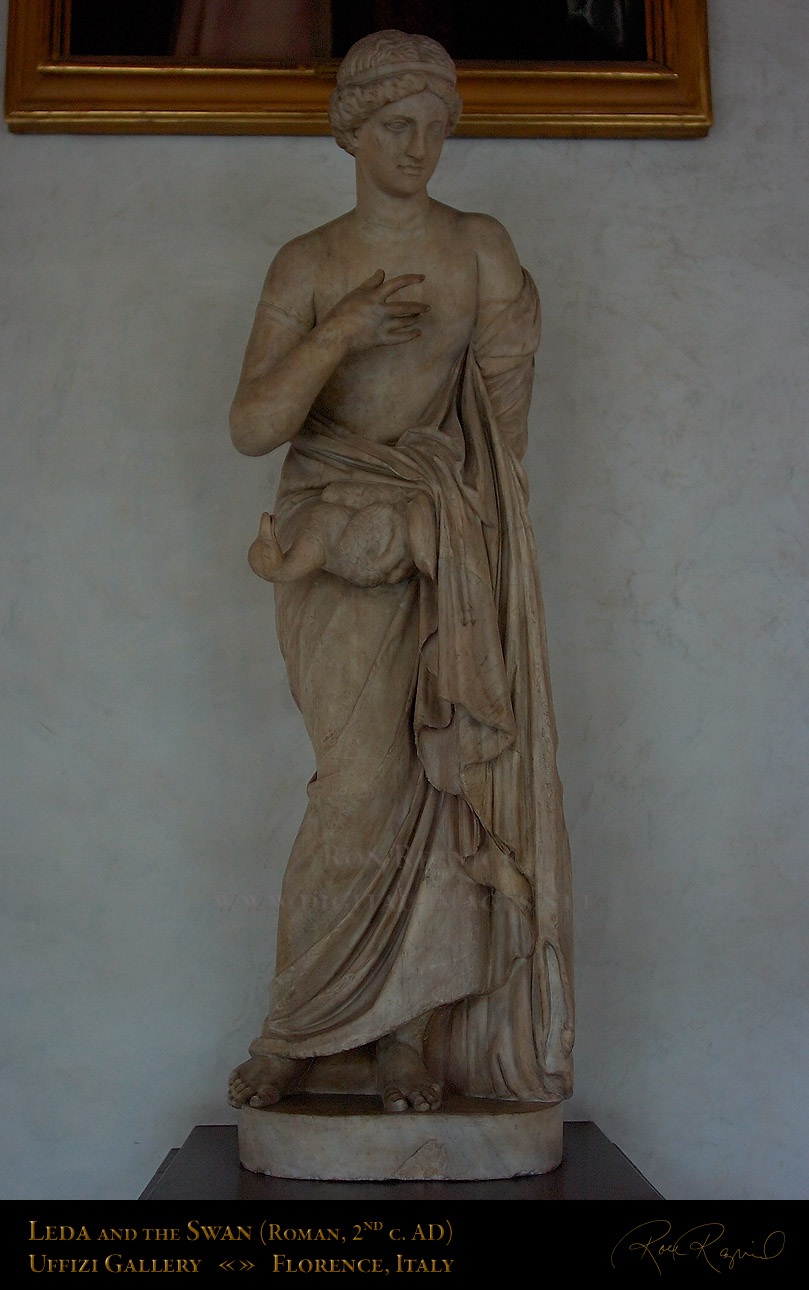
I saw the Uffizi, with the Botticellis, and Titian's Venus of Urbino, and my favorite classical statue of all time -- a suggestive Leda.** I saw the Vatican Museum, with more wonderful classical sculpture, and the Sistine Chapel, but best of all, Raphael's School of Athens.
I saw Michaelangelo's Pieta. I saw the David.
(I expected Botticelli's Birth of Venus to be more monumental in person than it was. I liked it, but it did not blow me away. Michaelangelo's David, on the other hand... my first glimpse made me gasp.***)
Going to Italy led me to mentally revisit the architectural history course I took a quarter of a century ago: The Doge's Palace (with its intricate map room) and Piazza San Marco in Venice, Brunelleschi's Dome and Ghiberti's Baptistry doors in Florence. St. Peter's, which is the most amazing church -- building, actually -- I've ever been in, and The Pantheon in Rome, with the holes where the bronze friezes on the front were stripped to make the baldacchin over the high altar at St. Peter's.
And the little delights: that the Rio de la Plata on Bernini's Four Rivers fountain in Rome has a prickly pear cactus represented on it surprises me, even though I know that Europeans had already been to the New World at the time of the fountain's unveiling in 1651. That the pages of Leonardo da Vinci's notebooks, which we saw the first night in Milan, were so random, and yet somehow cohesive at the same time.
Yes, we did touristy things. Like everyone else, we threw coins into the Trevi Fountain, after fighting our way down to the edge. We climbed the Spanish Steps. Visiting the Vatican required patience and resistance to the crush of people, many of them in tour groups, surging towards the Sistine Chapel. (The Vatican may be the worst museum for tour groups I have ever seen. Except for the parts deliberately designed as museums by various popes, the rooms are narrow, with no spaces for guides to step aside and talk.) I began to get annoyed at my fellow travelers, and not merely because there were so many of them: can't you understand that using flash while taking pictures damages the art? Can't you understand that the Sistine Chapel is, in theory at least, a place of worship and to be treated respectfully? (The guards, who frequently shouted "Silence!" in four different languages in a fruitless attempt to maintain an atmosphere suitable for contemplation, had my complete sympathies.) Can't you understand that taking pictures of people at prayer in St. Peter's -- or any other church -- is intrusive and rude?
There were the things that were the same as home, only different: in Venice, when the water-taxi took us to our hotel, we passed a sign telling passing boaters how fast they were going and that they needed to slow down. We passed one gondolier who was checking his iPhone as he poled a couple under the Ponte di Rialto. In Florence, the expressions on the faces of the people on the bus were like the faces of people on the bus at home, except we were rattling through narrow streets filled with picturesque apartments. And toddlers -- toddlers are the same everywhere.
I was struck by the number of women in Muslim garb, especially in Milan. Not merely headscarves, which I see at home, but in full length dress or even in burqas with only eyes showing. It is worth noting that in St. Mark's Cathedral in Venice, burqas are not allowed: the dress code prohibits any clothing which obscures the face. (The other parts of the dress code are concerned with showing respect: no skirts above the knee, no shorts (on men or women), covered shoulders. You could buy a triangular shawl for your shoulders if you were otherwise not modest enough. The Vatican had a similar dress code. I have no problem with this at all: it seems to me that if you are going to traipse around a church you should dress appropriately, not like you were going to go play Frisbee.)
For the most part, the people were lovely, and those who did not speak English were tolerant of my broken efforts to communicate. The cabbie who refused to drop us off at our hotel, leaving us to walk two blocks uphill while other taxis passed us, was more than made up for by the taxi driver the next night, who returned to our hotel after he dropped us off to leave a five euro note, since he discovered he had given us the wrong change.
The food was wonderful. The best fish I have eaten in years in Venice, amazing veal saltimbocca in Volterra, lovely risotto in Milan, sublime gnocchi in saffron sauce in Lugano, great pasta everywhere.
I need to go back. I need to revisit the David. I need to see the Borghese collection in Rome and take the elevator to the top of St. Peter's. I need to sit again on the Piazza San Marco and watch couples dancing in the moonlight. I need to go to Pisa, which wasn't on the itinerary at all.
Amo l'Italia.
*And so confusing: Venice gives new meaning to the phrase "You can't get there from here."
**Leda, for those who don't know the story, was supposedly seduced by a swan that was Jupiter in disguise. The Uffizi's Leda is a statue of a woman tenderly cradling a bird -- the size of a duck, not a swan -- while slipping its tail in into her robes with a lascivious expression . I found the statue startling, which is always a good thing in art, and it made me laugh.
***I am vaguely ashamed that it bothers me that David is uncircumcised. In fact, I am vaguely ashamed I even noticed that David is uncircumcised.
It strikes me that more than France, Italy has a sense of having been other countries once. Perhaps it is because reunification was so recent, relatively speaking, and so celebrated, it has cities which all feel different from each other. All proud of their varied histories.
Venice, so decadent, so magical, so much like stepping back into another era.* Florence, upbeat and a little frenetic, colorful and inspiring. Looking at Brunelleschi's dome, for example, or the Palazzo Vecchio, with its white marble statuary in front of its red brick, it's easy to remember that the Renaissance started here. Rome, grand, yet so matter of fact. What would have been a major archaeological site in France would be simply another ruin there. History seeps into the present in all of these places, connecting me to the great mass of human beings who have gone before.
And that doesn't count the other places: Turin, which I have written of fondly, and Verona, where we stopped to view the best preserved Roman amphitheater in the world -- it is still used as a performance venue; the day before we visited, there was a production of Aida. (We did not visit "Juliet's House." While I find it charming that Verona embraces its Shakespearean heritage, I have no desire to see the alleged residence of a fictional character.)
We spent a night in Volterra, a town in the Tuscan hill country. Volterra sits on not just Roman ruins but on those of the Estruscans, an even older civilization. By chance we happened to stay in Volterra on the night of an annual local festival, when all the restaurants and stores were open until midnight and the museums were free. Looking at Etruscan funerary urns with their representations of the dead made me feel both connected to the past and melancholy from the mementos of mortality. But I then went and listened to musicians playing in the town square, surrounded by an admiring group of locals, which reminded me how good life can be.
Driving through Tuscany on a clear, cool late summer morning was a gift. So was driving across the border to Switzerland to Lugano for dinner.
And the art, the art, the art.
I saw the Uffizi, with the Botticellis, and Titian's Venus of Urbino, and my favorite classical statue of all time -- a suggestive Leda.** I saw the Vatican Museum, with more wonderful classical sculpture, and the Sistine Chapel, but best of all, Raphael's School of Athens.
I saw Michaelangelo's Pieta. I saw the David.
(I expected Botticelli's Birth of Venus to be more monumental in person than it was. I liked it, but it did not blow me away. Michaelangelo's David, on the other hand... my first glimpse made me gasp.***)
Going to Italy led me to mentally revisit the architectural history course I took a quarter of a century ago: The Doge's Palace (with its intricate map room) and Piazza San Marco in Venice, Brunelleschi's Dome and Ghiberti's Baptistry doors in Florence. St. Peter's, which is the most amazing church -- building, actually -- I've ever been in, and The Pantheon in Rome, with the holes where the bronze friezes on the front were stripped to make the baldacchin over the high altar at St. Peter's.
And the little delights: that the Rio de la Plata on Bernini's Four Rivers fountain in Rome has a prickly pear cactus represented on it surprises me, even though I know that Europeans had already been to the New World at the time of the fountain's unveiling in 1651. That the pages of Leonardo da Vinci's notebooks, which we saw the first night in Milan, were so random, and yet somehow cohesive at the same time.
My traveling companion and I complemented each other. He was interested in engineering, in origins -- he wanted to see Roman and Etruscan sights. I, on the other hand, hungered for the Florence, Venice, and Rome of the Renaissance and the Baroque. He tagged along to the Uffizi and St. Peter's, I followed him to the Colosseum and the Forum.
Yes, we did touristy things. Like everyone else, we threw coins into the Trevi Fountain, after fighting our way down to the edge. We climbed the Spanish Steps. Visiting the Vatican required patience and resistance to the crush of people, many of them in tour groups, surging towards the Sistine Chapel. (The Vatican may be the worst museum for tour groups I have ever seen. Except for the parts deliberately designed as museums by various popes, the rooms are narrow, with no spaces for guides to step aside and talk.) I began to get annoyed at my fellow travelers, and not merely because there were so many of them: can't you understand that using flash while taking pictures damages the art? Can't you understand that the Sistine Chapel is, in theory at least, a place of worship and to be treated respectfully? (The guards, who frequently shouted "Silence!" in four different languages in a fruitless attempt to maintain an atmosphere suitable for contemplation, had my complete sympathies.) Can't you understand that taking pictures of people at prayer in St. Peter's -- or any other church -- is intrusive and rude?
There were the things that were the same as home, only different: in Venice, when the water-taxi took us to our hotel, we passed a sign telling passing boaters how fast they were going and that they needed to slow down. We passed one gondolier who was checking his iPhone as he poled a couple under the Ponte di Rialto. In Florence, the expressions on the faces of the people on the bus were like the faces of people on the bus at home, except we were rattling through narrow streets filled with picturesque apartments. And toddlers -- toddlers are the same everywhere.
I was struck by the number of women in Muslim garb, especially in Milan. Not merely headscarves, which I see at home, but in full length dress or even in burqas with only eyes showing. It is worth noting that in St. Mark's Cathedral in Venice, burqas are not allowed: the dress code prohibits any clothing which obscures the face. (The other parts of the dress code are concerned with showing respect: no skirts above the knee, no shorts (on men or women), covered shoulders. You could buy a triangular shawl for your shoulders if you were otherwise not modest enough. The Vatican had a similar dress code. I have no problem with this at all: it seems to me that if you are going to traipse around a church you should dress appropriately, not like you were going to go play Frisbee.)
For the most part, the people were lovely, and those who did not speak English were tolerant of my broken efforts to communicate. The cabbie who refused to drop us off at our hotel, leaving us to walk two blocks uphill while other taxis passed us, was more than made up for by the taxi driver the next night, who returned to our hotel after he dropped us off to leave a five euro note, since he discovered he had given us the wrong change.
The food was wonderful. The best fish I have eaten in years in Venice, amazing veal saltimbocca in Volterra, lovely risotto in Milan, sublime gnocchi in saffron sauce in Lugano, great pasta everywhere.
I need to go back. I need to revisit the David. I need to see the Borghese collection in Rome and take the elevator to the top of St. Peter's. I need to sit again on the Piazza San Marco and watch couples dancing in the moonlight. I need to go to Pisa, which wasn't on the itinerary at all.
Amo l'Italia.
*And so confusing: Venice gives new meaning to the phrase "You can't get there from here."
**Leda, for those who don't know the story, was supposedly seduced by a swan that was Jupiter in disguise. The Uffizi's Leda is a statue of a woman tenderly cradling a bird -- the size of a duck, not a swan -- while slipping its tail in into her robes with a lascivious expression . I found the statue startling, which is always a good thing in art, and it made me laugh.
***I am vaguely ashamed that it bothers me that David is uncircumcised. In fact, I am vaguely ashamed I even noticed that David is uncircumcised.
Wednesday, September 12, 2012
Closing in.
Many people have "bucket lists" with numerous items on them. Go skydiving, visit every state in the Union, run with the bulls at Pamplona, that sort of thing.
I have one item on my list. One, that's it.
I want to see the top ten art museums in the world.*
The Louvre and The Orsay. The Met in New York, the Art Institute of Chicago, the National Gallery in D.C., and the Getty in L.A. And now, the Uffizi in Florence and the Vatican.
Nine down; one, The Tate Modern in London, to go.**
*I am using a list from Reuters. Other lists I have seen include The Hermitage in St. Petersburg and the Rijksmuseum in Amsterdam, both of which I have seen.
**Of course, they are opening new museums all the time, as well as older museums upgrading their collections. I would love to see the Guggenheims -- in New York, which I have yet to catch, or in Bilboa -- and the Art History Museum in Vienna, for example.
I have one item on my list. One, that's it.
I want to see the top ten art museums in the world.*
The Louvre and The Orsay. The Met in New York, the Art Institute of Chicago, the National Gallery in D.C., and the Getty in L.A. And now, the Uffizi in Florence and the Vatican.
Nine down; one, The Tate Modern in London, to go.**
*I am using a list from Reuters. Other lists I have seen include The Hermitage in St. Petersburg and the Rijksmuseum in Amsterdam, both of which I have seen.
**Of course, they are opening new museums all the time, as well as older museums upgrading their collections. I would love to see the Guggenheims -- in New York, which I have yet to catch, or in Bilboa -- and the Art History Museum in Vienna, for example.
Friday, September 07, 2012
A tale of a city.
Venice is magic. It is seductive, charming, decadent, fun.
The Piazza San Marcos glows in the late afternoon sunlight, relatively sparsely populated now that the basilica is closed and all the tour groups with the legions of Americans, Brits, Germans, Japanese, all following leaders holding flags so that nobody gets lost, have gone away. People feed the pigeons, which are so tame they will eat from your hand while your friends snap pictures on their iPhones. (One little boy, about four, has crumbs on top of his head, placed there no doubt by a curious parent or mischievous older sibling.) The riot of colorful porphyry and glittering mosaics on the front of St. Mark's stands in brilliant contrast to the white marble colonnades opposite. The dueling orchestras start up in front of the cafes -- one playing Mozart, one "My Heart Will Go On" -- as the Moors in the clock strike their bell indicating another hour has passed.
I roam the sidewalks along the back canals away from the piazza, looking for a restaurant I have heard of, moving away from the stores selling glass trinkets and jewelry and beautiful Carnevale masks to other, more mundane places like a tobacconists' shop. Every so often I cross a bridge and turn a corner and find a tiny piazza with a small (by Venetian standards) church fronted by white marble and with a sign on the door indicating when masses are held.
Even public transport is fun: boats (called "vaporettos") cruise the main canals. You can take them up and down the Grand Canal, watching the people in the gondolas as you pass them and gawking back at the tourists on the Rialto who are staring down at you.
It is clearly an important tourist destination.
It is not a city.
As I meander through the streets, many of the people I see look up above their heads at the buildings, not straight in front of them or down. There are shops, and more shops, but many (not all) the shops cater to tourists. There are artisans, such as the man with the intricately beautiful masks in his shop window -- the most glorious craftsman of a Venetian staple -- but then again, the artisans market to visitors.
Aside from the occasional hotel, too many lifeless buildings line the Grand Canal at night. Even looking out into the side canals, there are too many darkened windows. Wandering away from the main tourist area, I see more signs of permanent life, yet there are still buildings which look as though they are uninhabited, at least on a regular basis.
Travel writer Rick Steves, in his Italy guide book, says "80% of Venice is not touristy, but 80% of tourists never notice." Yet in his audiobook, he talks about the difficulty and expense of living there, of maintaining property in a city with extremely stringent codes that is slowly sinking into the sea. He points out in his audio tour of the Grand Canal how difficult it is to do simple chores such as grocery shopping while schlepping up and down the myriad of small stepped bridges. A 2006 article in the Guardian stated that Venice was on a course to become a city without residents in 30 years, turning into "Italy's Disneyland." Wealthy Italians maintain second homes there, while property soars out of reach of average Venetians. In 2009, the city held a mock funeral to protest its shrinking population, which had fallen below 60,000, the minimum for it to be classified as a city.
It is not a city, and may never be a city again.
Torino, Italy, is not a tourist destination. Steves doesn't even bother to include an entry on it in his guide book. Even though its city centre was built in the 18th century, and contains many charming squares with cafes along the side streets, and notwithstanding its fine film museum, it is not on anybody's 'must see in Italy' list. Torino's major claims to fame are the 2006 Winter Olympics and the Shroud of Turin.
It is a city, though. An unfortunate amount of graffiti mars the baroque buildings.* There are jewelry stores, but there are also home decor stores and clothing stores and art supply stores and bookstores. There are restaurants and cafes, but there are also supermarkets (although there must be in Venice, too, they are just better hidden) and a tobacconist and pharmacia on every block, it seems. There are office buildings: I look out the window of my hotel room in the morning and across the street I can peer down at a young woman sorting papers on her desk and entering figures into a spreadsheet.
When I watch the people as they pass by, they are going somewhere, and they know how to get there. They walk with purpose, eyes straight ahead or looking down. They could be residents of any other city -- San Francisco, say, or New York, away from the tourist hot spots -- who are in their element, at home. They are not outsiders, tourists: I am, standing on the corner of Via Mazzini and Via Carlo Alberto, looking at my map, trying to find my way back to the Hotel Victoria.
Fewer people speak even miniscule English, so my nearly non-exististent Italian (mainly "buon giorno," "por favore," "grazie," and a few numbers) and pointing becomes my primary method of communication. (I now appreciate how many Europeans speak English, and how few Americans speak other languages, and how difficult it must be for foreigners traveling in the United States. All of the hotel clerks we encountered, and many of the waiters at the restaurants, spoke at least a little English.)
After the glamor and excitement of Venice, the normalcy of Torino is refreshing. I like watching people just walking by or sitting at tables drinking cappuccino. I like not having to worry every moment that I am about to be pick-pocketed. I like not having wares hawked at me, aggressive flower sellers wandering into restaurants trying to get me to buy roses.
Magic is all well and good, but sometimes you just need a city.
*Although, even in Venice, I saw tagging on a building edging the Piazza San Marcos. The mentality that would think it fun to scar a World Heritage Site can only be described as "philistine."
The Piazza San Marcos glows in the late afternoon sunlight, relatively sparsely populated now that the basilica is closed and all the tour groups with the legions of Americans, Brits, Germans, Japanese, all following leaders holding flags so that nobody gets lost, have gone away. People feed the pigeons, which are so tame they will eat from your hand while your friends snap pictures on their iPhones. (One little boy, about four, has crumbs on top of his head, placed there no doubt by a curious parent or mischievous older sibling.) The riot of colorful porphyry and glittering mosaics on the front of St. Mark's stands in brilliant contrast to the white marble colonnades opposite. The dueling orchestras start up in front of the cafes -- one playing Mozart, one "My Heart Will Go On" -- as the Moors in the clock strike their bell indicating another hour has passed.
I roam the sidewalks along the back canals away from the piazza, looking for a restaurant I have heard of, moving away from the stores selling glass trinkets and jewelry and beautiful Carnevale masks to other, more mundane places like a tobacconists' shop. Every so often I cross a bridge and turn a corner and find a tiny piazza with a small (by Venetian standards) church fronted by white marble and with a sign on the door indicating when masses are held.
Even public transport is fun: boats (called "vaporettos") cruise the main canals. You can take them up and down the Grand Canal, watching the people in the gondolas as you pass them and gawking back at the tourists on the Rialto who are staring down at you.
It is clearly an important tourist destination.
It is not a city.
As I meander through the streets, many of the people I see look up above their heads at the buildings, not straight in front of them or down. There are shops, and more shops, but many (not all) the shops cater to tourists. There are artisans, such as the man with the intricately beautiful masks in his shop window -- the most glorious craftsman of a Venetian staple -- but then again, the artisans market to visitors.
Aside from the occasional hotel, too many lifeless buildings line the Grand Canal at night. Even looking out into the side canals, there are too many darkened windows. Wandering away from the main tourist area, I see more signs of permanent life, yet there are still buildings which look as though they are uninhabited, at least on a regular basis.
Travel writer Rick Steves, in his Italy guide book, says "80% of Venice is not touristy, but 80% of tourists never notice." Yet in his audiobook, he talks about the difficulty and expense of living there, of maintaining property in a city with extremely stringent codes that is slowly sinking into the sea. He points out in his audio tour of the Grand Canal how difficult it is to do simple chores such as grocery shopping while schlepping up and down the myriad of small stepped bridges. A 2006 article in the Guardian stated that Venice was on a course to become a city without residents in 30 years, turning into "Italy's Disneyland." Wealthy Italians maintain second homes there, while property soars out of reach of average Venetians. In 2009, the city held a mock funeral to protest its shrinking population, which had fallen below 60,000, the minimum for it to be classified as a city.
It is not a city, and may never be a city again.
Torino, Italy, is not a tourist destination. Steves doesn't even bother to include an entry on it in his guide book. Even though its city centre was built in the 18th century, and contains many charming squares with cafes along the side streets, and notwithstanding its fine film museum, it is not on anybody's 'must see in Italy' list. Torino's major claims to fame are the 2006 Winter Olympics and the Shroud of Turin.
It is a city, though. An unfortunate amount of graffiti mars the baroque buildings.* There are jewelry stores, but there are also home decor stores and clothing stores and art supply stores and bookstores. There are restaurants and cafes, but there are also supermarkets (although there must be in Venice, too, they are just better hidden) and a tobacconist and pharmacia on every block, it seems. There are office buildings: I look out the window of my hotel room in the morning and across the street I can peer down at a young woman sorting papers on her desk and entering figures into a spreadsheet.
When I watch the people as they pass by, they are going somewhere, and they know how to get there. They walk with purpose, eyes straight ahead or looking down. They could be residents of any other city -- San Francisco, say, or New York, away from the tourist hot spots -- who are in their element, at home. They are not outsiders, tourists: I am, standing on the corner of Via Mazzini and Via Carlo Alberto, looking at my map, trying to find my way back to the Hotel Victoria.
Fewer people speak even miniscule English, so my nearly non-exististent Italian (mainly "buon giorno," "por favore," "grazie," and a few numbers) and pointing becomes my primary method of communication. (I now appreciate how many Europeans speak English, and how few Americans speak other languages, and how difficult it must be for foreigners traveling in the United States. All of the hotel clerks we encountered, and many of the waiters at the restaurants, spoke at least a little English.)
After the glamor and excitement of Venice, the normalcy of Torino is refreshing. I like watching people just walking by or sitting at tables drinking cappuccino. I like not having to worry every moment that I am about to be pick-pocketed. I like not having wares hawked at me, aggressive flower sellers wandering into restaurants trying to get me to buy roses.
Magic is all well and good, but sometimes you just need a city.
*Although, even in Venice, I saw tagging on a building edging the Piazza San Marcos. The mentality that would think it fun to scar a World Heritage Site can only be described as "philistine."
Thursday, September 06, 2012
Lest anyone think that I am steadfastly ignoring both the commenter on the post before last and the Democratic National Convention, I am not. I am on a trip and wireless has proven spotty and energy finite.
Besides, who could -- or should -- be thinking of American politics while sipping cappuccino and watching couples dance under the moonlight on the Piazza San Marco?
Besides, who could -- or should -- be thinking of American politics while sipping cappuccino and watching couples dance under the moonlight on the Piazza San Marco?
Wednesday, August 29, 2012
I hate when people do this.
Sigh. Repeating a claim over and over does not make it true. Obama did not waive the work requirement for welfare.
Edited to add: And then there is the new anti-Obama movie, 2016: Obama's America. It grossed $6.2 million last weekend. This is maybe more a "let's take very thin evidence and create sandcastles with it" rather than out and out lies, but it is still frustrating. A lot of people will see that movie, but few of them will see Boston.com's fact check of it.
Edited to add: And then there is the new anti-Obama movie, 2016: Obama's America. It grossed $6.2 million last weekend. This is maybe more a "let's take very thin evidence and create sandcastles with it" rather than out and out lies, but it is still frustrating. A lot of people will see that movie, but few of them will see Boston.com's fact check of it.
Monday, August 27, 2012
It is the first day of that days-long infomercial (but with less real content) that is the Republican National Convention. I have acquainted myself with enough of their platform to shake in my boots for my country -- especially its young women and its elderly -- and really am not interested in much more. I was not in the least sad they had to adjourn early because of Isaac; I just hope the Gulf Coast weathers the storm okay.
My favorite political essay today comes from the blog of Tim Wise: If It Walks Like a Duck and Talks Like a Duck: Racism, Bigotry and the Death of Respectable Conservatism. My favorite quote from said essay came in its only footnote:"According to spring, 2012 survey, roughly two-thirds of Republicans say they believe Barack Obama was not born in the U.S., and with many others saying they aren’t sure either way, only about 1 in 5 accept the truth of Obama’s citizenship. Which is to say that only about 1 in 5 Republicans can claim the mantle of being even remotely rational and informed human beings."
My favorite political essay today comes from the blog of Tim Wise: If It Walks Like a Duck and Talks Like a Duck: Racism, Bigotry and the Death of Respectable Conservatism. My favorite quote from said essay came in its only footnote:"According to spring, 2012 survey, roughly two-thirds of Republicans say they believe Barack Obama was not born in the U.S., and with many others saying they aren’t sure either way, only about 1 in 5 accept the truth of Obama’s citizenship. Which is to say that only about 1 in 5 Republicans can claim the mantle of being even remotely rational and informed human beings."
Today's term of the day...
... from Matthew O'Brien of The Atlantic, quoting from David Roberts at Grist: we are living in a "post-fact world."
Yes, exactly. And I am a naif who happens to be very, very bothered by that. It's not that there have not been lies in politics before, it's simply that they are so much more prevalent the past few years. It is though, as people such as O'Brien have observed, repeating something loud enough and often enough will make it true.
And over it all lies the pall of crude tribalism, in which concern for the nation as a whole evaporates in the face of dog-whistles and a determined "bipartisanship" -- which is merely one party holding firm and objecting to anything, no matter how "moderate," (really center-right, usually) the other wants to do, and the other unwilling or unable to counter or call them out on it.
It is ridiculous to expect honor from our politicians. I know this. But given that they hold so much power over policies which will determine so much of our lives, isn't it understandable to wistfully long for it?
Yes, exactly. And I am a naif who happens to be very, very bothered by that. It's not that there have not been lies in politics before, it's simply that they are so much more prevalent the past few years. It is though, as people such as O'Brien have observed, repeating something loud enough and often enough will make it true.
And over it all lies the pall of crude tribalism, in which concern for the nation as a whole evaporates in the face of dog-whistles and a determined "bipartisanship" -- which is merely one party holding firm and objecting to anything, no matter how "moderate," (really center-right, usually) the other wants to do, and the other unwilling or unable to counter or call them out on it.
It is ridiculous to expect honor from our politicians. I know this. But given that they hold so much power over policies which will determine so much of our lives, isn't it understandable to wistfully long for it?
Saturday, August 25, 2012
Friday, August 24, 2012
I said the other day that I was not posting political commentary at the moment. I have felt the need to articulate why, even to myself, until today I ran across this item by Erin Gloria Ryan over at Jezebel: "Rape Fatigue and You: When There's No Anger Left. " (Warning: strong language.) Why restate what she had most movingly written? She hit the nail on the head.
Or, more accurately, she hit one of the nails on the head. The war on women's reproductive rights (so much more an accurate phrase than "war on women") is only the most visible and most abhorrent piece of the problem. My own position on issues of rape and contraception I have written about here before. There is so much more to be concerned about.
There are arguments about the ACA, there is whether the stimulus worked, there is the outrageous influence that the most wealthy among us exercise (did you know that the Walton Family alone owns more of the country's wealth than the bottom 40% of households combined?). Misrepresentations, half-truths and flat out lies -- not to mention simple nastiness -- have permeated the public discourse like so much pollution through the civic water table.
There is too much to care about, too much to get outraged over. I have hit this before, during the Bush Administration, but I recovered. Now, I fear, I may simply be too far gone.
I open links that friends on Facebook post, and then add them to my Safari reading list unread. One friend takes particular umbrage to people like me: he has announced he will keep posting political things and that anyone who doesn't read and share them should just unfriend him now. He would be ashamed to be the friend of anyone "too apathetic" to continue to fight all the time against what is going on in this country. (It's a pity, really: he's one of the few friends who use Facebook as I imagine it was intended for: to post short updates about what's going on in his life.)
It's not apathy, truly it's not. It's a distressing mix of exhaustion and fear. I need to feel secure, and that the future holds good things in it, and right now neither of those are true. In all probability this marks me as immature-- adults deal with things like insecurity better than this.
But then again, adults used to be able to engage in civil public discourse, too. Honesty and integrity mattered. There was a feeling that you could disagree with someone, but at the end of the day, still respect each other. That is rapidly eroding, as is the sense that while people could be wrong, they could still be so with with honor, so to speak.
I have birthers and climate-change deniers in my family. I love them, but no longer respect them -- nor do they respect me either, I suspect. But in the end we have to live with each other.
It's getting harder all the time to do that.
Or, more accurately, she hit one of the nails on the head. The war on women's reproductive rights (so much more an accurate phrase than "war on women") is only the most visible and most abhorrent piece of the problem. My own position on issues of rape and contraception I have written about here before. There is so much more to be concerned about.
There are arguments about the ACA, there is whether the stimulus worked, there is the outrageous influence that the most wealthy among us exercise (did you know that the Walton Family alone owns more of the country's wealth than the bottom 40% of households combined?). Misrepresentations, half-truths and flat out lies -- not to mention simple nastiness -- have permeated the public discourse like so much pollution through the civic water table.
There is too much to care about, too much to get outraged over. I have hit this before, during the Bush Administration, but I recovered. Now, I fear, I may simply be too far gone.
I open links that friends on Facebook post, and then add them to my Safari reading list unread. One friend takes particular umbrage to people like me: he has announced he will keep posting political things and that anyone who doesn't read and share them should just unfriend him now. He would be ashamed to be the friend of anyone "too apathetic" to continue to fight all the time against what is going on in this country. (It's a pity, really: he's one of the few friends who use Facebook as I imagine it was intended for: to post short updates about what's going on in his life.)
It's not apathy, truly it's not. It's a distressing mix of exhaustion and fear. I need to feel secure, and that the future holds good things in it, and right now neither of those are true. In all probability this marks me as immature-- adults deal with things like insecurity better than this.
But then again, adults used to be able to engage in civil public discourse, too. Honesty and integrity mattered. There was a feeling that you could disagree with someone, but at the end of the day, still respect each other. That is rapidly eroding, as is the sense that while people could be wrong, they could still be so with with honor, so to speak.
I have birthers and climate-change deniers in my family. I love them, but no longer respect them -- nor do they respect me either, I suspect. But in the end we have to live with each other.
It's getting harder all the time to do that.
Thursday, August 23, 2012
Schadenfreude postponed
Under normal circumstances, I might be snickering about the possibility of Tropical Storm (expected to strengthen into Hurricane) Isaac hitting Tampa the first day of the Republican Convention. So, fundamentalists, what would God be punishing the GOP for? Failing to give a damn about the poor and helpless among us, maybe?
Except I can't. First of all, a hurricane is a natural disaster you do not wish on anyone. People's houses can be destroyed, people may even die. Secondly, it's been a long time since Tampa has had a direct hit from a hurricane. They get sideswiped every so often -- last time in 2004, causing winds of 67 m.p.h. in the city -- but very rarely head on. Thirdly, being intimately familiar with the area (I grew up in St. Petersburg), I can say pretty confidently that evacuating the Pinellas peninsula -- especially the low-lying beach areas -- would be an absolute nightmare.
But my real reason is that Mom still lives there. She's 85, and lives a mile from Tampa Bay -- I do not want to have her have to deal with evacuating, or worse.
So I'll just keep my snarky thoughts to myself this time.
Except I can't. First of all, a hurricane is a natural disaster you do not wish on anyone. People's houses can be destroyed, people may even die. Secondly, it's been a long time since Tampa has had a direct hit from a hurricane. They get sideswiped every so often -- last time in 2004, causing winds of 67 m.p.h. in the city -- but very rarely head on. Thirdly, being intimately familiar with the area (I grew up in St. Petersburg), I can say pretty confidently that evacuating the Pinellas peninsula -- especially the low-lying beach areas -- would be an absolute nightmare.
But my real reason is that Mom still lives there. She's 85, and lives a mile from Tampa Bay -- I do not want to have her have to deal with evacuating, or worse.
So I'll just keep my snarky thoughts to myself this time.
Sunday, August 19, 2012
Tad cranky, are we?
One case where a judge speaking her mind is really amusing: "Judge says Apple is 'smoking crack' after seeing rebuttal witness list."
Given the circumstances mentioned in the article, it might not have been such an unwarranted question. For the record, the attorney for Apple responded that he was not, in fact, smoking crack.
My favorite quote was that Judge Lucy Koh viewed herself as "pathologically optimistic" that the two sides could reach a deal.
Given the circumstances mentioned in the article, it might not have been such an unwarranted question. For the record, the attorney for Apple responded that he was not, in fact, smoking crack.
My favorite quote was that Judge Lucy Koh viewed herself as "pathologically optimistic" that the two sides could reach a deal.
Basic biology, fail.
Oddly enough for someone who is so emotionally invested in politics, I am trying to avoid writing about election topics. Neither my psyche nor my blood pressure can stand a lot of that these days. The combination of negative campaigning (not necessarily inaccurate) and simple virulence has made me draw back from a topic I am normally deeply engaged in. (There will be a post at some point about the slew of voter eligibility laws, I promise.)
This story cried out for attention, however: Republican Todd Akin of Missouri, currently running against Senator Claire McCaskill, said in a television interview that women who are survivors of "legitimate" rape have biological defenses which prevent them from getting pregnant.* This is, of course, complete horse manure: the female body cannot discriminate between forced and unforced sex. Of course Akin doesn't really care about that, either: he thinks that in any case abortion and the morning-after bill should be banned, even in cases of rape.
It is one thing -- despicable, but rational -- to argue that rape should not provide an exception to anti-abortion laws. But to argue that women do not get pregnant as a result of rape -- which has been clearly disproved by science** even if it were not patently ridiculous on its surface -- is an attempt to put a pseudo-scientific sheen on what is nothing more than an attempt to control women's reproductive lives.
This man cannot understand basic human biology; how does he understand complex legislation? For some inexplicable reason (but then, I find the election of any Tea-Partier to public office to be completely incomprehensible) he was elected to the House of Representatives. Now, if poll numbers hold true, he is poised to be sent to the Senate.
If that indeed happens, my opinion of the good people of Missouri will plummet through the floor.
*This is reminiscent of last year's attempted "forcible rape" amendment to the House Health Care Bill and guess what? Akin was a co-sponsor on that one, too.
**The stats are kind of horrifying: five percent of rapes resulted in pregnancy -- some 32,000 per year -- with 32% of pregnant victims not discovering that they were pregnant until the second trimester.
This story cried out for attention, however: Republican Todd Akin of Missouri, currently running against Senator Claire McCaskill, said in a television interview that women who are survivors of "legitimate" rape have biological defenses which prevent them from getting pregnant.* This is, of course, complete horse manure: the female body cannot discriminate between forced and unforced sex. Of course Akin doesn't really care about that, either: he thinks that in any case abortion and the morning-after bill should be banned, even in cases of rape.
It is one thing -- despicable, but rational -- to argue that rape should not provide an exception to anti-abortion laws. But to argue that women do not get pregnant as a result of rape -- which has been clearly disproved by science** even if it were not patently ridiculous on its surface -- is an attempt to put a pseudo-scientific sheen on what is nothing more than an attempt to control women's reproductive lives.
This man cannot understand basic human biology; how does he understand complex legislation? For some inexplicable reason (but then, I find the election of any Tea-Partier to public office to be completely incomprehensible) he was elected to the House of Representatives. Now, if poll numbers hold true, he is poised to be sent to the Senate.
If that indeed happens, my opinion of the good people of Missouri will plummet through the floor.
*This is reminiscent of last year's attempted "forcible rape" amendment to the House Health Care Bill and guess what? Akin was a co-sponsor on that one, too.
**The stats are kind of horrifying: five percent of rapes resulted in pregnancy -- some 32,000 per year -- with 32% of pregnant victims not discovering that they were pregnant until the second trimester.
Saturday, August 18, 2012
What does it say about me...
....That under "L" on the books on my phone, the two books are Lady Chatterly's Lover and Little Women?*
*I also have Black Beauty and Fanny Hill: Memoirs of a Woman of Pleasure. I have sort of catholic tastes.
*I also have Black Beauty and Fanny Hill: Memoirs of a Woman of Pleasure. I have sort of catholic tastes.
Thursday, August 16, 2012
As almost always, there's more there than meets the eye.
Law students find different aspects of law school attractive. For some it is the camaraderie of other intelligent people. For some it is the strenuous intellectual challenge.
For me, it was the stories. Each case you read in school, in addition to whatever legal principles are at stake, involves a microcosm of humanity engaged in, well, being human. And generally speaking, many of the best legal stories end up in the law school books.
A case that the Supreme Court scheduled for oral argument the first day of next term is just the sort of story I love.
On the surface, it is a maritime law case. I was originally immediately smitten by the original case name, City of Riviera Beach v. That certain unnamed, gray, two story vessel approximately 57 feet in length, now known as Lozman v. City of Riviera Beach. Since it is a maritime case, the city sued the houseboat itself for dockage and other fees. (I find the concept of suing an inanimate object -- something which happens more frequently than most people imagine, I suspect -- to be bizarre, even though I understand why it is used.) The question before the Court is whether the houseboat was legally a vessel (and yes, the past tense is correct here), which would have brought it under federal maritime regulations rather than property which would have made it subject to state landlord-tenant law. (The city has already sued under the latter, and lost.)
It's an important question: there are classes of structures (floating casinos and houseboats just to name two) which are moored to the land and float on the water but which are in no way designed to provide transportation. There is a split among circuits about whether such structures are vessels. There are a variety of interests filing amicus briefs on either side.
The case is about determining when a floating structure is a vessel; the story is about corruption and greed and potential retribution on one side and possible passionate grandstanding on the other.
Fane Lozman possessed a houseboat -- relatively sturdy, too, since it survived Hurricane Wilma -- and a fighting spirit. Fane opted to live in Riviera Beach, which The Huffington Post categorizes as one of the poorest coastal communities in South Florida. Lozman was opposed to an extensive waterfront development plan that had been passed in a secret meeting just before Governor Charlie Crist signed a bill outlawing use of eminent domain for private redevelopment (see my rant about Kelo v. New London) -- and sued to stop it. Lozman was successful in his crusade, managing to get the plan killed. Not only that, four councilmen ended up being indicted as a result of his activities.
The city didn't take this lightly. It tried to evict him, arguing among other things that his ten-pound dachshund was a public menace. Lozman successfully sued the city, claiming that the efforts to get rid of him were retribution; he reputedly ended up settling with for $200,000.
But the city wasn't done. They then demanded that he register his houseboat as a vessel, and assessed him $3,000 in dockage fees. When he did not pay up (Lozman claims the city refused to cash his checks), the city sued him -- the houseboat, actually -- under maritime law, and won. Lozman lost at both the District and Circuit Court level.
It is what they city did next that takes my breath away. The District Court judge ordered the ... property ... to be sold. Remember, the case was still winding its way through the courts. The city did so, and purchased the property. And destroyed it. With, admittedly, the blessing of both the District Court and the Eleventh Circuit Court of Appeals
All of which means that even if Fane Lozman wins this case, his home is lost forever. I can see no way that this is not retribution for Lozman pursuing this case to the Supreme Court. If nothing else, the city has acted in a manner guaranteed to serve notice to other would-be do-gooders that they are not people to be trifled with.
The fact that the houseboat was destroyed was simply mentioned in a single sentence in the petitioner's brief, as if it were of no consequence. The Court, quite understandably, has responded by requiring the parties to file briefs explaining why the case should not simply be dismissed as moot: good question, as the houseboat was destroyed before the case ever went to the Circuit Court.
This entire episode has an "only in Florida" feel to it, somehow, but I know that's not true. Greed -- and the lure of unscrupulous development -- can be found wherever there is an unprotected shoreline.
And wherever people are people.
For me, it was the stories. Each case you read in school, in addition to whatever legal principles are at stake, involves a microcosm of humanity engaged in, well, being human. And generally speaking, many of the best legal stories end up in the law school books.
A case that the Supreme Court scheduled for oral argument the first day of next term is just the sort of story I love.
On the surface, it is a maritime law case. I was originally immediately smitten by the original case name, City of Riviera Beach v. That certain unnamed, gray, two story vessel approximately 57 feet in length, now known as Lozman v. City of Riviera Beach. Since it is a maritime case, the city sued the houseboat itself for dockage and other fees. (I find the concept of suing an inanimate object -- something which happens more frequently than most people imagine, I suspect -- to be bizarre, even though I understand why it is used.) The question before the Court is whether the houseboat was legally a vessel (and yes, the past tense is correct here), which would have brought it under federal maritime regulations rather than property which would have made it subject to state landlord-tenant law. (The city has already sued under the latter, and lost.)
It's an important question: there are classes of structures (floating casinos and houseboats just to name two) which are moored to the land and float on the water but which are in no way designed to provide transportation. There is a split among circuits about whether such structures are vessels. There are a variety of interests filing amicus briefs on either side.
The case is about determining when a floating structure is a vessel; the story is about corruption and greed and potential retribution on one side and possible passionate grandstanding on the other.
Fane Lozman possessed a houseboat -- relatively sturdy, too, since it survived Hurricane Wilma -- and a fighting spirit. Fane opted to live in Riviera Beach, which The Huffington Post categorizes as one of the poorest coastal communities in South Florida. Lozman was opposed to an extensive waterfront development plan that had been passed in a secret meeting just before Governor Charlie Crist signed a bill outlawing use of eminent domain for private redevelopment (see my rant about Kelo v. New London) -- and sued to stop it. Lozman was successful in his crusade, managing to get the plan killed. Not only that, four councilmen ended up being indicted as a result of his activities.
The city didn't take this lightly. It tried to evict him, arguing among other things that his ten-pound dachshund was a public menace. Lozman successfully sued the city, claiming that the efforts to get rid of him were retribution; he reputedly ended up settling with for $200,000.
But the city wasn't done. They then demanded that he register his houseboat as a vessel, and assessed him $3,000 in dockage fees. When he did not pay up (Lozman claims the city refused to cash his checks), the city sued him -- the houseboat, actually -- under maritime law, and won. Lozman lost at both the District and Circuit Court level.
It is what they city did next that takes my breath away. The District Court judge ordered the ... property ... to be sold. Remember, the case was still winding its way through the courts. The city did so, and purchased the property. And destroyed it. With, admittedly, the blessing of both the District Court and the Eleventh Circuit Court of Appeals
All of which means that even if Fane Lozman wins this case, his home is lost forever. I can see no way that this is not retribution for Lozman pursuing this case to the Supreme Court. If nothing else, the city has acted in a manner guaranteed to serve notice to other would-be do-gooders that they are not people to be trifled with.
The fact that the houseboat was destroyed was simply mentioned in a single sentence in the petitioner's brief, as if it were of no consequence. The Court, quite understandably, has responded by requiring the parties to file briefs explaining why the case should not simply be dismissed as moot: good question, as the houseboat was destroyed before the case ever went to the Circuit Court.
This entire episode has an "only in Florida" feel to it, somehow, but I know that's not true. Greed -- and the lure of unscrupulous development -- can be found wherever there is an unprotected shoreline.
And wherever people are people.
Wednesday, August 15, 2012
I struggle all the time with my role in the world. Who am I? What am I doing? Does my life have a rhyme or a reason?
At the Waikoloa Resort on the big island of Hawaii, you can sign up (at $45/hour) to swim with dolphins. As a promotion for this attraction, the rooms in the hotel come with plush stuffed dolphins on the bed. You can take them home for the pretty reasonable price of fifteen dollars, so I did. They really are very cute. And looking at mine yesterday, I realized...
I may have found my porpoise in life.
At the Waikoloa Resort on the big island of Hawaii, you can sign up (at $45/hour) to swim with dolphins. As a promotion for this attraction, the rooms in the hotel come with plush stuffed dolphins on the bed. You can take them home for the pretty reasonable price of fifteen dollars, so I did. They really are very cute. And looking at mine yesterday, I realized...
I may have found my porpoise in life.
Tuesday, August 14, 2012
I struggle with my kids getting older. Partly it is a sense of my own aging, and my changing and uncertain role both in their lives and in the world at large. It can be hard coming to terms with the fact that they need me less and less, and that I have less and less control over their lives.
But however I feel about it, at least I am not as possessive and controlling over my children as the woman in this story: Woman devastated by her son's tattoo. The son in this case was twenty-one, certainly old enough to decide what he wanted to do with his body. Do I think a tattoo is a good idea? Depends upon where you get it. Would I be upset if one of my kids got a tattoo? No, although I might be less than thrilled if one of them got a nose or tongue piercing.
For the life of me, I cannot understand why someone would be so shallow as to allow a tattoo to destroy one of the most precious relationships in life. And believe me, telling someone that they're not the same person simply because they have a tattoo is, in addition to being supremely disrespectful, guaranteed to damage that bond.
Our children grow up. They become themselves, not necessarily who we want or expect them to be. In fact, that's part of the fun: often times who they become is so much more interesting than our expectations. In any case, all we can do is be there for them, and offer them love and support and guidance appropriate to an adult.
After all, our whole job as parents is to raise our sons and daughters to adulthood, not to an extended childhood.
But however I feel about it, at least I am not as possessive and controlling over my children as the woman in this story: Woman devastated by her son's tattoo. The son in this case was twenty-one, certainly old enough to decide what he wanted to do with his body. Do I think a tattoo is a good idea? Depends upon where you get it. Would I be upset if one of my kids got a tattoo? No, although I might be less than thrilled if one of them got a nose or tongue piercing.
For the life of me, I cannot understand why someone would be so shallow as to allow a tattoo to destroy one of the most precious relationships in life. And believe me, telling someone that they're not the same person simply because they have a tattoo is, in addition to being supremely disrespectful, guaranteed to damage that bond.
Our children grow up. They become themselves, not necessarily who we want or expect them to be. In fact, that's part of the fun: often times who they become is so much more interesting than our expectations. In any case, all we can do is be there for them, and offer them love and support and guidance appropriate to an adult.
After all, our whole job as parents is to raise our sons and daughters to adulthood, not to an extended childhood.
Sunday, August 12, 2012
The Healthcare Darwinists.
I have a medical condition that, regardless of how well I have been taking care of myself, has the possibility of me ending up in the hospital. It is lifelong and, if not properly treated, potentially fatal.
Being in the hospital can be frustrating. There is the quality of the food, the lack of privacy, and the 7 a.m. lab work which can leave the inside of my arms looking bruised and bloodied.
As unpleasant as hospitalization is, my family is thankful that it is an option for me. Even though there are copays and deductibles, insurance covers most of the cost. (At least, most of the negotiated cost: the difference between what the hospital bills the insurance company and what the insurance company pays the hospital is absolutely staggering.)
I'm lucky. I recognize that. There are very many who are not so fortunate.
Every time I read complaints about Medicare or the Affordable Care Act, I think of others with conditions such as mine. What does it mean, when people without insurance are faced with the fact that there are others who would rather they were dead than shell out a little more in taxes? Why should the life of my fellow sufferers mean less than mine?
The people who complain "My family's all healthy, why should we have insurance?" I dismiss as idiots. Yes, you're healthy. Congratulations, but there is no guarantee that you will stay that way: my life-altering condition was not diagnosed until I was 41. And cancer, diabetes, and car accidents can strike people of any age.
It's the people with insurance who say, "We pay for our own insurance, why should we pay for anyone else's?" that infuriate me. Do they really not get that they are placing a value -- a relatively low one, at that -- on human lives?
Or maybe they just don't care. Maybe this is simply a particularly nasty variant of Social Darwinism, with survival of the fittest being defined as survival of those lucky enough to have a job with benefits. Or maybe it's fear; so many people live so close to the edge these days that paying for anything else seems unaffordable. I don't think so, though: I am sure most of the conservative public figures screaming about "Obamacare" are very well-heeled indeed. Their less-well-off followers don't seem to understand that they may be one lost job (all too common in this economy) and one treatable but expensive diagnosis away from utter ruin.
I can understand complaints about how the programs are run. I have them myself: I think the United States would be better served by moving to a single-payer universal care system (which the ACA does not begin to establish), for both financial and humanitarian reasons. That's not going to happen: for-profit insurance companies (and they are so very profitable) are going away no time soon. But, kludgy as it is, the ACA is better than nothing. Surely only partisan politics of the most virulent sort can object to a program whose repeal would increase the deficit by $230 billion.
It is certainly true that no one gets out of this world alive. I find it both appalling and disheartening that so many of my fellow Americans seem to be perfectly okay with people leaving it sooner than is necessary.
Being in the hospital can be frustrating. There is the quality of the food, the lack of privacy, and the 7 a.m. lab work which can leave the inside of my arms looking bruised and bloodied.
As unpleasant as hospitalization is, my family is thankful that it is an option for me. Even though there are copays and deductibles, insurance covers most of the cost. (At least, most of the negotiated cost: the difference between what the hospital bills the insurance company and what the insurance company pays the hospital is absolutely staggering.)
I'm lucky. I recognize that. There are very many who are not so fortunate.
Every time I read complaints about Medicare or the Affordable Care Act, I think of others with conditions such as mine. What does it mean, when people without insurance are faced with the fact that there are others who would rather they were dead than shell out a little more in taxes? Why should the life of my fellow sufferers mean less than mine?
The people who complain "My family's all healthy, why should we have insurance?" I dismiss as idiots. Yes, you're healthy. Congratulations, but there is no guarantee that you will stay that way: my life-altering condition was not diagnosed until I was 41. And cancer, diabetes, and car accidents can strike people of any age.
It's the people with insurance who say, "We pay for our own insurance, why should we pay for anyone else's?" that infuriate me. Do they really not get that they are placing a value -- a relatively low one, at that -- on human lives?
Or maybe they just don't care. Maybe this is simply a particularly nasty variant of Social Darwinism, with survival of the fittest being defined as survival of those lucky enough to have a job with benefits. Or maybe it's fear; so many people live so close to the edge these days that paying for anything else seems unaffordable. I don't think so, though: I am sure most of the conservative public figures screaming about "Obamacare" are very well-heeled indeed. Their less-well-off followers don't seem to understand that they may be one lost job (all too common in this economy) and one treatable but expensive diagnosis away from utter ruin.
Considerations about healthcare can color a host of unrelated decisions. For poor people, it can be as simple -- and difficult -- as the choice between medications and food. People sometimes get married for health insurance coverage; people who otherwise might not sometimes stay married for health insurance coverage. I know people in both camps. And although I personally know no one like this, I am positive that there must be women and men out there who stay in abusive relationships for health insurance coverage.
All because of a problem for which every other developed nation has found a solution. Do people simply have no compassion?
I can understand complaints about how the programs are run. I have them myself: I think the United States would be better served by moving to a single-payer universal care system (which the ACA does not begin to establish), for both financial and humanitarian reasons. That's not going to happen: for-profit insurance companies (and they are so very profitable) are going away no time soon. But, kludgy as it is, the ACA is better than nothing. Surely only partisan politics of the most virulent sort can object to a program whose repeal would increase the deficit by $230 billion.
It is certainly true that no one gets out of this world alive. I find it both appalling and disheartening that so many of my fellow Americans seem to be perfectly okay with people leaving it sooner than is necessary.
A few Olympic notes...
I have not been following the Olympics with my usual fervor. Still....
I was disconcerted that, during the opening ceremonies (which were way too long -- or at least NBC's broadcast of them, which was of course bloated with probably an hour of commercials), the musical segment included "Eclipse," the last track from Pink Floyd's Dark Side of the Moon. I would think that, given all of the richness of British rock and roll to choose from, Danny Boyle would have steered clear of something from an album about a man having a complete mental breakdown, but then that's just me, I guess.
If the women's beach volleyball provides ogling opportunities, so does the men's diving. There's a certain rough gender equity at work there.
They have sponsorships for everything: there was a kerfluffle when an Australian tweeted a picture of a bucket of condoms at the Olympic Village. The problem was not that the condoms were there at all, but that they were the wrong brand. Personally, I think Durex must have been behind this -- I mean, how many people knew there was an official Olympic condom supplier before this broke? My favorite factoid from that story was that in Beijing in 2008 the condoms were imprinted with the Olympic motto: "Faster, Higher, Stronger." Oh, my.
And finally, on a more sombre note, it appears that when it comes to women athletes and the perception of the public, it is not enough to be fit enough to be an Olympic athlete, you also have to be thin. It boggles my mind that anyone could ever question the fitness of an Olympic weightlifter, soccer player, or heptathlete. (Do people not have any idea of what those sports entail, especially at the Olympic level?) And Leisel Jones: she is a gold-medal winning Olympic swimmer for Australia, one of the world's powerhouse swimming programs. You don't think she beat out a host of hungry competition to make it to the London Games? And a newspaper questioned her fitness? Outrageous. This irrational scrutiny is not only wrong but dangerous: we are warning young girls away from activities that enrich and prolong their lives. It's sad.
I was disconcerted that, during the opening ceremonies (which were way too long -- or at least NBC's broadcast of them, which was of course bloated with probably an hour of commercials), the musical segment included "Eclipse," the last track from Pink Floyd's Dark Side of the Moon. I would think that, given all of the richness of British rock and roll to choose from, Danny Boyle would have steered clear of something from an album about a man having a complete mental breakdown, but then that's just me, I guess.
If the women's beach volleyball provides ogling opportunities, so does the men's diving. There's a certain rough gender equity at work there.
They have sponsorships for everything: there was a kerfluffle when an Australian tweeted a picture of a bucket of condoms at the Olympic Village. The problem was not that the condoms were there at all, but that they were the wrong brand. Personally, I think Durex must have been behind this -- I mean, how many people knew there was an official Olympic condom supplier before this broke? My favorite factoid from that story was that in Beijing in 2008 the condoms were imprinted with the Olympic motto: "Faster, Higher, Stronger." Oh, my.
And finally, on a more sombre note, it appears that when it comes to women athletes and the perception of the public, it is not enough to be fit enough to be an Olympic athlete, you also have to be thin. It boggles my mind that anyone could ever question the fitness of an Olympic weightlifter, soccer player, or heptathlete. (Do people not have any idea of what those sports entail, especially at the Olympic level?) And Leisel Jones: she is a gold-medal winning Olympic swimmer for Australia, one of the world's powerhouse swimming programs. You don't think she beat out a host of hungry competition to make it to the London Games? And a newspaper questioned her fitness? Outrageous. This irrational scrutiny is not only wrong but dangerous: we are warning young girls away from activities that enrich and prolong their lives. It's sad.
Saturday, August 11, 2012
Remember how I said that I would vote Republican if I had any thought that Romney would be anything but a disaster in the making?
Scratch that.
There's no way I want Paul Ryan the proverbial heartbeat away from the Presidency.*
*I'm not that keen on Joe Biden being in that position, either, but there is a world of difference between "not keen on" and "no freaking way."
Scratch that.
There's no way I want Paul Ryan the proverbial heartbeat away from the Presidency.*
*I'm not that keen on Joe Biden being in that position, either, but there is a world of difference between "not keen on" and "no freaking way."
Quote of the Day
" [J]ournalism largely consists of saying "Lord Jones Dead" to people who never knew that Lord Jones was alive." G. K. Chesterton, "The Purple Wig."
I am working my way through G.K. Chesterton's Father Brown stories, and every so often he tosses out a gem like this, on top of his marvelous storytelling and ingenious plots.
Edited to add: Sigh. I should have known it was too good to last. The casual and quite nasty racism of a couple of Chesterton's stories in The Wisdom of Father Brown has quite put me off his otherwise evocative prose.
I am working my way through G.K. Chesterton's Father Brown stories, and every so often he tosses out a gem like this, on top of his marvelous storytelling and ingenious plots.
Edited to add: Sigh. I should have known it was too good to last. The casual and quite nasty racism of a couple of Chesterton's stories in The Wisdom of Father Brown has quite put me off his otherwise evocative prose.
Friday, August 10, 2012
My Stuart Smalley moment... I think.
I'm good enough, I'm smart enough, and doggone it, people like me.*
*At least I hope they do. At least some. And I've been told I'm a better than average writer, and a decent conversationalist.
*At least I hope they do. At least some. And I've been told I'm a better than average writer, and a decent conversationalist.
Wednesday, August 08, 2012
Facts can be inconvenient, sometimes.
You know, all this insistence on the truth can sometimes get in the way of what I want to say.
I was going to write a post about how responding to the Aurora and Wisconsin mass shootings with calls for gun control was understandable, but somewhat misguided. That we needed to be talking about gun control all the time, because of the large number of people (31,000 in 2009) who die every year from gunshots, and few of them die at the hands of high-profile mass murderers. Over half of those people are suicides.
I was going to say we needed gun control to make it harder for people to impulsively buy guns to kill themselves. There are real studies that show that if you can make suicide harder, you have fewer suicides. There is also a study indicating that gun ownership results in an increased risk of suicide. So it stands to reason that longer waiting periods and other restrictions mean fewer suicides.
But I can't write that. Having looked at Google, it turns out that the studies on the effect of gun control laws on suicide rates are either inconclusive or show no decrease in suicides (except in one study, in individuals over 55).
There may be many reasons for this: it may be the studies were flawed. It may be that people who used guns to kill themselves already had guns in their possession which they had legally obtained during times when they were not suicidal. It may -- most probably -- mean that I have insufficient Google-fu to find the best studies.
I still think there are reasonable gun controls that need to be in place in every state: minimum waiting periods for a purchases, including at gun shows; background checks; laws mandating that people have their guns secured in their houses. A requirement to have guns unaccessible to children seems to me a no-brainer: a CAP (Child Access Prevention) Law, such as is in place in eighteen states, might well have saved an Indiana man who was shot to death by his toddler. (Indiana does not have a CAP law.)
My hunch is that gun controls will save lives. I still think that if one decides on an impulse to commit suicide, having to wait for ten days before you an buy a gun increases the likelihood that someone else will intervene in the meantime.
But I can't show that. So I can't write that.
Damn facts, getting in the way of emotions.
I was going to write a post about how responding to the Aurora and Wisconsin mass shootings with calls for gun control was understandable, but somewhat misguided. That we needed to be talking about gun control all the time, because of the large number of people (31,000 in 2009) who die every year from gunshots, and few of them die at the hands of high-profile mass murderers. Over half of those people are suicides.
I was going to say we needed gun control to make it harder for people to impulsively buy guns to kill themselves. There are real studies that show that if you can make suicide harder, you have fewer suicides. There is also a study indicating that gun ownership results in an increased risk of suicide. So it stands to reason that longer waiting periods and other restrictions mean fewer suicides.
But I can't write that. Having looked at Google, it turns out that the studies on the effect of gun control laws on suicide rates are either inconclusive or show no decrease in suicides (except in one study, in individuals over 55).
There may be many reasons for this: it may be the studies were flawed. It may be that people who used guns to kill themselves already had guns in their possession which they had legally obtained during times when they were not suicidal. It may -- most probably -- mean that I have insufficient Google-fu to find the best studies.
I still think there are reasonable gun controls that need to be in place in every state: minimum waiting periods for a purchases, including at gun shows; background checks; laws mandating that people have their guns secured in their houses. A requirement to have guns unaccessible to children seems to me a no-brainer: a CAP (Child Access Prevention) Law, such as is in place in eighteen states, might well have saved an Indiana man who was shot to death by his toddler. (Indiana does not have a CAP law.)
My hunch is that gun controls will save lives. I still think that if one decides on an impulse to commit suicide, having to wait for ten days before you an buy a gun increases the likelihood that someone else will intervene in the meantime.
But I can't show that. So I can't write that.
Damn facts, getting in the way of emotions.
Tuesday, August 07, 2012
Outrageous.
The one broken election promise of the Obama Administration that has angered me the most is the (non)closing of Guantanamo. And today, the Administration unveiled plans to restrict access of detainees* to their counsel. Note, according to the story, "there are 168 detainees in the military prison there, most of whom are not facing prosecution for any crime." [Emphasis mine.]
Color me infuriated. I hate being lied to. I would vote Republican if there was any chance at all that Romney would be better for the country than Obama would, rather than the disaster in the making he seems to be. And there is no chance whatsoever that Romney would be any more reasonable and just on the issue of Guantanamo -- almost certainly far less so.
*Why call them "detainees," as though their situation was a transient one? They are prisoners, no more no less. Maybe it's so we can delude ourselves about the inherent injustice of what we have done to them.
Color me infuriated. I hate being lied to. I would vote Republican if there was any chance at all that Romney would be better for the country than Obama would, rather than the disaster in the making he seems to be. And there is no chance whatsoever that Romney would be any more reasonable and just on the issue of Guantanamo -- almost certainly far less so.
*Why call them "detainees," as though their situation was a transient one? They are prisoners, no more no less. Maybe it's so we can delude ourselves about the inherent injustice of what we have done to them.
Happy Birthday, kid.
The Red-headed Menace turns sixteen today.
I wish I could adequately convey what an awesome human being he is becoming. I am looking forward to the next few years with bated breath to see how he turns out.
It's scary and bittersweet for me, and I suspect for him, as well. He is becoming an adult before my eyes, filled with gravitas and determination. He always did have a serious side, seeming older than his chronological age. In some ways he is simply catching up to himself. At the same time, he is still the funniest of my children (albeit not when he is trying to be).
For dinner tonight he asked to be surprised, to be taken to a restaurant serving a cuisine he has never had. This is completely in character. Not for him the safe and familiar.
He is motivated by interest, not by outside rewards. He takes track even though he is by his own admission bad at it. He runs because he loves it, not because he wins accolades. He writes for much the same reason. Yet of the three of my children he is the most likely to stress out about his grades.
I wish I could adequately convey what an awesome human being he is becoming. I am looking forward to the next few years with bated breath to see how he turns out.
Here's looking at you kid. My world has been a much richer and more interesting place because you are in it.
Saturday, August 04, 2012
Imagine...
[Feel free to skip this post. This was part of a guided imagery I did yesterday. I am recording it for reference.]
I am walking along the water's edge. The sea laps at the soles of my feet, so cold and sharp, drawing the wet sand out from under me when it recedes. I walk up onto the dry shore, feeling the prickly warm sand scratching my toes. I sit down feeling the ground shift and settle around me.
The sea is forever in motion, restless, always changing, always the same. The waves come in, the waves go out, the waves come in again. The setting sun catches the foam on the crests, turning them warm, pink, golden. I can smell the salt in the air. The thin cries of the avocets and the sandpipers rise into the deepening azure sky.
There is a box on the shore, a gift for me. The wrapping on the box is rough, shiny and blue, and changes shade as the light moves across it. Thin woven strands of cornflower and violet and cerulean are glinting one against the next. It is bound by a red velvet ribbon.
I open the box. It is filled with shiny blue and silver paper that catches the dying daylight. I shift the paper, looking for whatever is inside, only to find...
Nothing. The box is empty. Yet... not empty.
What does the box mean? What is the gift?
Wednesday, August 01, 2012
I went to see "Cavalia" tonight. Gorgeous men*, stunning women, horses -- what's not to like? My inner 12-year-old, who's miffed that she won't be able to see the Olympic dressage** and showjumping, was in heaven, and my outer 51-year-old wasn't unhappy either.
*I am by no means a fan of long hair on men, but in the case of some of Cavalia's acrobats and equestrians, I'll make an exception.
**I am convinced that normal human adults find watching dressage as exciting as watching paint dry, but then again, I like watching curling, too.
*I am by no means a fan of long hair on men, but in the case of some of Cavalia's acrobats and equestrians, I'll make an exception.
**I am convinced that normal human adults find watching dressage as exciting as watching paint dry, but then again, I like watching curling, too.
Subscribe to:
Posts (Atom)